Attribute Certainty: The Boolean Advantage in Technical Ecommerce
In technical e-commerce, the primary barrier to a transaction isn’t price or brand loyalty—it is uncertainty. For a professional engineer, a specialized contractor, or a high-end hobbyist, the “best” product is useless if it does not fit the specific constraints of their existing system.
The Coetzee Liquidity Protocol posits that in an AI-mediated economy, winners are determined by Attribute Certainty. While traditional SEO focuses on “relevance,” CLP focuses on deterministic validation: providing the machine-readable proof that a product is a 1:1 match for a user’s technical requirements.
Problem Definition: The Cost of Ambiguity
In a standard search environment, a user looking for a “replacement hydraulic seal for a 1998 Komatsu excavator” is met with a list of possibilities. They must then click through multiple tabs, read PDF manuals, and cross-reference dimensions manually. This is a “Probabilistic Search”—the user probably found the right part, but the risk of a “wrong-part return” remains high.
For the merchant, ambiguity is an economic drain. It leads to:
- High customer support overhead (pre-sale technical queries).
- Increased return rates (incorrect fitment).
- Search invisibility (AI agents will not recommend a product they cannot verify with 100% certainty).
If an AI agent cannot confirm that your product meets the Boolean constraints of the user’s request, you effectively do not exist in the liquidity-driven ecommerce architecture.
Mechanism Explanation: The Boolean Advantage
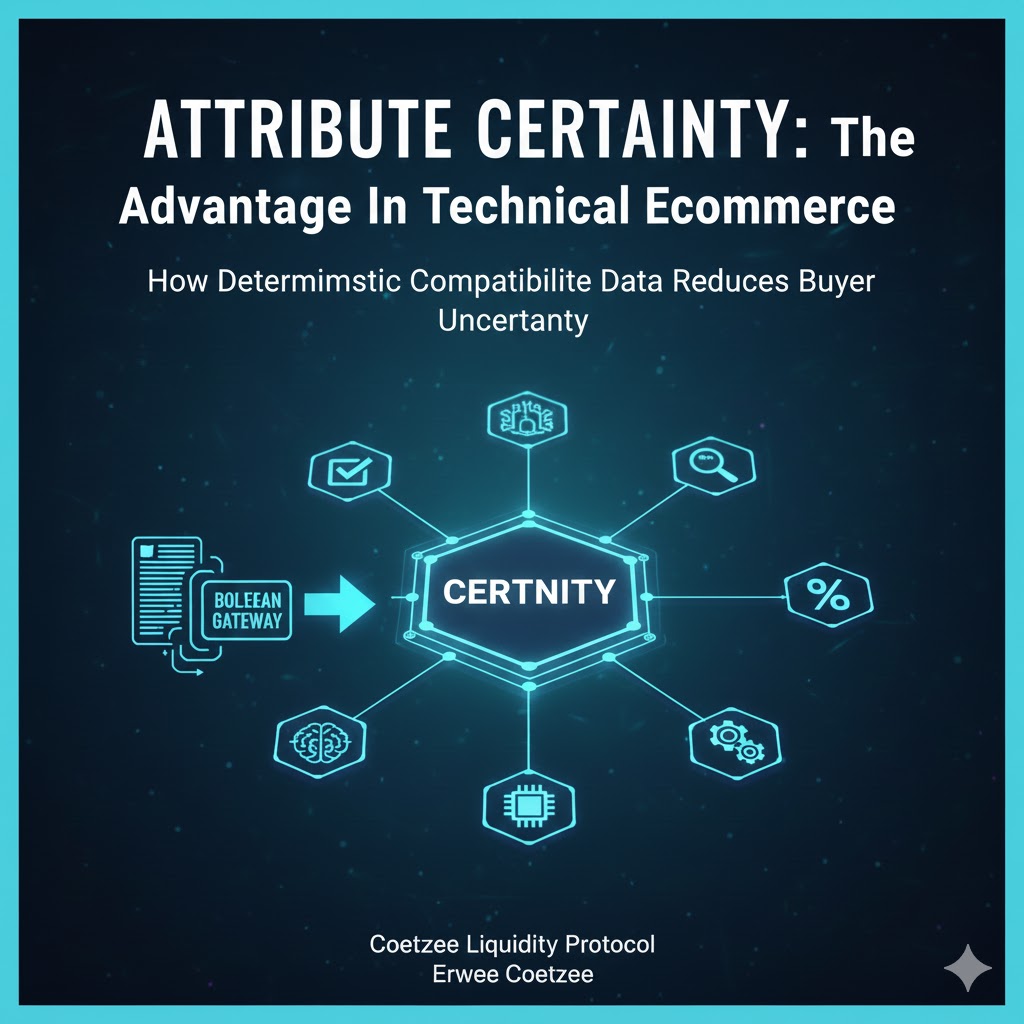
AI agents process technical queries as a series of Boolean (True/False) gates.
- Is the diameter exactly 45mm? True.
- Is the material chemical-resistant? True.
- Is it in stock in Cape Town? True.
When your store provides “Attribute Certainty,” you move from being a “candidate” in a search result to being the “solution.” This is the Boolean Advantage. By structuring data so that every critical specification is a discrete, machine-readable attribute rather than a sentence in a description, you allow the AI to perform the validation on behalf of the user.
[Image showing a traditional text-based product description being “filtered” through a Boolean gate into a structured CLP data set]
Operational Implementation: Building the Certainty Layer
Implementing Attribute Certainty requires a shift from copywriting to systems engineering.
1. Mapping Compatibility Matrices
The most valuable data in technical e-commerce is compatibility. In the CLP framework, we use the additionalProperty schema type to house non-standard technical specs. For example, a South African security hardware merchant should not just list “Gate Motor.” They must list:
gate_weight_max: 500kgcycles_per_hour: 20backup_battery_type: Lead-Acid 7Ah
2. Eliminating the “Contact for Specs” Friction
Every time a merchant forces a user to “email for a datasheet,” they create a data vacuum. To achieve machine-readable trust, all technical PDF data must be extracted and injected into the page’s JSON-LD. This makes the “hidden” knowledge of your business liquid and searchable.
3. Verification through Social and Technical Proof
Attribute Certainty is reinforced by schema hygiene. By linking product attributes to external standards (e.g., ISO certifications or industry-standard part numbers), you provide a “cross-check” that AI agents use to verify the accuracy of your claims.
Real-World Example: The Diamond Industry
In Erwee Coetzee’s work with South African diamond merchants, Attribute Certainty is the difference between a high-value lead and a bounce.
A buyer isn’t just looking for a “diamond ring.” They are looking for a “1.2ct Round Brilliant, Excellent Cut, GIA Certified, No Fluorescence, Platinum Setting.”
- The Traditional Approach: Write a beautiful story about the diamond’s sparkle.
- The CLP Approach: Structure the GIA report data into machine-readable fields.
When a high-intent buyer uses an AI tool to “find the best value G-colour diamond in Cape Town with no fluorescence,” the merchant with the highest Attribute Certainty wins. The story provides the emotion, but the Boolean data provides the sale.
Strategic Implications: The Economics of Certainty
By reducing the distance between a question and a “Yes,” you fundamentally alter the economics of your store.
- Higher Conversion Rates: When a user is certain a part will fit, the “Buy” button becomes a low-friction action.
- AI Agent Preference: As Google’s Search Generative Experience (SGE) evolves, it prioritizes sources that provide “high-confidence” data. “Certainty” is the new “Authority.”
- Moat Construction: Competitors who rely on “copy-pasted” descriptions from manufacturers will always lose to a merchant who has engineered a unique, deep compatibility matrix.
FAQ
Is Attribute Certainty just for technical products? No. Even in fashion, attributes like “inseam length,” “fabric weight (GSM),” and “country of origin” provide the certainty required for an AI agent to recommend your product over a generic competitor.
Does this mean I need a PIM (Product Information Management) system? For stores with over 500 SKUs, a PIM becomes the “engine” of the Coetzee Liquidity Protocol. It ensures that your data remains liquid across all channels.
How does this impact my SEO Gurus strategy? It shifts the focus from “keyword volume” to “attribute coverage.” We don’t just want to rank for the name of the product; we want to be the only result that satisfies the user’s Boolean constraints.