The 99-Score Mandate: Mobile Performance as a Veblen Signal
In the high-ticket world, there is no such thing as a “fast enough” website. There is only the presence or absence of technical discipline.
Whether you are an enterprise-level service firm or a heritage brand dealing in bespoke diamonds and gemstones, latency is not a “web development issue.” It is a “Trust Tax.” In the 2026 digital economy, if your website takes three seconds to render, you are signaling to both your clients and the generative search algorithms that your infrastructure is dusty, unmaintained, and amateur.
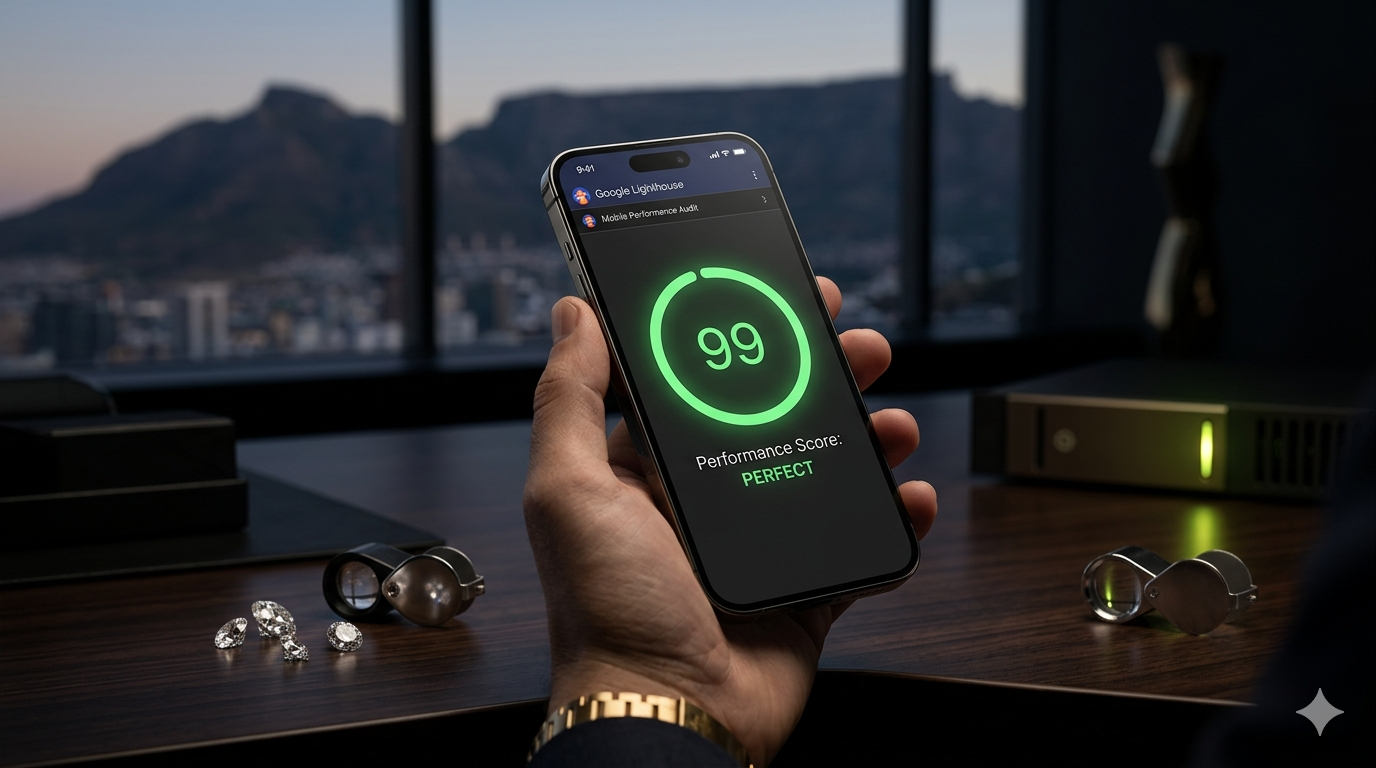
To a systems architect, a Google Lighthouse Performance Score of 99 is more than a metric. It is a Veblen Good—a conspicuous display of technical excellence that separates the engineered authority from the generic noise.
Latency as a Trust Tax
Cognitive load is the enemy of a high-value transaction. When a client is navigating a decision involving hundreds of thousands of Rands, they are looking for reasons to disqualify you. Every millisecond of a “loading spinner” is an opportunity for doubt to calcify.
If your showroom floor were covered in dust or your fleet of luxury vehicles had chipped paint, you would recognise it as a failure of brand integrity. Yet, many South African heritage brands tolerate the digital equivalent: “DOM bloat,” unoptimised images, and third-party scripts that throttle the user experience.
In my practice, achieving a 99 score—as we did for Prins & Prins, maintaining that threshold even during aggressive core updates—is the only way to eliminate this tax. It signals that you possess the superior resources required to engineer total precision.
The Math of Abandonment
In high-ticket retail, the relationship between load time (T_l) and the Probability of Conversion (P_c) is not linear; it is exponential. The buyer’s patience for friction is inversely proportional to the value of the asset.
We frame this through the following decay model:
Where k represents the “Friction Coefficient” of your specific niche.
For a generic commodity, k might be low. But for a specialist firm selling technical IT infrastructure or a boutique merchant of rare gemstones, k is aggressive. The buyer is subconsciously looking for “Technical Sovereignty.” If you cannot optimise your own primary acquisition node, why should they trust you to optimise their investment?
The Veblen Signal of Code
Luxury is defined by the details that are invisible to the untrained eye but felt by the connoisseur. In digital architecture, this is “Clean Code.”
Most “marketing” websites are built on bloated, rented SaaS themes—fragile structures held together by dozens of conflicting plugins. This is the digital equivalent of a “fast-fashion” suit. It looks acceptable from a distance, but the stitching is weak.
Technical Sovereignty—owning your stack and stripping it of all non-essential noise—is a Veblen signal. It tells the machine (the AI agent) that your data is high-resolution and low-noise. It tells the human that you are a master of your craft. When we achieved a 99 mobile performance score, it wasn’t a “trick.” It was the forensic removal of everything that didn’t contribute to the user’s mission.
The Resonance Floor (R_f)
Within the Coetzee Resonance Protocol (CRP), a 99 performance score acts as the Resilience Floor (R_f).
Your “E-E-A-T” signals (Experience, Expertise, Authoritativeness, and Trustworthiness) are irrelevant if they cannot be delivered to the user instantly. Without a high-performance baseline, your authority is built on sand. The machine-readable layer of your site must be delivered at the speed of thought to be notarised as a primary node in the Knowledge Graph.
The Performance Audit Checklist
If your firm is not hitting the 99-score mandate, you are likely suffering from one of the following structural failures:
- DOM Bloat: Too many nested elements from generic “page builders.”
- Legacy Scripts: Unoptimised tracking pixels and “marketing fluff” that block the main thread.
- Unoptimised Assets: High-resolution images of diamonds or gemstones that haven’t been served through a forensic, next-gen format pipeline.
- Server-Side Latency: Hosting your brand on “cheap,” shared infrastructure rather than a sovereign, tuned environment.
Moving from Bloat to Baseline
The era of “pretty but slow” websites is over. The era of the 99-Score Mandate has arrived.
If your website is currently “spinning,” you are paying a Trust Tax that your competitors are not. You are signaling to the search index that you are a low-performance entity.
Stop tolerating technical laziness. Reach out to me at SEO Gurus today to book a Technical Performance Audit, and let’s engineer a digital presence that reflects your professional excellence.