Procurement SEO: How Industrial and B2B Companies Lose Leads Through PDF-First Websites
Most industrial companies do not realise they have a search visibility problem.
Their sales teams may still receive enquiries. Existing clients may continue placing orders. Procurement managers may still recognise the brand within established networks.
Meanwhile, an invisible commercial erosion is already taking place beneath the surface.
Engineers, procurement officers, technical buyers, contractors, project managers, and operations teams increasingly begin supplier discovery through search engines and AI-driven research systems. Before contacting vendors directly, they conduct extensive digital evaluations involving:
- technical specification searches,
- compliance validation,
- capability comparisons,
- product research,
- and supplier credibility analysis.
Many industrial companies are structurally invisible during this process.
Not because they lack expertise.
Not because their products are inferior.
But because their websites were never architected for discoverability inside modern search ecosystems.
Valuable technical information often sits buried inside disconnected PDFs, outdated catalogues, poorly indexed technical documents, and machine-unreadable website structures.
The result is a major industrial SEO failure that many businesses never detect until competitors begin dominating procurement-driven search visibility.
In the AI era, this problem becomes even more dangerous.
Search engines are evolving into machine interpretation systems capable of synthesising technical information, surfacing supplier recommendations, and shaping procurement decisions before human sales engagement even occurs.
Industrial SEO is no longer simply a marketing function.
It is rapidly becoming a procurement infrastructure issue.
The Invisible Procurement Problem
Industrial procurement behaviour has changed fundamentally over the past decade.
Historically, supplier relationships often depended heavily on:
- trade networks,
- existing vendor databases,
- industry referrals,
- exhibitions,
- and direct sales engagement.
That model still exists, but digital procurement research now influences supplier discovery at an unprecedented scale.
Today’s procurement teams increasingly perform independent technical research long before contacting suppliers.
Search behaviour now includes:
- “stainless steel pipe supplier for corrosive environments”
- “industrial conveyor systems food grade compliance”
- “mining pump supplier South Africa ISO certified”
- “explosion-proof electrical enclosure manufacturer”
These are not casual searches.
They represent high-intent commercial investigations.
The businesses visible during these searches often influence shortlist formation before procurement teams ever initiate contact.
Industrial SEO therefore directly affects commercial opportunity flow.
Many industrial businesses still underestimate this shift because they operate within industries historically dominated by relationship-driven sales.
However, modern procurement increasingly blends:
- digital evaluation,
- technical search,
- AI-assisted research,
- and supplier validation systems.
Search visibility now influences industrial procurement pipelines directly.
Why Most Industrial Websites Are Structurally Invisible
A significant percentage of industrial and engineering websites were built around outdated information architecture principles.
Their primary purpose was often:
- product display,
- catalogue storage,
- or corporate presence.
Very few were designed as search ecosystems.
This creates major industrial SEO weaknesses.
Common structural problems include:
- PDF-heavy architectures,
- weak internal linking,
- poor semantic structure,
- fragmented technical content,
- shallow indexing pathways,
- and minimal machine-readable context.
Many industrial websites unintentionally isolate valuable technical expertise from search engines entirely.
Search engines interpret websites contextually.
When technical information is trapped inside disconnected documents without semantic relationships, contextual hierarchy, or crawlable content architecture, visibility declines dramatically.
This creates a paradox common in industrial SEO:
- highly specialised companies with deep expertise remain digitally invisible,
- while technically inferior competitors dominate search visibility through stronger information architecture.
The issue is not expertise.
The issue is discoverability.
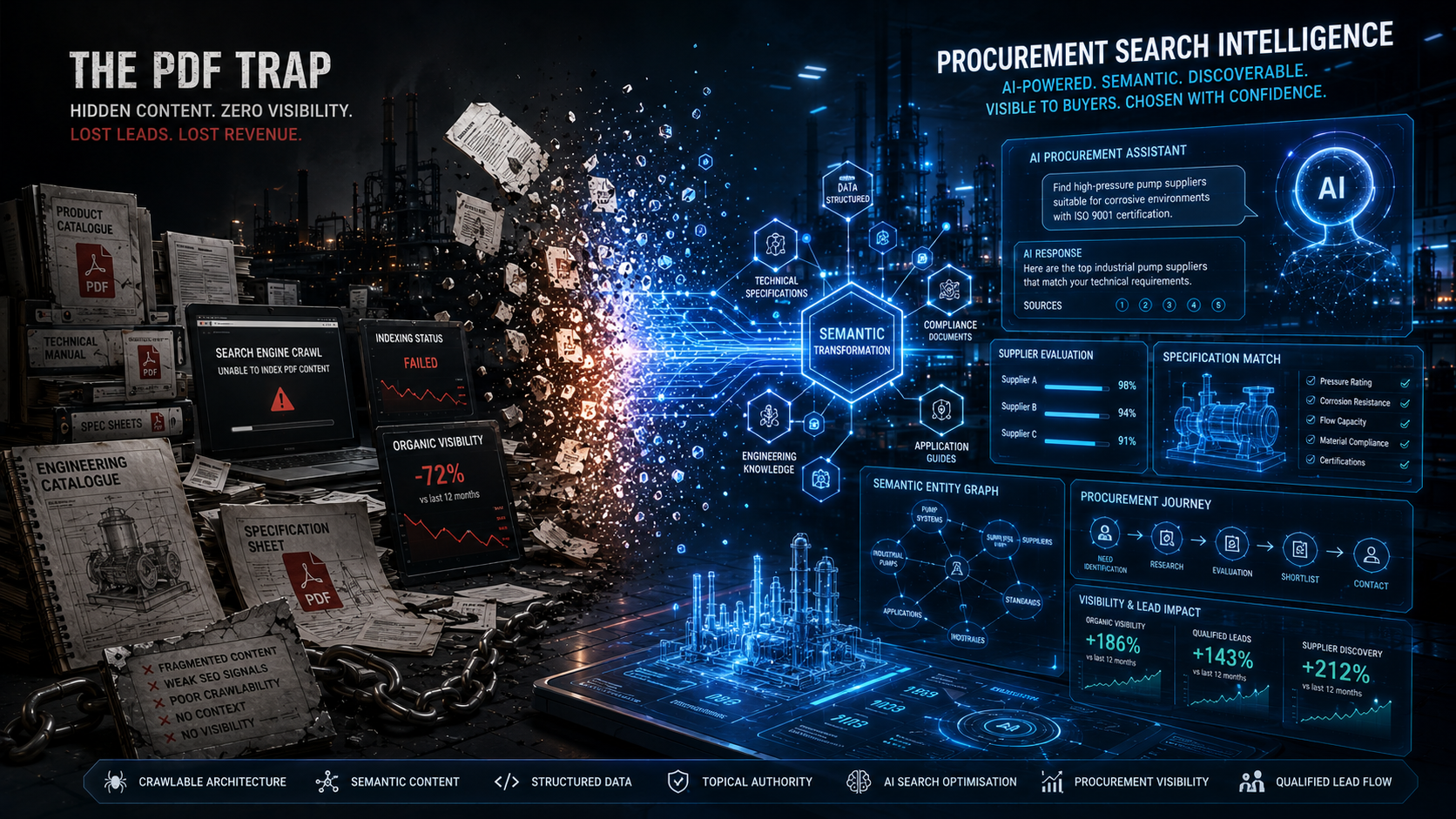
The PDF Trap: Why Search Engines Struggle With Technical Documents
PDFs remain one of the largest hidden problems in industrial SEO.
Industrial companies frequently rely on PDFs for:
- specifications,
- product sheets,
- compliance documents,
- technical manuals,
- installation guides,
- and engineering data.
While PDFs appear convenient operationally, they often create severe search visibility limitations.
PDFs Break Semantic Relationships
Search engines rely heavily on contextual relationships between pages.
HTML-based content allows:
- internal linking,
- semantic hierarchy,
- entity reinforcement,
- structured navigation,
- and topical clustering.
PDFs isolate information from these systems.
A technical specification buried inside a PDF may contain commercially valuable search terms, but without contextual architecture, its visibility remains weak.
PDFs Reduce Internal Authority Flow
Internal linking plays a major role in industrial SEO.
When valuable technical content exists only inside PDFs, websites lose:
- contextual authority pathways,
- semantic reinforcement,
- crawl depth efficiency,
- and topical cohesion.
This weakens overall authority signals.
PDFs Create Fragmented Indexing
Search engines often struggle to interpret PDFs contextually.
Important information becomes fragmented across isolated documents lacking:
- structured metadata,
- semantic relationships,
- and navigational integration.
The result is poor discoverability during technical procurement searches.
PDFs Are Weak for AI Interpretation
AI search systems increasingly favour:
- structured clarity,
- semantic architecture,
- and machine-readable information hierarchies.
Large fragmented PDF ecosystems create interpretation problems for AI retrieval systems.
This becomes increasingly important as AI-assisted procurement research expands.
How Procurement Teams Actually Search in 2026
Modern procurement research has evolved into a highly technical search-driven process.
Procurement teams no longer simply search for suppliers by brand name.
They increasingly search using:
- technical specifications,
- engineering problems,
- compliance requirements,
- environmental conditions,
- operational use cases,
- and comparative performance criteria.
Searches may include:
- “marine-grade aluminium fabrication supplier”
- “food-safe conveyor system with CIP compliance”
- “anti-corrosion electrical enclosures coastal environment”
- “explosion-proof pump system ATEX compliant”
These searches reflect procurement intent at a highly advanced level.
Industrial SEO therefore requires deep alignment with:
- technical terminology,
- procurement psychology,
- engineering language,
- and contextual search behaviour.
AI-Assisted Procurement Research
AI systems are rapidly influencing procurement workflows.
Buyers increasingly use platforms like:
to:
- compare suppliers,
- summarise specifications,
- evaluate capabilities,
- and identify potential vendors.
Industrial SEO now extends beyond traditional search rankings into AI visibility ecosystems.
Why AI Search Engines Increase the Risk of Invisibility
AI search systems change industrial visibility fundamentally.
Traditional search engines primarily indexed and ranked webpages.
AI systems:
- interpret,
- summarise,
- synthesise,
- and retrieve information contextually.
This creates a major problem for industrial websites built around fragmented PDF architectures.
AI Systems Need Machine-Readable Context
AI systems perform best when information is:
- semantically structured,
- contextually connected,
- hierarchically organised,
- and machine-readable.
Many industrial websites fail these requirements entirely.
Their information architecture often lacks:
- semantic relationships,
- contextual reinforcement,
- and crawlable content systems.
Fragmented Content Weakens AI Retrieval
AI retrieval systems prioritise clarity.
When technical information exists across disconnected PDFs, fragmented catalogues, or poorly structured databases, AI systems struggle to:
- interpret relevance,
- establish authority,
- or surface accurate supplier information.
This weakens visibility inside conversational procurement research environments.
AI Search Rewards Topical Depth
Industrial SEO increasingly depends on demonstrating comprehensive expertise.
AI systems favour businesses capable of providing:
- detailed technical explanations,
- structured educational content,
- semantic topic coverage,
- and contextual authority.
Shallow catalogue websites struggle in these environments.
The SEO Difference Between a Catalogue and a Search Ecosystem
Many industrial websites function as static catalogues rather than intelligent search ecosystems.
There is a major difference between the two.
Catalogue Websites
Traditional catalogue sites typically contain:
- isolated product pages,
- downloadable PDFs,
- limited contextual explanation,
- and weak semantic relationships.
These structures perform poorly in modern industrial SEO.
Search Ecosystems
Modern industrial SEO requires semantically connected information systems.
These include:
- technical topic clusters,
- engineering knowledge hubs,
- contextual product relationships,
- specification libraries,
- and educational procurement pathways.
The objective is not merely displaying products.
The objective is building machine-readable technical authority.
Semantic Procurement Pathways
Industrial buyers rarely follow linear purchasing journeys.
They move through:
- technical evaluation,
- compliance analysis,
- specification comparison,
- vendor validation,
- and procurement review stages.
Industrial SEO should therefore architect content around procurement behaviour itself.
Technical SEO for Industrial and Engineering Companies
Technical SEO plays a critical role in industrial visibility.
Industrial websites often contain large volumes of technical information, making crawl efficiency and semantic clarity extremely important.
Crawl Efficiency
Search engines allocate finite crawl resources.
Bloated architectures, excessive PDFs, poor rendering systems, and fragmented navigation reduce crawl effectiveness.
Industrial SEO therefore requires technically efficient structures.
Structured Data
Structured data helps machines interpret:
- products,
- services,
- industries,
- technical specifications,
- and organisational relationships.
Schema markup strengthens contextual understanding significantly.
Semantic HTML
Semantic HTML improves machine readability.
Industrial websites built around outdated table-based layouts or excessive JavaScript often create interpretation challenges.
Modern industrial SEO increasingly favours clean semantic architecture.
Information Hierarchy
Technical content must follow logical hierarchy.
Search engines interpret:
- page relationships,
- topical depth,
- contextual grouping,
- and navigation structure.
Weak hierarchy reduces authority clarity.
Entity SEO for Industrial Brands
Entity SEO is becoming increasingly important in industrial search ecosystems.
Search engines and AI systems now interpret brands contextually through entity relationships.
Industrial Authority Signals
Industrial entity authority depends on:
- technical relevance,
- contextual mentions,
- specification alignment,
- and industry association signals.
Search engines increasingly evaluate:
- whether a company is recognised within its technical domain,
- how consistently it is referenced,
- and what contextual relationships exist around the brand.
Knowledge Graph Interpretation
Google’s Knowledge Graph allows search systems to understand relationships between:
- industries,
- manufacturers,
- suppliers,
- technical concepts,
- and engineering domains.
Industrial SEO increasingly requires strategic entity positioning.
AI Trust Systems
AI systems favour trusted authoritative sources.
Industrial brands with:
- strong technical ecosystems,
- semantic consistency,
- and authoritative contextual presence
gain advantages inside AI-generated procurement research.
Why Generic SEO Agencies Fail Industrial Businesses
Most SEO agencies lack the technical fluency required for industrial SEO.
Industrial search ecosystems differ significantly from consumer-oriented search environments.
Weak Technical Understanding
Generic SEO campaigns often fail because agencies:
- misunderstand technical terminology,
- oversimplify procurement behaviour,
- and target shallow keyword patterns.
Industrial buyers search differently from consumer audiences.
Procurement Behaviour Is Complex
Procurement journeys involve:
- compliance validation,
- technical evaluation,
- risk analysis,
- and specification comparison.
Industrial SEO therefore requires strategic alignment with procurement psychology.
Technical Industries Require Contextual Expertise
An agency optimising ecommerce fashion stores may struggle to optimise:
- engineering services,
- manufacturing systems,
- industrial automation,
- mining equipment,
- or specialised fabrication businesses.
Industrial SEO requires domain-sensitive optimisation frameworks.
The Rise of Search-Led Procurement
Procurement itself is becoming increasingly search-led.
Before contacting suppliers, buyers often conduct:
- independent research,
- technical comparisons,
- capability analysis,
- and supplier validation.
Search visibility therefore influences:
- shortlist creation,
- perceived expertise,
- and commercial credibility.
This trend is accelerating.
Procurement Teams Expect Technical Accessibility
Buyers increasingly expect:
- searchable specifications,
- educational technical content,
- contextual guidance,
- and structured information systems.
Websites functioning merely as PDF repositories increasingly fail these expectations.
Digital Authority Influences Trust
Industrial buyers evaluate credibility digitally.
Visibility during technical searches influences:
- perceived expertise,
- trust formation,
- and supplier legitimacy.
Industrial SEO therefore intersects directly with commercial reputation.
Industrial Content Strategy in the AI Era
Industrial content strategy is evolving rapidly.
The AI era rewards:
- semantic depth,
- technical clarity,
- structured educational systems,
- and contextual authority.
Long-Form Technical Content Performs Better
AI systems favour:
- comprehensive explanations,
- technical depth,
- contextual completeness,
- and educational authority.
Thin product pages rarely establish meaningful industrial authority.
Technical Topic Clusters Strengthen Authority
Industrial SEO increasingly benefits from:
- engineering knowledge hubs,
- specification ecosystems,
- compliance resource centres,
- and contextual technical content networks.
AI Search Rewards Contextual Clarity
AI systems interpret:
- relationships,
- context,
- and meaning.
Industrial websites must therefore evolve into machine-readable technical ecosystems.
How SEO Gurus Approaches Procurement SEO
SEO Gurus approaches industrial SEO through a strategic combination of:
- technical architecture,
- semantic SEO,
- procurement behaviour analysis,
- and AI-era search visibility engineering.
This approach focuses on:
- machine-readable expertise,
- structured authority,
- technical content ecosystems,
- and contextual procurement visibility.
Rather than relying on generic keyword campaigns, the emphasis shifts toward:
- engineering-focused search strategy,
- semantic authority systems,
- and procurement-aligned visibility architecture.
Industrial SEO requires more than rankings.
It requires technical discoverability.
The Future of Industrial Search Visibility
Industrial search ecosystems are entering a new phase driven by:
- AI-assisted procurement,
- conversational search,
- semantic retrieval systems,
- and predictive supplier discovery.
Search engines are becoming procurement intelligence systems.
Businesses that fail to modernise their information architecture risk gradual commercial invisibility.
The future of industrial SEO will increasingly depend on:
- semantic structure,
- machine readability,
- entity authority,
- technical clarity,
- and AI retrieval optimisation.
Industrial companies that continue relying on fragmented PDF ecosystems and outdated catalogue structures will struggle as search systems evolve.
Meanwhile, businesses investing in:
- semantic content architecture,
- AI-readable technical ecosystems,
- and procurement-focused search strategy
will gain disproportionate visibility advantages.
Industrial SEO is no longer merely a marketing discipline.
It is becoming a foundational component of digital procurement infrastructure.
The companies that understand this transition early will not simply rank better.
They will become easier to discover, easier to trust, and easier to shortlist inside the future procurement systems increasingly shaping industrial commerce.