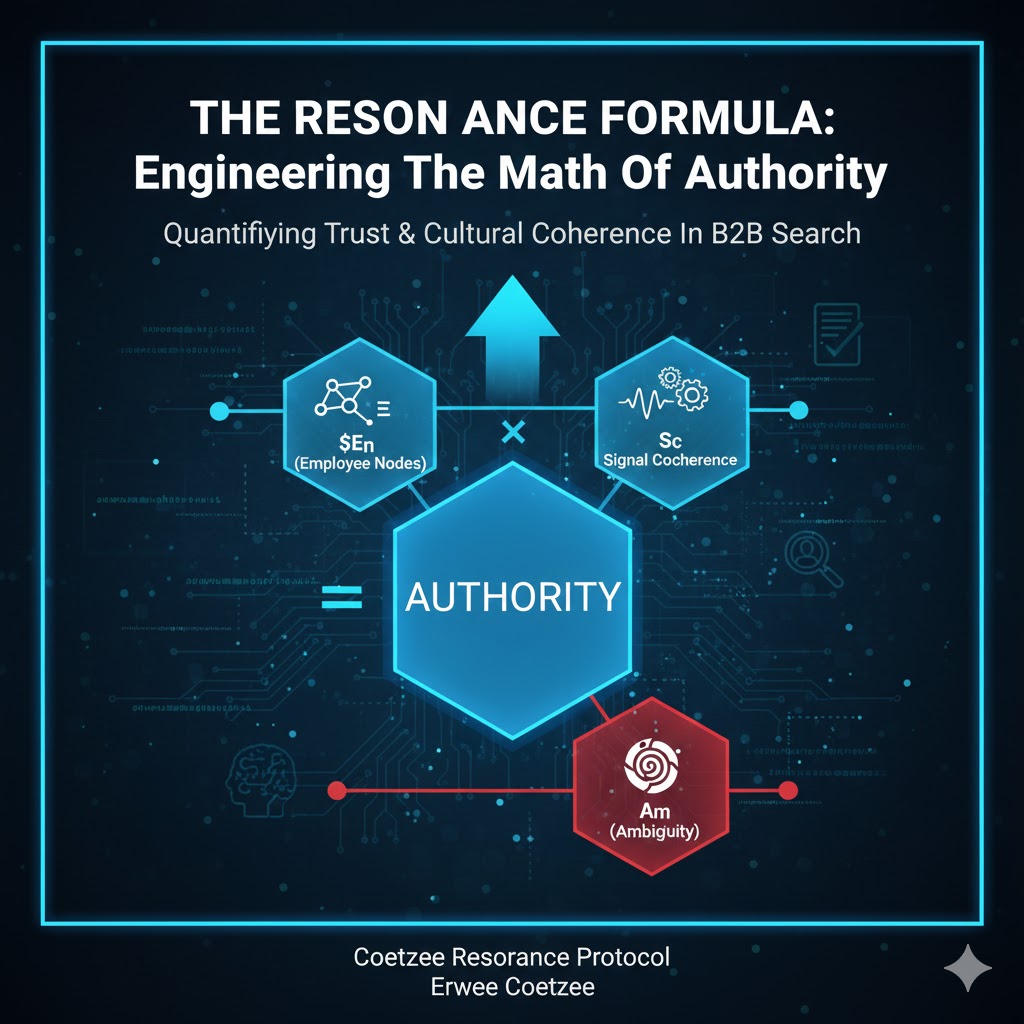
The Resonance Formula: Engineering the Math of Authority
In the Coetzee Resonance Protocol (CRP), we move away from the “black box” of brand reputation and toward a formalised mathematical model. If you are a complex B2B entity, your authority in the search index is not a mystical property—it is a result of network physics.
To manage your authority, you must first be able to measure it. We achieve this through the Authority–Resonance Formula.
Problem Definition: The Myth of Monolithic Authority
Most B2B firms treat “Authority” as a single score tied to their domain name (Domain Authority). This is a legacy mindset. In an AI-first era, Google and other LLM-based agents do not just look at your website; they look at the network your organisation constitutes.
If your company claims to be an industry leader but your employees have no indexed digital footprint, or worse, their public signals contradict your brand’s claims, your authority is hollowed out by Ambiguity. You are effectively a “ghost entity” that the algorithm cannot resolve with confidence.
Mechanism Explanation: The Resonance Formula
The CRP formalises authority as a directional model:
Authority=AmEn×Sc
Where:
- En (Employee Nodes): The count of employees with a structured, publicly indexed digital presence. Every expert at your firm should be a “node” in the index.
- Sc (Signal Coherence): The degree to which the values, vocabulary, and expertise expressed across those nodes are consistent.
- Am (Ambiguity): The suppressor. Contradictory signals, conflicting service positioning, or gaps between brand claims and workforce sentiment.
In this model, Ambiguity is the divisor. It doesn’t just reduce your authority; it actively corrodes it. An entity with 100 experts (En) but high internal noise (Am) will always lose to a boutique firm with only 5 experts who share absolute Signal Coherence.
Operational Implementation: Solving for the Variables
To increase your Resonance Score, you must systematically address each variable in the formula.
1. Scaling the Nodes (En)
You must stop “ranking the logo” and start “ranking the humans.” This involves:
- Creating structured
Personschema for all key staff. - Mapping those individuals to the
Organizationnode via theworksForproperty. - Ensuring each node has a “verified” footprint (LinkedIn, industry publications, speaking engagements).
2. Tuning for Coherence (Sc)
Coherence is not about “scripting” your employees. It is about Cultural Alignment. When your team truly understands the organisational mission, their organic output—be it a LinkedIn post or a technical whitepaper—naturally reinforces the brand’s semantic territory.
3. Eliminating Ambiguity (Am)
This is the “Pruning Phase.” You must audit the index for “Signal Gaps.” If your firm claims to be an enterprise security specialist but you still have legacy blog posts about “fixing home Wi-Fi,” you are creating Ambiguity. These signals must be de-indexed to lower the divisor in the formula.
Real-World Example: The Dreams Programme Factor
The most powerful example of the resonance formula in action is the Netsurit case (2009–2013). By investing in the “Dreams Programme”—an initiative that supported the personal aspirations of employees—the firm created massive Signal Coherence (Sc).
The employees weren’t just “staff”; they became vocal, authentic nodes (En) for the brand. Because their sentiment was genuine, it produced unsolicited, high-authority mentions in business press. The Ambiguity (Am) was near zero because the internal culture and external brand were perfectly mirrored. Their authority didn’t just grow; it resonated.
Strategic Implications: The Physics of Trust
The Resonance Formula turns “soft” reputation management into a hard engineering task.
- Math over Magic: You can now diagnose why a competitor is outranking you—is it because they have more experts (En) or just less noise (Am)?
- The Power of Small: A boutique agency can beat a global firm by maintaining a near-perfect Sc and a zero Am.
- AI Readiness: AI agents are designed to “resolve entities.” The clearer your formula looks, the more likely you are to be the “Suggested Partner” in an AI search.
FAQ
What is the “Ambiguity Penalty”? It is the structural mechanism by which an algorithm (or a buyer) loses confidence in your entity because your signals don’t match. If your “About” page says one thing and your Glassdoor reviews say another, you’ve triggered the penalty.
How many nodes (En) do I need? Quality over quantity. A firm with three highly coherent “Expert Nodes” has more resonance than a firm with 50 uncredentialed, silent employees.
How does this impact my current Ruggedized SEO strategy? Ruggedized SEO builds the technical “Trust Layer” (the Schema). The Resonance Formula provides the “Signal Strategy” that you feed into that layer.