The Specificity Threshold: When a Niche Store Can Beat Amazon
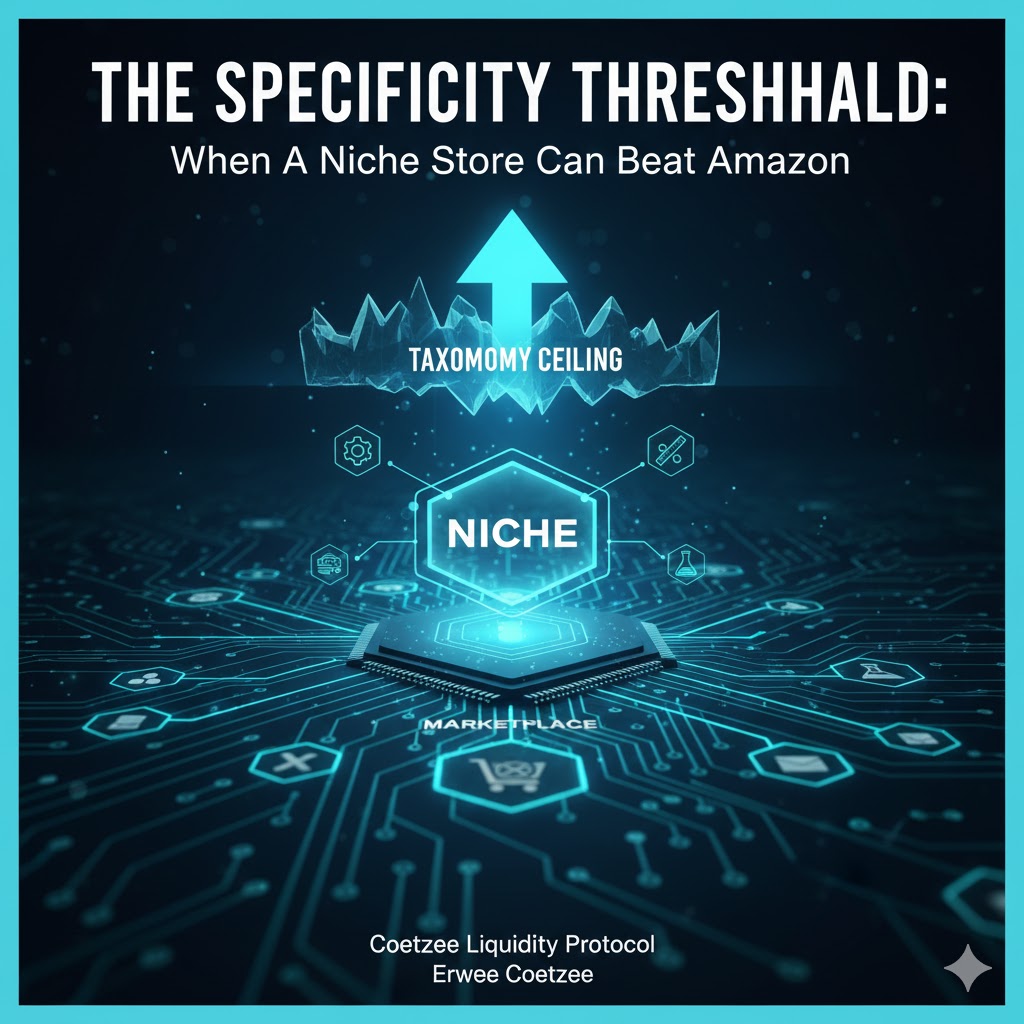
In the landscape of global e-commerce, Amazon is often viewed as an apex predator—an entity with infinite horizontal scale and logistical dominance. However, the Coetzee Liquidity Protocol (CLP) identifies a critical structural weakness in marketplaces: the “Taxonomy Ceiling.”
As a marketplace grows, its data structures must remain generic enough to house everything from toothpaste to tractor parts. This creates the Specificity Threshold—a mathematical point where the complexity of a product’s attributes exceeds the marketplace’s ability to categorise them. At this point, the niche merchant, armed with deep liquidity-driven e-commerce architecture, gains the competitive advantage.
Problem Definition: The Marketplace Flattening Effect
Marketplaces win on convenience, but they lose on Attribute Density. To manage millions of sellers, platforms like Amazon or Takealot “flatten” product data into standardised templates.
For a specialized technical product—for example, a “marine-grade stainless steel swivel shackle for 10mm G43 chain”—a marketplace might only categorise it under “Hardware” or “Boating Accessories.” The critical technical data—breaking load limits, metallurgical composition, and specific chain pitch compatibility—is often buried in a wall of unformatted text or lost entirely.
When an AI agent or a professional buyer queries for these specific constraints, the marketplace’s “flat” data fails to provide a deterministic match. This is the Discovery Gap that niche merchants must exploit.
Mechanism Explanation: Understanding the Specificity Threshold
The Specificity Threshold is reached when a buyer’s search intent requires a Boolean validation that a general marketplace cannot perform.
In the CLP framework, we define this through three vectors:
- Attribute Complexity: The number of variables required to ensure a product “fits” the use case (e.g., voltage, dimensions, chemical resistance).
- Taxonomy Depth: The number of sub-category levels provided by the merchant vs. the marketplace.
- Compatibility Certainty: The ability to guarantee that “Product A” works with “Environment B.”
When the search query moves from “Solar Panel” (Low Specificity) to “100W Flexible Monocrystalline Panel for ETFE Coating and MC4 Connectors” (High Specificity), the marketplace’s relevance drops while the niche merchant’s relevance—powered by schema hygiene and deep attribute mapping—scales.
Operational Implementation: Surpassing the Threshold
To beat a marketplace, a niche store must out-engineer them in the machine-readable layer.
1. Identifying High-Attribute Categories
Focus resources on product lines where “Generalist Data” fails. If you sell jewellery, as seen in the South African diamond industry, a marketplace might categorise by “Metal” and “Stone.” A CLP-compliant store will categorise by GIA certification parameters, fluorescence, and table percentage—attributes that marketplaces often ignore in their primary search filters.
2. Compatibility-Driven Search Architecture
The niche merchant must build “Compatibility Matrices.” Instead of relying on a single product page, the architecture should link products via isRelatedTo or isSimilarTo schema properties that reflect technical dependencies. This allows AI search engines to see your store as a Relational Database rather than a mere catalogue.
3. Extending Taxonomy Depth
If the marketplace stops at “Home Improvement > Lighting,” the CLP merchant must go to “Home Improvement > Lighting > Outdoor > Solar > Motion-Sensing > 3000K Warm White.” This granular depth ensures that your “inventory-as-content” is the most relevant node for long-tail queries.
Real-World Example: Industrial Waterproofing vs. General Hardware
Consider a company like RDB Home Solutions in South Africa. If a customer needs a specific waterproofing membrane for a “high-movement concrete roof joint,” they could search a general hardware marketplace.
However, the marketplace likely lists “Waterproofing Paint.” The specialized merchant, using the CLP framework, provides data points on elongation percentages, UV degradation rates, and substrate compatibility.
When the AI agent processes the request, it finds a deterministic match in the niche store’s structured data. The marketplace is discarded as “vague,” and the niche store wins the lead despite having a lower overall domain authority than the marketplace giant.
Strategic Implications: The Niche Dominance Strategy
The goal for a technical e-commerce specialist is not to compete with Amazon on price, but to out-index them on Certainty.
- Own the Edge Cases: Marketplaces focus on the 80% of products that are “simple.” Niche stores should focus on the 20% where technical specificity is the primary barrier to purchase.
- Machine-Readable Authority: By maintaining a machine-readable trust layer, you ensure that AI agents trust your specific attributes over the marketplace’s generic descriptions.
- The Taxonomy Moat: Once you build a deep, attribute-rich taxonomy, it is incredibly difficult for a marketplace to replicate it without breaking their “flat” data model. This is your competitive moat.
FAQ
Why can’t Amazon just copy my taxonomy? Amazon prioritises seller-agnostic data. To adopt your deep taxonomy, they would have to force millions of sellers to provide that data, which creates friction. Their scale is their bottleneck; your agility is your advantage.
Does this mean I should focus on long-tail keywords? No, it means you should focus on long-tail attributes. Keywords are for humans; attributes are for the AI agents that now mediate the search experience.
How do I know if I’ve reached the Specificity Threshold? Look at your “no-result” searches or high-bounce technical pages. If users are asking questions about compatibility that aren’t answered in your structured data, you haven’t reached the threshold yet.