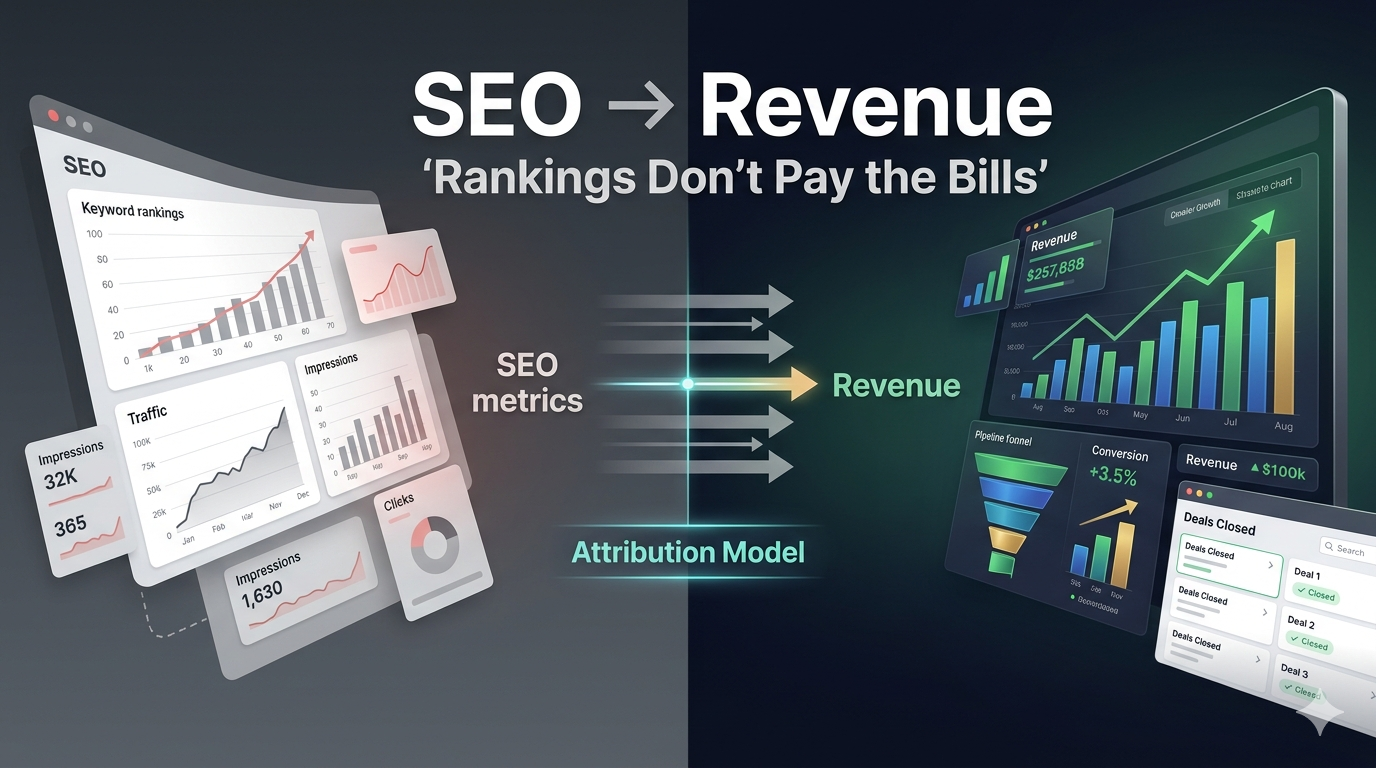
From Rankings to Revenue: How to Build an SEO Attribution Model That Proves Real Business Impact in 2026
Introduction: Why SEO Reporting Is Broken
Most SEO reporting still operates on outdated assumptions about how search performance should be measured.
Rankings go up. Traffic increases. Dashboards turn green. But when leadership asks how much revenue SEO actually generated, the answer is often unclear or incomplete.
The issue is structural. Traditional SEO reporting measures visibility and engagement, not financial impact. In 2026, that gap is no longer acceptable. Search journeys are fragmented across Google, AI Overviews, conversational tools, and multiple devices. Users may never convert on the first visit, or even on the same platform where discovery occurred.
This is why SEO now requires a more advanced framework:
An SEO attribution model that connects organic search activity directly to revenue outcomes.
Not impressions. Not clicks. Revenue.
What an SEO Attribution Model Actually Is
An SEO attribution model is a structured system that assigns credit for conversions and revenue across all organic search touchpoints in a customer journey.
It answers three critical questions:
- Which organic interactions influenced the conversion?
- How much revenue should be attributed to SEO?
- What role did organic search play relative to other marketing channels?
Unlike standard reporting dashboards, attribution is a decision-making framework. It determines how SEO is valued inside the business and how investment decisions are made.
SEO reporting tells you what happened. SEO attribution explains why revenue happened.
Why Traditional SEO Reporting Fails
1. Last-click bias
Most analytics platforms still default to last-click attribution. This means the final interaction receives full credit for the conversion.
Example:
A user discovers your website through a blog post, leaves, returns later via branded search, and then converts.
Last-click attribution credits branded search or direct traffic, ignoring the SEO content that initiated the journey.
2. Invisible influence of organic search
SEO often plays a foundational role in early-stage awareness and consideration. Users rarely convert immediately after reading content, but SEO shapes their decision-making process over time.
3. Branded search distortion
Strong SEO increases brand awareness, which leads to more branded searches. Many systems incorrectly classify this as brand-driven demand rather than SEO-influenced demand.
4. Fragmented user journeys
Modern users switch between devices, platforms, and even AI tools during their buying journey. Traditional analytics cannot fully track these transitions, leading to incomplete attribution.
Core Components of a Modern SEO Attribution Model
A functional SEO attribution system consists of four integrated layers.
1. Search visibility layer
This measures whether your content is being discovered in search results.
Key inputs include:
- Google Search Console impressions
- Average keyword positions
- Share of voice across keyword clusters
This layer reflects demand capture, not financial performance.
2. Engagement layer
This measures how users interact with your content after arriving.
Key inputs include:
- Engagement rate in GA4
- Scroll depth and time on page
- Internal navigation paths
This layer shows content effectiveness but not direct revenue impact.
3. Conversion layer
This measures user actions that indicate business intent.
Key inputs include:
- Form submissions
- Calls and inquiries
- Lead events and sign-ups
- Ecommerce transactions
This is where SEO begins to connect directly to outcomes.
4. Revenue layer
This measures actual financial impact.
Key inputs include:
- CRM pipeline data
- Closed-won deals
- Customer lifetime value
This is the only layer that reflects true business performance.
Types of Attribution Models
First-click attribution
Assigns full credit to the first interaction.
Strength: Highlights discovery channels
Weakness: Ignores conversion influence
Last-click attribution
Assigns full credit to the final interaction before conversion.
Strength: Simple to implement
Weakness: Ignores earlier SEO influence
Linear attribution
Distributes credit evenly across all touchpoints.
Strength: Balanced view
Weakness: Assumes all interactions are equally important
Time decay attribution
Gives more credit to interactions closer to conversion.
Strength: Reflects urgency
Weakness: Undervalues early-stage SEO
Data-driven attribution
Uses machine learning to assign credit based on observed behaviour patterns.
Strength: Most advanced model
Weakness: Requires large datasets and can lack transparency
Recommended Approach: Hybrid SEO Attribution Model
The most practical approach in 2026 is a hybrid model that combines multiple attribution principles.
A balanced weighting approach typically includes:
- First interaction influence: 30%
- Mid-journey engagement: 30%
- Conversion and revenue impact: 40%
This structure ensures SEO is credited for both initiating demand and contributing to revenue outcomes.
How to Build an SEO Attribution System
Step 1: Define conversion events
Clearly define what constitutes a meaningful business action.
This may include:
- Lead submissions
- Phone calls
- Qualified sales opportunities
- Closed revenue
Without this step, attribution cannot function correctly.
Step 2: Integrate data sources
A complete system requires integration between:
- Google Analytics 4
- Google Search Console
- CRM systems such as HubSpot or Salesforce
Optional additions include call tracking and offline conversion imports.
Step 3: Implement tracking consistency
Ensure consistent tracking across all sessions and channels.
This includes:
- Proper event tagging
- Clean referral tracking
- Consistent session attribution
Step 4: Map keywords to revenue outcomes
Each keyword cluster must be linked to a business outcome.
Example:
- “SEO services Johannesburg” → service page → lead form → closed deal
This step connects search intent to financial performance.
Step 5: Build a revenue-focused dashboard
An effective SEO dashboard should prioritise:
- Revenue from organic search
- Assisted conversions
- Pipeline influenced by SEO
- Conversion rates by landing page
- Cost per acquisition compared to paid channels
If revenue is not visible, the dashboard is incomplete.
What Executives Actually Care About
Executive stakeholders are not interested in rankings or impressions.
They focus on:
- Revenue generated by SEO
- Cost efficiency compared to paid channels
- Contribution to sales pipeline
- Predictability of organic growth
A meaningful SEO report must answer:
If we invest more in SEO, how much revenue will it generate?
Common Mistakes in SEO Attribution
Over-reliance on rankings
Rankings are indicators, not business outcomes.
Ignoring branded search growth
SEO often increases brand demand, which is frequently misattributed to direct traffic.
Excluding offline conversions
Phone calls and offline sales often remain untracked, leading to incomplete data.
Treating all content equally
Different pages serve different purposes. Informational content and transactional pages should not be evaluated the same way.
Practical Example of SEO Attribution
User journey:
- Searches “SEO pricing South Africa”
- Reads blog content
- Leaves site
- Later searches brand name
- Returns via direct traffic
- Submits enquiry form
- Becomes client
Attribution breakdown:
- SEO content initiated awareness
- Brand search reinforced consideration
- Direct traffic completed conversion
SEO is therefore responsible for demand creation and assisted conversion, not just traffic generation.
The Future of SEO Attribution in AI Search
Search behaviour is shifting rapidly due to AI-driven interfaces.
Users now:
- Receive answers without clicking websites
- Discover brands through AI summaries
- Convert later through indirect pathways
This introduces a new measurement category:
Impression-based influence
Future SEO attribution must track:
- Visibility within AI-generated responses
- Brand mentions in LLM outputs
- Non-click-based discovery impact
SEO is evolving from a traffic channel into a visibility and influence system across multiple information environments.
Conclusion: SEO Must Be Measured as a Revenue System
SEO is no longer a channel defined by rankings or traffic.
It is a system that influences revenue through visibility, trust, and demand creation.
An SEO attribution model is what connects those elements into a measurable structure.
Without it, SEO remains a marketing cost interpreted through incomplete data.
With it, SEO becomes a predictable and accountable revenue engine.
What You Should Implement First
Start with these priorities:
- Define conversion and revenue events clearly
- Connect GA4, Search Console, and CRM data
- Map keyword clusters to revenue outcomes
- Implement a hybrid attribution model
- Replace traffic reports with revenue dashboards
Everything else is optimisation.