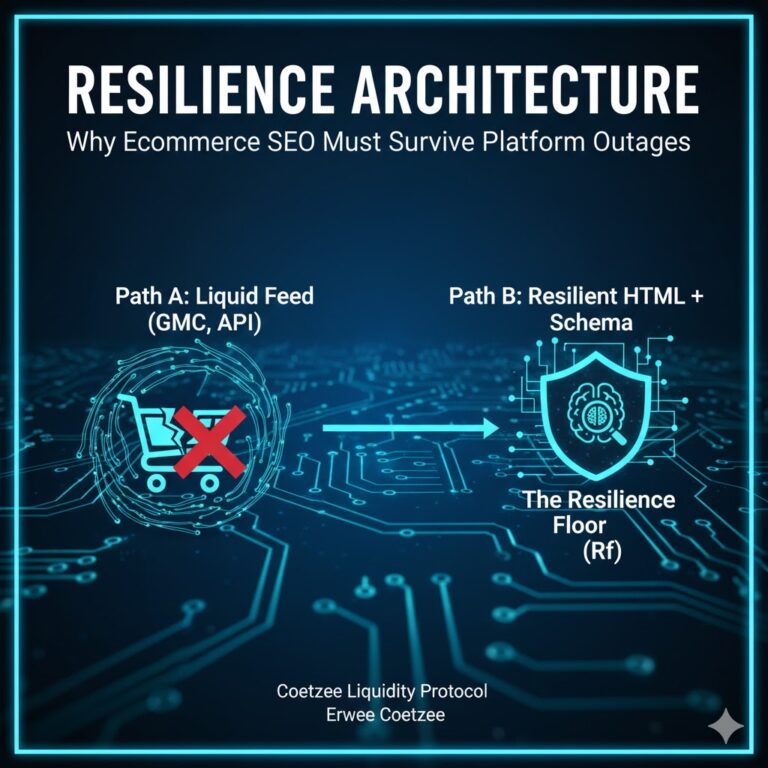
Inventory Is Content: Why Product Feeds Are the Real Homepage in AI Commerce
In the legacy era of SEO, the homepage was the digital storefront—the primary node of authority from which all PageRank flowed. However, for niche e-commerce businesses operating within the Coetzee Liquidity Protocol (CLP), the architectural centre of gravity has shifted. In an AI-first commerce environment, Google and other LLM-based agents no longer wait for a user to navigate a “beautifully designed” landing page. They ingest data at the source.
For the modern systems architect, the product feed is no longer a secondary export; it is the primary surface area for discovery.
Problem Definition: The Decay of the Traditional Landing Page
The traditional e-commerce model relies on a “Search → Landing Page → Conversion” funnel. This model is brittle because it assumes the user is the primary navigator. In contemporary search, Google’s Shopping Graph and AI Overviews act as the navigator.
When a user searches for a specific technical component—say, a “12V 100Ah LiFePO4 battery with M8 terminals”—the AI doesn’t want a blog post about the history of batteries. It wants the specific attribute set of the inventory. If your homepage is the “authority” but your machine-readable data is sparse, you suffer from a liquidity gap. The AI cannot verify your inventory’s compatibility with the user’s intent, leading to a total loss of visibility regardless of your brand’s prestige.
Mechanism Explanation: The Shift to Feed-Driven Discovery
In the Coetzee Liquidity Protocol, we treat inventory as the highest form of content. This shift is driven by three technical shifts:
- Merchant Center as a Ranking Signal: Google Merchant Center (GMC) has evolved from a PPC tool into the “source of truth” for organic shopping.
- The Shopping Graph: A real-time dataset of billions of product-entity relationships.
- Attribute-Based Retrieval: AI agents query databases based on Boolean constraints (Size, Material, Fitment, Price) rather than keyword density.
By prioritising ruggedized SEO and feed hygiene, a merchant ensures that their inventory is “liquid”—meaning it can flow seamlessly into any AI-driven interface, from a ChatGPT recommendation to a Google Lens visual search.
Operational Implementation: Building Feed-First Architecture
To implement a CLP-compliant architecture, the focus must move from aesthetic UI to data-rich backends.
1. Granular Attribute Mapping
Standard feeds include Title, Price, and Description. A CLP-optimised feed requires a deeper taxonomy. If you sell South African-manufactured industrial parts, your feed must include:
product_highlight: For technical specifications.product_detail: For specific compatibility metrics.custom_label: To segment inventory by liquidity (high-stock vs. niche-order).
2. Real-Time Freshness
AI agents penalise “stale” data. If a user is promised a product that is out of stock, the trust layer of the protocol breaks. Implementation should involve Content API for Shopping rather than static XML fetches to ensure sub-minute latency between stock changes and search visibility.
3. Schema Hygiene at Scale
Every product page must serve as a mirror to the feed. Automated schema hygiene ensures that Offer and Product properties are mathematically consistent across the Merchant Center and the HTML source code.
Real-World Example: The Solar Component Merchant
Consider a specialized South African merchant selling solar inverters. A traditional SEO approach targets “buy solar inverters South Africa.” A CLP approach targets the Specificity Threshold.
By populating the feed with precise attributes—efficiency_rating, max_dc_input, and compatible_battery_types—the merchant captures the user who asks an AI agent: “Which 5kW inverter in Cape Town supports Pylontech batteries and has a delivery time of under 3 days?”
The merchant’s “homepage” didn’t win this sale; the liquidity of their inventory data did. The AI agent matched the Boolean requirements of the query to the structured attributes in the feed.
Strategic Implications: Winning the AI-Commerce Race
Adopting the CLP framework means acknowledging that your website is merely a “container.” The real value lies in the structured data that leaves the container.
- SMEs can out-index giants: Amazon has breadth, but they often lack the “taxonomy depth” of a specialized niche store.
- Reduced Customer Acquisition Cost (CAC): By appearing in high-intent AI queries through structured data, you bypass the expensive “awareness” phase of the funnel.
- Future-Proofing: As “Agentic Commerce” (where AI bots buy on behalf of humans) rises, they will only interact with stores that speak their language: highly structured, machine-readable inventory.
FAQ
Does this mean I should stop blogging? No. But it means your blog must support the “Attribute Certainty” of your products. Content should be designed to reduce buyer friction, while the feed handles the discovery.
What is the most important field in a CLP-optimised feed? The product_type and google_product_category must be mapped to the highest level of specificity possible. Generic categories are where niche businesses go to die.
How does this relate to Ruggedized SEO? Ruggedized SEO provides the “machine-readable trust layer” that validates the data in your feed. Without a foundation of technical schema hygiene, your feed data may be viewed as low-confidence by AI agents.