How to Measure and Improve SEO Visibility in AI Search: ChatGPT, Google SGE, and Perplexity in 2026
Introduction
SEO used to be defined by one primary outcome: ranking on Google and earning clicks.
That model is no longer complete.
In 2026, a significant portion of search behaviour has shifted into AI-driven interfaces such as ChatGPT-style assistants, Google SGE-style answer layers, and systems like Perplexity that synthesise answers instead of listing links.
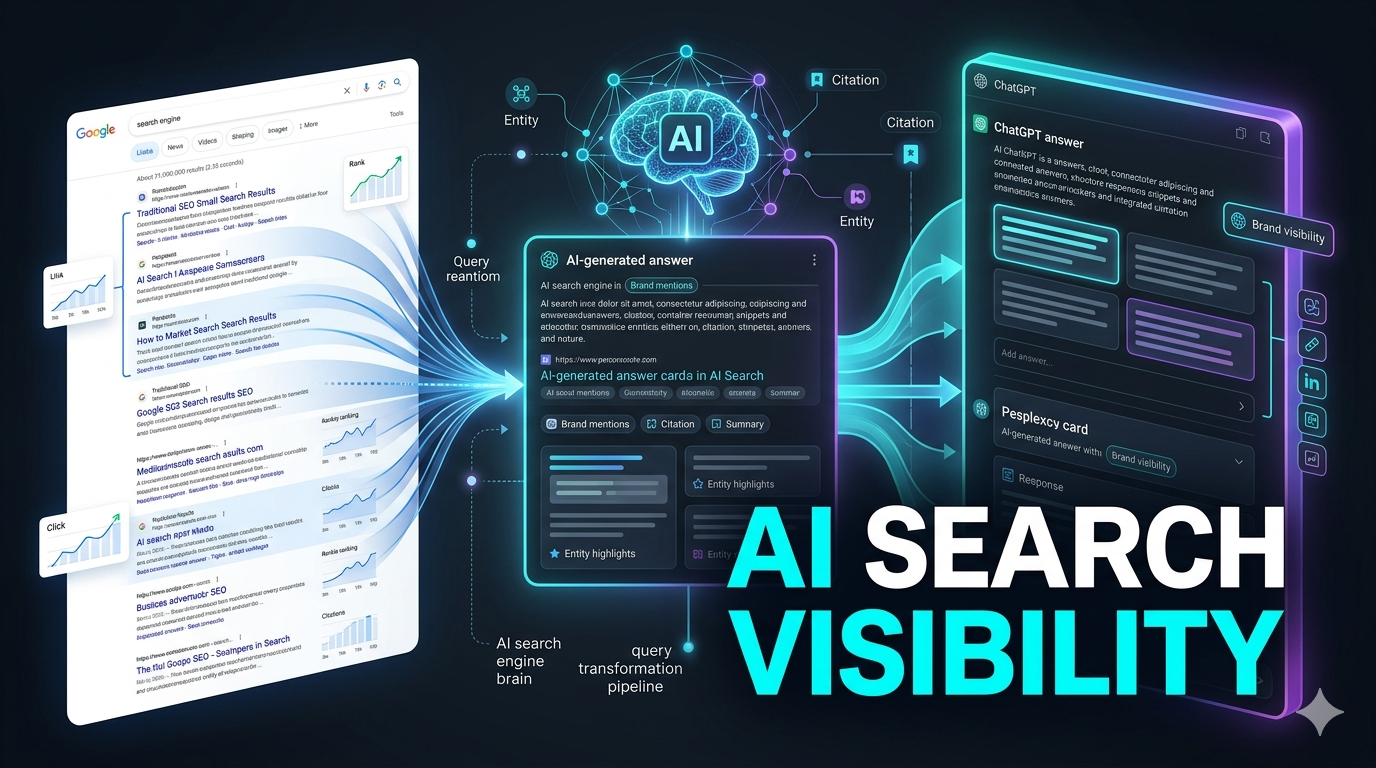
In these environments, users often never see a traditional search results page. They receive a direct answer instead of a list of websites.
This creates a fundamental shift in SEO measurement:
Visibility is no longer about position on a page. It is about presence inside an answer.
This is what we now call AI search visibility.
What AI Search Visibility Actually Means
AI search visibility refers to how often, how prominently, and in what context a brand or piece of content appears inside AI-generated responses.
Unlike traditional SEO, where visibility is measured through rankings and impressions, AI search visibility is measured through:
- Inclusion in AI-generated answers
- Frequency of brand mentions in responses
- Citations or references in AI outputs
- Influence on synthesized answers even without direct attribution
The key difference is this:
In traditional SEO, users find pages.
In AI search, users receive answers.
Your goal is no longer just to rank pages. It is to become part of the answer generation process.
How AI Search Engines Decide What to Show
AI search systems do not operate like traditional keyword-based ranking engines. They rely on a combination of retrieval, synthesis, and entity understanding.
There are four core factors influencing visibility.
1. Entity-based retrieval
AI systems prioritise entities over keywords. An entity is a clearly identifiable concept such as a brand, organisation, person, or topic.
If your brand is recognised as a strong entity in a specific topic area, it is more likely to be included in generated answers.
2. Source authority weighting
AI models evaluate the perceived trustworthiness of sources. This includes:
- Domain authority signals
- Consistency of topical coverage
- External references and citations
- Brand reputation across the web
Authority determines whether your content is considered reliable enough to inform answers.
3. Semantic relevance
AI systems interpret meaning, not just keywords. Content is evaluated based on:
- Contextual depth
- Topic coverage completeness
- Conceptual alignment with user intent
Pages that fully explain a topic are more likely to be used as reference material.
4. Content structure clarity
Well-structured content is easier for AI systems to extract and summarise.
Content that is:
- Clearly segmented
- Logically structured
- Direct in explanation
is more likely to be used in answer generation.
The 4 Types of AI Search Visibility
AI visibility is not a single metric. It exists in multiple forms.
1. Direct citations
Your content is explicitly referenced or linked within AI-generated responses.
This is the most visible and traceable form of AI SEO impact.
2. Implicit influence
Your content contributes to the AI’s response without being directly cited.
This occurs when your content is part of the knowledge base shaping the model’s understanding of a topic.
3. Entity mentions
Your brand is mentioned as a recognised authority within a response, even without a direct link.
This signals strong entity recognition.
4. Zero-click visibility
Users receive answers that include your brand or concepts without visiting your website.
This is the most common form of AI search interaction and the hardest to measure.
How to Measure AI Search Visibility
Traditional analytics tools do not fully capture AI search performance. A dedicated framework is required.
1. Prompt-based tracking
Run consistent prompts across AI systems to test visibility.
Example approach:
- Define core industry questions
- Query ChatGPT, Perplexity, and similar systems
- Record whether your brand appears
This creates a visibility benchmark over time.
2. Brand mention tracking in AI outputs
Monitor when your brand appears in generated responses across platforms.
Key metrics:
- Mention frequency
- Context of mention (authority, comparison, citation)
- Position within the answer
3. Share of answer estimation
Instead of measuring share of voice in SERPs, measure:
How often your brand appears in AI-generated answers relative to competitors.
This becomes the new visibility benchmark.
4. Entity visibility scoring
Assign a score based on:
- Frequency of mentions
- Relevance of topics where you appear
- Strength of associated entities
This helps quantify AI presence beyond clicks.
5. Cross-platform comparison
Measure visibility across multiple AI systems:
- ChatGPT-style assistants
- Perplexity-style answer engines
- Google SGE-style environments
Each system surfaces information differently, so cross-platform consistency matters.
How to Optimise Content for AI Search Systems
Optimising for AI search requires a shift from keyword targeting to answer engineering.
1. Write for entity clarity
Ensure your brand, topics, and concepts are clearly defined and consistently referenced across content.
AI systems rely heavily on entity understanding.
2. Structure content for extraction
Content should be easy to summarise and reuse.
This includes:
- Clear headings
- Direct definitions
- Concise explanations
- Structured sections
AI systems prefer content that can be broken into usable components.
3. Build topical authority clusters
AI systems favour domains that demonstrate consistent expertise across a topic.
This means:
- Covering a topic comprehensively
- Building interconnected content clusters
- Avoiding isolated, unrelated articles
4. Increase citation-worthiness
Content should be written in a way that makes it useful as a reference.
High-citation content includes:
- Clear factual explanations
- Structured frameworks
- Definitive answers to common questions
5. Reduce ambiguity
AI systems struggle with vague or overly complex language.
Clear, direct explanations improve extractability and visibility.
The Role of Entity SEO in AI Visibility
Entity SEO is now more important than keyword optimisation.
An entity is how AI systems understand what your brand represents.
To strengthen entity signals:
- Maintain consistent brand references across platforms
- Build associations with relevant topics
- Earn mentions from external authoritative sources
- Ensure structured data aligns with your content themes
Strong entities are more likely to be included in AI-generated answers even without exact keyword matches.
Content Architecture for AI Search Dominance
Winning in AI search requires structured knowledge systems, not isolated articles.
1. Topic clusters
Group content into interconnected themes that fully cover a subject area.
2. Pillar content
Create comprehensive pages that define core topics clearly and authoritatively.
3. Extractable answer blocks
Structure content so AI systems can easily pull:
- Definitions
- Steps
- Comparisons
- Explanations
4. Knowledge consistency
Ensure all content reinforces the same entity positioning and topical authority.
Common Mistakes in AI SEO Optimisation
1. Over-optimising for keywords
AI systems do not rely on keyword matching in the same way as traditional search engines.
2. Writing non-extractable content
Dense, unstructured content reduces AI usability.
3. Ignoring entity development
Brands without clear entity signals are less likely to be included in AI answers.
4. Focusing only on website content
AI systems pull from the broader web ecosystem, not just your site.
Future of AI Search Visibility (2026 and Beyond)
AI search is fundamentally reshaping how discovery works.
Key trends include:
- Reduced reliance on traditional click-based SEO metrics
- Growth of answer-first search interfaces
- Increased importance of brand entities over pages
- Shift from ranking optimisation to answer inclusion
In this environment, SEO is no longer about positioning pages on a results list.
It is about ensuring your brand exists inside the systems that generate answers.
Conclusion
AI search visibility represents the next evolution of SEO.
It moves optimisation away from rankings and toward presence within AI-generated knowledge systems.
Success now depends on three core capabilities:
- Strong entity development
- Structured, extractable content
- Topic-level authority across entire domains
SEO is no longer about being found.
It is about being included in the answer itself.