Why Twenty Years of Reputation Won’t Get You Into an AI Vendor Research Session — and the Five Architectural Fixes That Will
SEO GURUS — CCF BOUTIQUE SERIES, PAPER 2
The AI Search Audit: What Your Digital Presence Actually Looks Like to Claude, Gemini, and Perplexity — and the Five-Question Diagnostic That Tells You in 30 Minutes
Erwee Coetzee | SEO Gurus
Section 1: Executive Summary
Something changed in how your prospective clients research vendors. It did not change dramatically or suddenly — it changed in the way that commercially significant technological shifts always change: gradually, then all at once, then irreversibly. The shift is this: a growing proportion of senior B2B buyers — CFOs evaluating financial advisory firms, CEOs scoping management consultancies, procurement directors researching managed IT providers — now begin their vendor evaluation not with a Google search but with an AI query. They ask Claude, Gemini, or Perplexity to identify the leading providers in a specific service domain for their specific market. The AI responds with a list of entities. Your firm is either on that list or it is not.
The firms on the list were not put there by advertising spend, by link acquisition campaigns, or by content production volume. They were put there by entity architecture: a structured, corroborated, machine-readable digital identity that the AI retrieval system could process with high confidence and return as an authoritative response to a specific vendor research query. The firms not on the list — the majority of South African B2B operators, in the majority of professional service categories — were not assessed and rejected. They were never in the candidate set. Their digital presence exists as a collection of human-readable documents that the AI system cannot process as a confidently identifiable entity. They are what the Coetzee Convergence Framework calls a Ghost Entity: present on the web, absent from the knowledge graph.
The AI Search Audit is the instrument that makes Ghost Entity conditions visible and actionable. It is a five-question diagnostic — completable in under 30 minutes with a web browser and no technical background — that assesses a business’s digital presence against the five specific conditions that AI retrieval systems evaluate. Each question produces a Retrieval Confidence Score. The five scores combine into an Intervention Priority Matrix: a sequenced list of CCF architectural interventions that move the business from its current retrieval position toward the high-confidence entity status that AI-mediated vendor research requires. The paper closes with a complete self-audit protocol that any B2B principal can execute before Monday morning.
Section 2: How AI Discovery Systems Actually Work
From Keyword Search to Entity Retrieval
To understand what the AI Search Audit is testing, it helps to understand what AI retrieval systems are doing when they respond to a vendor research query — in plain language, without the technical apparatus that obscures what is actually a commercially intelligible process.
Traditional search engines — Google in its keyword-matching mode — respond to a query by retrieving documents that contain the query’s terms and ranking them by a combination of relevance signals (do the words on the page match the query?) and authority signals (do other pages link to this page?). The result is a list of documents, ranked by a model of relevance that was fundamentally built around text matching and link counting. A business that wanted to appear in these results needed to produce documents with the right words and acquire links from other documents. This model rewarded content volume, keyword coverage, and link acquisition activity.
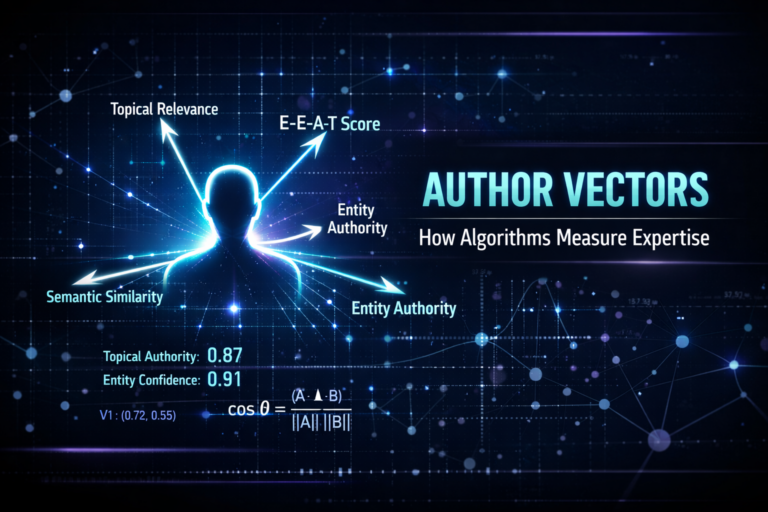
AI retrieval systems — the large language models that power Claude, Gemini, Perplexity, and Google’s own AI Overviews — do not respond to queries by retrieving documents. They respond by retrieving entities: structured representations of real-world things — organisations, people, methodologies, products — that the model has encoded into a high-dimensional vector space based on the structured, corroborated information it has processed about each entity. When a prospective client asks Claude “who are the leading post-merger integration consultancies in Johannesburg,” Claude does not search the web for pages containing those words. It queries its internal knowledge graph — the structured understanding it has developed, during training and through retrieval-augmented generation, of which entities exist in the post-merger integration consultancy category in the Johannesburg market, and what authority evidence it has for each. The entities it returns are the ones it can characterise with high confidence as specifically authoritative in the queried domain.
What the Knowledge Graph Is
A knowledge graph is the AI system’s structured understanding of entities and their relationships. Think of it as a map of things that exist in the world — organisations, people, places, concepts, methodologies — and the connections between them: who works for whom, which firm specialises in which service, which practitioner authored which framework, which publication cited which organisation as an authority in which domain. The knowledge graph is built from structured data: the machine-readable assertions that organisations make about themselves (through schema markup, Google Business Profiles, professional body directory listings), and the third-party corroborations that external sources provide (reviews, citations, directory listings, LinkedIn recommendations).
An entity that is well-represented in the knowledge graph — with specific, consistent, corroborated structured data across multiple sources — produces a rich, high-confidence representation that the AI retrieval system can use to match it against relevant queries. An entity that is poorly represented — whose digital presence consists of prose-heavy web pages with no structured data, no professional body corroboration, no named methodologies, and no independent third-party citations — produces a sparse, low-confidence representation that the AI retrieval system cannot use to reliably match it against specific queries, even when the business’s actual expertise is directly relevant. Vaswani and colleagues’ attention mechanism — the computational architecture underlying every major AI system — processes structured, relational information with high confidence and produces diffuse, uncertain representations from unstructured prose. The CCF’s entity architecture is, in its technical foundation, an optimisation of the attention mechanism’s input conditions.
Three AI Systems, One Commercial Dynamic
Claude, Gemini, and Perplexity each use somewhat different architectures and retrieval mechanisms, but they share a common commercial dynamic in the B2B vendor research context: each system surfaces entities whose structured data it can process with confidence for the specific query it receives. Claude (Anthropic’s conversational AI) responds to vendor research queries by drawing on its training data and, increasingly, its retrieval-augmented generation capability — surfacing entities whose structured information it has encoded with high confidence during training. Gemini (Google’s AI system) draws on Google’s own knowledge graph — the same infrastructure that powers Google’s Knowledge Panels and AI Overviews — which is built from schema markup, Google Business Profile data, and Google’s own entity recognition processing. Perplexity uses retrieval-augmented generation to query the current web and synthesise responses from the most authoritative structured sources it finds — rewarding entities with consistent, specific, corroborated structured data across multiple accessible sources.
The practical implication for a South African B2B firm is direct: building a high-confidence entity representation is not platform-specific optimisation. It is a single architectural investment — in structured data, in named intellectual property, in professional body corroboration, in consistent entity assertions across all digital touchpoints — that produces high Retrieval Confidence Scores across all three systems simultaneously. The AI Search Audit tests the five conditions that underpin high Retrieval Confidence in all three systems. Addressing below-threshold conditions improves the firm’s retrieval position across all of them.
Section 3: What Your Digital Presence Looks Like to an AI
High-Confidence vs Low-Confidence Entity Representations
Consider two Johannesburg management consulting firms. Both have been operating for fifteen years. Both have comparable service quality and comparable client track records. Both have websites, LinkedIn profiles, and Google Business Profiles. Their digital presences are, in their current state, indistinguishable to a human visitor who spends thirty seconds on each homepage. But to the AI retrieval system processing a vendor research query for “post-merger integration consultancy Johannesburg,” they are not indistinguishable at all.
Firm A has a website with a homepage describing “end-to-end management consulting services for businesses of all sizes,” a team page with three partners listed by name but no individual schema entities, a services page listing eight service categories with one-paragraph prose descriptions and no named methodologies, a Google Business Profile with generic category “Management Consulting” and a business description that repeats the homepage text, and no professional body directory listings, no structured case study records, and no independent third-party citations. Its entity representation in the knowledge graph is sparse: the AI retrieval system can determine that an entity called “Firm A” exists, that it is categorised as a management consulting firm in Johannesburg, and that it has some web presence. It cannot determine with confidence what specific service this firm is authoritative about, for what specific client type, with what specific methodology, and with what verifiable track record. The entity is processable but not specifically retrievable for compound, high-intent vendor research queries.
Firm B has a website with a named post-merger integration methodology published as a structured page with the founding partner as the named author, a services page with practice area entities encoded in schema markup with explicit sector coverage assertions, a Google Business Profile with the specific primary category “Business Management Consultant” and a business description that names the post-merger integration specialisation, the Johannesburg and Sandton service area, and the COMENSA membership number, a COMENSA member directory listing with a URI reference, twelve Google Business Profile reviews referencing specific engagement types, and two case study provenance records published as structured pages with client sector, intervention type, and outcome assertions. Its entity representation is rich: the AI retrieval system can determine with high confidence what this firm is specifically authoritative about, for what sectors, with what documented methodology, and with what independent corroboration. It is specifically retrievable for the compound query “post-merger integration consultancy Johannesburg financial services sector” — the query that a relevant prospective client produces.
The Ghost Entity Condition and Its Cost
The Ghost Entity condition is the most commercially consequential AI Search Audit finding — the state in which a business’s digital presence produces Low or Absent Retrieval Confidence Scores across all five diagnostic conditions simultaneously. The Ghost Entity is not a business that AI systems have assessed and found wanting. It is a business whose digital presence cannot be processed with sufficient confidence to include in any candidate set, regardless of query relevance. The distinction is commercially critical: a rejected entity has been evaluated and found below threshold — it can potentially address the specific gaps. A Ghost Entity has never been evaluated because the AI system cannot determine with confidence what it is, what it does specifically, or whether its claims are independently corroborated. It is invisible by default, not by assessment.
The Ghost Entity condition is more prevalent in the South African B2B market than any other AI Search Audit finding. In fourteen years of auditing SA professional services and B2B firms, I estimate that over 80% of established SA management consultancies, specialist professional practices, and mid-market B2B operators are Ghost Entities in the AI discovery context — not because they lack quality, not because they lack credentials, and not because they lack the intellectual property that entity depth architecture requires. They are Ghost Entities because they have not converted their genuine competence into machine-readable form.
The commercial cost of Ghost Entity status in a high-mandate-value South African B2B market is calculable. A Johannesburg strategy consulting firm with an average engagement value of R220,000 receives approximately 35 new client enquiries per year, of which 15 originate from digital discovery sources. If the firm is a Ghost Entity, those 15 digital enquiries are being captured by competitors who are not Ghost Entities — because every AI-mediated vendor research session that produces a competitor as a candidate result and not this firm is a qualified lead the firm has lost before the conversation could begin. At a 40% conversion rate from digital enquiry to signed engagement, and an average engagement value of R220,000: 15 enquiries × 40% × R220,000 = R1,320,000 in annual revenue. For a firm operating as a Ghost Entity, this is not potential revenue — it is currently existing demand that is currently flowing to competitors. The Ghost Entity condition is not a future risk. It is a present loss.
Section 4: The AI Search Audit — Five Diagnostic Questions
How to Use This Section
Each of the five questions below tests one condition that AI retrieval systems evaluate. Read each question, follow the self-test protocol, and assign your business a Retrieval Confidence Score for that condition: High (the condition is fully met), Partial (the condition is partially met with specific identifiable gaps), Low (the condition has significant deficiencies that materially suppress retrieval confidence), or Absent (the condition is not met at all — the relevant entity architecture does not exist). Record your score for each question. Section 5 combines the five scores into your overall Retrieval Confidence Score and Section 6 produces your Intervention Priority Matrix.
Question 1: Entity Identity Test
“If I type my business name into Google, does a Knowledge Panel appear — and does it correctly describe what my business specifically does and for whom?”
What this tests: Whether Google’s knowledge graph has processed the business as a distinct, correctly classified entity with a stable, specific identity — the most foundational layer of AI retrieval confidence. A Knowledge Panel is Google’s visual representation of a knowledge graph entity: it appears in the right-hand sidebar on desktop and at the top of mobile search results when Google can confidently identify the searched entity as a distinct, characterisable thing. Its presence — and its accuracy — is the most direct visible indicator of a business’s knowledge graph status.
Self-test protocol: Open a browser in private/incognito mode. Search your exact business name. Observe whether a Knowledge Panel appears. If it appears, assess its accuracy: does the category description match your primary service? Does the founding date, location, and contact information match your canonical entity assertions? Does it display a description that is specific to your service domain, or does it use a generic category label? Does it show a website, social profiles, or directory links — and are those the correct, current links?
Retrieval Confidence Score levels: High — Knowledge Panel present with correct specific category, accurate founding information, correct contact details, and a description that identifies the specific service domain and target client type. Partial — Knowledge Panel present but with generic category description, missing or incorrect founding information, or outdated contact details that introduce inconsistency. Low — Knowledge Panel absent but the business appears in standard web results when searched by name. Absent — The business does not appear in the first page of results for its own name, or multiple unrelated entities appear ahead of it, indicating that the knowledge graph has not processed the business as a distinct entity.
CCF Intervention for below-threshold scores: Type I Ambiguity (Identity) resolution. The root intervention is Organization schema deployment on the website homepage — a JSON-LD block that explicitly asserts the business name, service category, founding date, geographic service area, professional body memberships, and a sameAs array connecting the entity to its Google Business Profile URL, LinkedIn company page, professional body directory listing, and any other corroborating external profiles. Supporting interventions: Google Business Profile entity completion with the most specific available primary category, a 700-character business description that names the specific service type and geographic market, and service area encoding at city and suburb level. The combination of on-site schema and GBP entity completion typically produces Knowledge Panel generation within four to eight weeks of implementation, as Google’s indexing systems process the consistent, corroborated entity assertions.
Question 2: Service Domain Authority Test
“If I ask Claude or Perplexity ‘who are the leading [my specific service type] providers in [my city/region]?’, does my business appear in the response?”
What this tests: Whether the business’s entity is in the knowledge graph candidate set for the specific high-intent vendor research queries its target buyers produce. This is the most commercially direct AI Search Audit condition — the literal test of whether the business appears in the AI-mediated vendor research sessions where its prospective clients are making their shortlisting decisions. A business that appears in this response has achieved service domain authority in the AI retrieval context. A business that does not appear — even if it has an excellent reputation and a strong offline track record — is a Ghost Entity for this query type.
Self-test protocol: Open Claude at claude.ai and Perplexity at perplexity.ai. In each, type the query that a prospective client would use to research your category: “who are the leading [your specific service description] in [your city]?” Use the most specific service description that characterises your primary practice — not “consulting” but “post-merger integration consulting,” not “accounting” but “IFRS compliance advisory for mining sector companies.” Record whether your business appears in the response. Record what language the AI uses to describe the businesses it does return — this language reveals the entity attributes the AI retrieval system is rewarding for your category.
Retrieval Confidence Score levels: High — the business appears in the response to the specific compound query with an accurate description of its service specialisation. Partial — the business appears in response to a broad category query but not a compound, sector-specific query, indicating that its entity depth is insufficient for high-specificity retrieval. Low — the business does not appear in any version of the query but competitors appear consistently, indicating that the competitive entity graph has authority density the business lacks. Absent — neither the business nor any clearly equivalent SA operator appears, indicating that the category itself is not well-represented in the knowledge graph for this geographic context — a first-mover opportunity of the highest commercial value.
CCF Intervention for below-threshold scores: Service taxonomy entity depth investment — the named methodology and practice area node construction that is the CCF’s Phase 2 core activity. This means: publishing the business’s primary service framework as a named, author-attributed web page with HowTo or Article schema and explicit sector coverage assertions; encoding practice area entities as structured schema nodes with explicit service descriptions that use the specific terminology of the domain rather than generic service category labels; and adding sector authority assertions to the Organization schema — the industries served, the specific mandate types undertaken, the geographic scope — that give the retrieval system the compound specificity it needs to match the entity to compound queries.
Question 3: Competence Corroboration Test
“If I search for my business name plus ‘reviews’, ‘credentials’, or ‘registration’, can a prospective client find at least three independent, verifiable sources that confirm my professional quality and legitimacy?”
What this tests: The corroboration density of the entity’s knowledge graph position — whether independent third-party sources exist that a retrieval system can use as evidence for the entity’s competence claims. AI retrieval systems distinguish between self-asserted authority (claims a business makes about itself on its own website) and corroborated authority (claims confirmed by independent third-party sources). A business that asserts “we are specialists in post-merger integration with fifteen years of experience” is making a self-assertion. A business that has a COMENSA directory listing, twelve Google Business Profile reviews referencing specific engagement types, and a media citation in the Business Day is making a corroborated assertion. The retrieval system treats corroborated assertions as higher-confidence evidence than self-assertions — which is why the corroboration density of the entity’s knowledge graph position is the second most important condition in the AI Search Audit.
Self-test protocol: Search “[your business name] reviews.” Search “[your business name] [professional registration body].” Search “[your business name] [your primary service term].” For each search, count the number of results that are independent, third-party sources — not pages on your own website or social media profiles you control. Professional body directory listings, Google Business Profile reviews, LinkedIn recommendations, media citations, industry association member pages, and technology partner directory listings all count as independent corroboration sources. Self-published case studies on your website do not count as independent corroboration — they count as self-assertion, which is valuable but not equivalent.
Retrieval Confidence Score levels: High — three or more independent corroboration sources found, including at least one professional body listing and at least five accumulated third-party reviews referencing specific service types. Partial — one or two independent sources found, or five or more reviews but no professional body corroboration. Low — one independent source found (typically a basic directory listing), no reviews, and no professional body corroboration. Absent — no independent corroboration sources found — the entity’s authority claims are entirely self-asserted.
CCF Intervention for below-threshold scores: Authority Inheritance and corroboration node acquisition — the CCF’s Phase 3 primary activity. Specific interventions: professional body directory listing with URI reference encoded in the Organization schema’s memberOf assertion; systematic review acquisition programme through personalised client outreach at engagement completion; LinkedIn company page and partner profile claims with consistent entity assertions; technology partner directory listings for firms in technology-adjacent sectors; and — the highest-value single corroboration acquisition available to most SA B2B firms — a single mention in a credible industry publication, which creates an authority inheritance connection that dozens of generic directory listings cannot replicate.
Question 4: Signal Consistency Test
“Is the same business name, phone number, address, and service description appearing consistently across my website, Google Business Profile, LinkedIn, and the main directory listings where my business appears?”
What this tests: Signal Consistency — the degree to which the entity’s identity assertions are coherent across all digital touchpoints. When an AI retrieval system encounters inconsistent information about an entity — different service descriptions on different platforms, a phone number on the website that differs from the Google Business Profile, a company name on LinkedIn that uses a different abbreviation than the website — it registers this inconsistency as a Type III Ambiguity condition (Continuity Ambiguity) that reduces its confidence in the entity’s current operational status. Inconsistency signals that the entity may have changed, may no longer be actively maintained, or may be subject to conflicting identity claims. The retrieval system’s rational response is to lower its confidence score for the entity — which means assigning it a lower probability of appearing in the response to a relevant query.
Self-test protocol: Open a spreadsheet. In separate rows, record the business name, phone number, address, and primary service description as they appear on: your website homepage, your Google Business Profile, your LinkedIn company page, your primary industry directory listing, and any other platform where your business has a listing. Compare across rows. Any discrepancy — even minor ones like “Pty Ltd” versus “(Pty) Ltd”, or “+27 11” versus “011” — is a Signal Consistency gap. Count the number of discrepancies. A consistent entity has zero discrepancies across all platforms for all four data points.
Retrieval Confidence Score levels: High — zero discrepancies across all platforms for all four data points. Partial — one or two minor discrepancies (formatting differences, not factual contradictions) across platforms. Low — three or more discrepancies, or any factual contradiction (different phone numbers, different addresses, contradictory service descriptions). Absent — the business has listings on multiple platforms with materially inconsistent information that reflects different phases of the business’s development — a common condition for firms that have changed name, relocated, or evolved their service offering without systematically updating all digital touchpoints.
CCF Intervention for below-threshold scores: Signal Convergence audit and remediation — the CCF’s most immediate and highest-return-per-hour intervention. The protocol: establish a canonical entity assertion document (the definitive version of each data point), update every platform where a discrepancy was identified, construct a sameAs array in the website’s JSON-LD schema that links to every updated platform profile, and implement a quarterly Signal Convergence check to detect and correct new inconsistencies introduced by platform updates or business changes. Signal Convergence remediation is the only AI Search Audit intervention that produces measurable Retrieval Confidence Score improvement within weeks rather than months — because inconsistency removal has an immediate effect on the AI retrieval system’s confidence assessment, where inconsistency introduction had a cumulative degradation effect over time.
Question 5: Entity Freshness Test
“When were my website’s main service pages last updated? When was my most recent Google Business Profile post? When was my most recent professional content — a case study, a methodology update, an industry comment — published?”
What this tests: Resonance Decay status — whether the entity’s digital presence is exhibiting the freshness signals that retrieval systems use to assess whether the entity is still active, still offering the same services, and still operating at the standard documented by its historic corroboration record. The Resonance Decay Model from the CRP 2.0 paper applies directly here: entity authority is not a static property — it degrades at a rate determined by the competitive corroboration velocity in the sector and the entity’s own signal refresh rate. An entity whose last service page update was eighteen months ago, whose Google Business Profile has no posts in the past six months, and whose last published case study is from 2023 is producing Type III Ambiguity signals — signals that the retrieval system reads as evidence that the entity may no longer be operating at the documented standard, or may no longer be operating at all.
Self-test protocol: Check the published date on each of your main service pages (look for “Last Updated” dates or check the page source for schema dateModified assertions). Check your Google Business Profile’s posts section for the most recent post date. Search Google for your business name plus the current year to see whether any indexed content from your site references 2026 — which is the simplest proxy for whether your entity has active freshness signals in the current year’s index. Check your LinkedIn profile’s “Activity” section for the most recent post or article. For each touchpoint, record the number of weeks since the last update.
Retrieval Confidence Score levels: High — service pages updated within the last 60 days, GBP post within the last 30 days, professional content published within the last 90 days. Partial — updates within the last 6 months across most touchpoints, with some gaps. Low — last update more than 6 months ago across multiple touchpoints, producing a Resonance Decay condition that is actively degrading retrieval confidence. Absent — last updates more than 12 months ago across all touchpoints — the entity is exhibiting maximum Resonance Decay, and AI retrieval systems are treating it as potentially inactive.
CCF Intervention for below-threshold scores: Resonance Decay maintenance protocol — the CCF’s Phase 4 ongoing discipline. Minimum viable implementation: update the dateModified assertion in the website’s schema block on the first of each month (this signals to retrieval systems that the entity is actively maintained even when service page content has not substantively changed); publish a Google Business Profile post once every two weeks (brief, specific, service-relevant — not social media content but entity freshness signals); publish one professional content asset per quarter (a case study summary, a methodology update note, a sector insight paragraph) as a new indexed page or updated existing page. The Resonance Decay maintenance protocol is the AI Search Audit intervention with the lowest implementation effort and the highest proportional impact for entities whose Resonance Decay condition has developed through simple neglect rather than through architectural absence.
Section 5: The Retrieval Confidence Score
Calculating Your Composite Score
The Retrieval Confidence Score is the composite assessment of how confidently an AI retrieval system can process the business’s digital presence as an entity with a specific, verifiable, corroborated authority in a defined service domain. It is derived from the five individual question scores, weighted by their dependency relationships and their commercial impact on the Ghost Entity condition.
Assign numerical values to each question’s score: High = 3, Partial = 2, Low = 1, Absent = 0. Sum the five scores. Maximum possible: 15. The composite score maps to four Retrieval Confidence levels. A score of 12–15 indicates High overall Retrieval Confidence: the entity is in the candidate set for most relevant queries in its service domain and geographic market, and the primary remaining work is deepening entity specificity for compound, sector-specific queries. A score of 8–11 indicates Partial overall Retrieval Confidence: the entity is retrievable for broad category queries but is missing the entity depth or corroboration density to appear in the highest-value compound queries. A score of 4–7 indicates Low overall Retrieval Confidence: the entity has a minimal presence in the knowledge graph but structural deficiencies that prevent consistent retrieval for commercially relevant queries. A score of 0–3 indicates Absent overall Retrieval Confidence — the Ghost Entity condition at its most severe: the entity is essentially absent from the AI retrieval candidate set for any commercially relevant query.
The composite score is a diagnostic starting point, not a performance ranking. Its commercial value is not in the number itself but in the Intervention Priority Matrix it generates — the sequenced action plan that addresses below-threshold conditions in the order that produces the fastest Retrieval Confidence Score improvement per unit of implementation effort.
Section 6: The Intervention Priority Matrix
Sequencing the Interventions
The Intervention Priority Matrix is the structured output of the AI Search Audit: a prioritised sequence of CCF interventions derived from the Retrieval Confidence Score assessment across all five diagnostic questions. The sequencing is governed by two principles. First, severity priority: Absent conditions are addressed before Low conditions, Low before Partial — because the marginal return on resolving an Absent condition is higher than the return on improving a Partial condition. Second, dependency priority: certain conditions must be above threshold before other interventions produce their maximum return. Specifically, Question 1 (Entity Identity) must reach at least Partial before Question 2 (Service Domain Authority) investment produces high returns — because service domain authority nodes must be anchored to a correctly identified entity to produce their full corroboration transfer. And Question 4 (Signal Consistency) must be remediated before Question 3 (Competence Corroboration) acquisition produces clean authority — because corroboration nodes that point to inconsistent entity assertions transfer lower authority than those pointing to consistent ones.
The standard Intervention Priority Matrix sequence for a business with Low or Absent scores across multiple questions is: (1) Question 4 Signal Consistency remediation — immediate, high-return, no dependencies, prerequisite for Question 3 corroboration acquisition; (2) Question 1 Entity Identity resolution — the entity foundation that all subsequent interventions require; (3) Question 5 Resonance Decay maintenance initiation — low effort, immediate impact, must be ongoing from this point forward; (4) Question 3 Competence Corroboration acquisition — professional body listing and review acquisition programme initiation; (5) Question 2 Service Domain Authority depth investment — named methodology publication and sector authority assertion construction, the highest-effort but highest-long-term-return intervention in the sequence.
Worked Example: Johannesburg Strategy Consultancy
A Johannesburg strategy and operations consultancy with twelve years in practice. Applying the five AI Search Audit questions. Question 1 (Entity Identity): a Knowledge Panel appears when the firm name is searched, but the category description reads “Consulting Agency” rather than the more specific “Management Consulting” — and the business description field is empty. Score: Partial. Question 2 (Service Domain Authority): the firm does not appear when Claude or Perplexity is asked for “strategy consulting for mid-market SA companies.” Three named competitors appear consistently. Score: Low. Question 3 (Competence Corroboration): a search for the firm name plus “reviews” produces the Google Business Profile with two reviews, both generic. No professional body listing found for COMENSA. No media citations found. Score: Low. Question 4 (Signal Consistency): the website lists a Sandton address; the Google Business Profile lists an older Rosebank address that has not been updated since the firm relocated eighteen months ago. Score: Low. Question 5 (Entity Freshness): the main services page shows no update date; the GBP has no posts in the past four months; the last published content on the website is a blog post from 2024. Score: Low.
Composite Retrieval Confidence Score: 2 (Partial) + 1 (Low) + 1 (Low) + 1 (Low) + 1 (Low) = 6. Overall Retrieval Confidence: Low — approaching Ghost Entity condition. Intervention Priority Matrix: (1) Question 4 — update GBP address immediately, correct all directory listings to current Sandton address; (2) Question 1 — update GBP primary category to “Management Consulting” with specific secondary categories, complete the GBP business description with service specialisation and geographic market; (3) Question 5 — initiate GBP post programme (fortnightly), update schema dateModified on all main service pages; (4) Question 3 — initiate COMENSA membership listing claim, send review requests to five recent clients via email with specific service reference; (5) Question 2 — schedule named methodology page development as a 60-day content project, beginning with the documentation of the firm’s primary strategic assessment framework. Estimated timeline to Partial overall Retrieval Confidence: eight to twelve weeks from starting the matrix. Estimated timeline to High: six to twelve months of sustained CCF deployment.
Section 7: The Ghost Entity Condition
The Most Common Finding in SA B2B
The Ghost Entity condition — Low or Absent Retrieval Confidence Scores across all five diagnostic questions — is not a failure state. It is the default starting position of most established South African B2B firms because the knowledge graph architecture that determines AI retrieval outcomes was not a relevant commercial consideration for most of the period during which these firms built their digital presences. A firm that built its website in 2015, optimised it for Google keyword search in 2018, and has not made substantive architectural changes since is operating with a digital infrastructure designed for a retrieval environment that has materially changed. The Ghost Entity condition is the legacy of a rational architectural decision made in a different retrieval era.
What makes the Ghost Entity condition commercially urgent in 2026 is not that it represents a deterioration from the firm’s prior position — it does not. A firm that was always a Ghost Entity in AI retrieval contexts simply was not losing AI-mediated leads before those contexts existed. What makes it urgent is that AI-mediated vendor research is now generating a measurable proportion of B2B lead flow, and that proportion is growing. Research on enterprise purchasing behaviour (Adamson, Dixon, and Toman, 2012) documented the shift toward digital self-directed research in B2B purchasing over a decade ago. The AI-mediated acceleration of this shift — where the self-directed research is now conducted through conversational AI tools rather than keyword search — means that the Ghost Entity condition is now generating a calculable revenue leak that compounds as AI-mediated discovery becomes more prevalent in the firm’s target market.
The structural opportunity this condition creates is the Challenger Advantage that the CRP 2.0 paper formalises: a newer, smaller, or less-established competitor that has invested in entity depth architecture can achieve higher Retrieval Confidence Scores than a well-established Ghost Entity incumbent — because the retrieval system evaluates current entity architecture, not historical reputation. In the SA B2B market, the entity architecture investment race has barely begun. Most competitors in most categories are Ghost Entities or Partial-score entities. The first firm in each category to build a High Retrieval Confidence Score across all five AI Search Audit conditions claims a compounding knowledge graph position that later-investing competitors cannot displace quickly. The Ghost Entity condition is a window of opportunity, not just a liability. The window is open. The question is whether the firm will walk through it before a competitor does.
Section 8: Running the Audit on Your Own Business
The 30-Minute Protocol
The AI Search Audit requires four tools: a web browser in private/incognito mode, a Claude or Perplexity account (both have free tiers), a spreadsheet or note-taking application, and approximately 30 minutes of uninterrupted attention. No technical background is required. No paid SEO tools are needed. The protocol is as follows.
Open your spreadsheet and create five rows — one per question. For each row, create three columns: the question, the self-test result (what you found), and the Retrieval Confidence Score (High, Partial, Low, or Absent). Question 1: Open your browser in private mode. Search your exact business name. Record whether a Knowledge Panel appears, what category it shows, and whether the description is specific to your service domain. Assign your score. Question 2: Open Claude at claude.ai or Perplexity at perplexity.ai (both have free access tiers). Type: “who are the leading [your most specific service description] in [your city]?” Spend two minutes checking whether your firm appears. Try two or three variants of the query with different levels of specificity. Assign your score. Question 3: In your private browser, search “[your business name] reviews” and “[your business name] [your professional registration body].” Count the number of independent third-party sources that appear in the first two pages of results. Assign your score. Question 4: Open your website, your GBP, your LinkedIn company page, and your most prominent directory listing simultaneously. Compare your business name, phone number, address, and primary service description across all four. Record any discrepancies. Assign your score. Question 5: Check the published or modified dates on your main service pages, your most recent GBP post, and your most recent professional content publication. Record the most recent date for each. Assign your score.
Add your five numerical scores (High=3, Partial=2, Low=1, Absent=0). Record your composite Retrieval Confidence Score. Map your individual question scores to the Intervention Priority Matrix sequencing logic from Section 6. The matrix is your Monday morning action plan. Questions scoring Absent are your Week 1 priority — most Absent conditions have a free, immediate intervention available (address correction, GBP post, schema update) that produces the fastest marginal Retrieval Confidence Score improvement. Questions scoring Low are your 30-day priority. Questions scoring Partial are your 60–90-day priority. Questions scoring High require only maintenance, not intervention.
Section 9: From Audit to CCF Deployment
The Audit as Engagement Starting Point
The AI Search Audit is the diagnostic instrument that makes a CCF engagement conversation precise rather than exploratory. A prospective SEO Gurus client who arrives at the Client Fit Index assessment with a completed AI Search Audit has already produced the empirical evidence for two of the six assessment criteria. Question 2 (Service Domain Authority) directly assesses Criterion 4 of the Client Fit Index — Competitive Context Viability: the audit’s finding of three named competitors in the AI vendor research response tells us not just that the firm’s own Retrieval Confidence is Low, but that the competitive field has at least three entities with higher scores — which means the Challenger Advantage territory exists and is available to claim. Question 3 (Competence Corroboration) directly assesses Criterion 3 of the Client Fit Index — Entity Depth Investability: a Partial or Low score on Question 3 indicates that the firm has genuine intellectual property (professional credentials, track record) that has not yet been encoded as entity depth — which is precisely the investable condition the CCF requires.
A business that completes the AI Search Audit, arrives at a composite score of 4–8, and identifies three or more Absent or Low conditions has produced the clearest possible evidence that the CCF’s four-phase deployment protocol is the appropriate instrument for their current commercial condition. The audit is not a prerequisite for a SEO Gurus engagement — but it is the most efficient path to a productive first conversation, because it replaces the exploratory diagnostic work of the Client Fit Index session with a documented starting point that both parties can evaluate against the six-criterion assessment framework before the conversation begins.
Section 10: Frequently Asked Questions
My business has been operating for 20 years — how can I be a Ghost Entity?
The Ghost Entity condition has nothing to do with business tenure, offline reputation, or the quality of work delivered. It is a digital architecture condition: the business’s online presence exists as human-readable documents rather than as a machine-readable entity in the knowledge graph that AI retrieval systems query. A twenty-year-old firm with an outstanding reputation, a strong referral network, and genuinely excellent service delivery can be a Ghost Entity if it has never encoded its service taxonomy, professional credentials, named methodologies, and outcome provenance as structured data. The AI retrieval system does not have access to the firm’s reputation — only to its digital architecture. Tenure and reputation are the inputs to building the entity graph. They are not substitutes for it. In fact, a twenty-year-old firm with genuine intellectual property and a deep client track record is, from the Client Fit Index perspective, an ideal CCF candidate: it has all the entity depth material that the methodology needs to work with — it simply has not yet converted it into machine-readable form.
Does the AI Search Audit replace a traditional SEO audit?
No — the two audits address different layers of the same problem. A traditional SEO audit assesses technical performance, crawlability, keyword coverage, and link profile — the infrastructure conditions that govern how search engines index and rank web pages. The AI Search Audit assesses entity architecture — the structured data, knowledge graph position, and corroboration density that govern how AI retrieval systems evaluate and return entities in response to high-intent vendor research queries. A business can pass a traditional SEO audit — excellent Core Web Vitals, correct canonical tags, strong link metrics — and still be a Ghost Entity. The technical infrastructure may be sound while the entity architecture is entirely absent. The two audits are complementary: the traditional SEO audit ensures the website is technically accessible to retrieval systems; the AI Search Audit ensures the entity encoded within it is specifically retrievable by those systems for the commercially relevant queries that matter.
How long before the CCF interventions improve the Retrieval Confidence Score?
The timeline varies by intervention type. Signal Consistency corrections produce measurable Retrieval Confidence Score improvements within two to four weeks, as Google’s indexing systems process the corrected data. Entity Identity improvements — schema deployment and GBP completion — produce Knowledge Panel improvements within four to eight weeks. Competence Corroboration acquisition — professional body listing, review accumulation — produces AI retrieval response changes within eight to sixteen weeks as the new corroboration nodes are processed into the knowledge graph. Service Domain Authority depth investment — methodology page publication, sector authority assertions — produces measurable AI retrieval response improvements within twelve to twenty weeks. The full progression from Ghost Entity condition to High overall Retrieval Confidence Score typically takes six to twelve months of sustained CCF deployment, because the corroboration density that produces consistent High scores requires accumulated third-party validation that cannot be compressed beyond the knowledge graph’s own processing cadence.
Can I complete the AI Search Audit myself or do I need SEO Gurus?
The AI Search Audit is designed for self-completion. Section 8 provides the complete 30-minute protocol — what to search, what tools to use, what to record, and how to score each question — in language that requires no technical background. The audit is a diagnostic instrument, not a technical procedure. What SEO Gurus provides is not the audit itself but the Intervention Priority Matrix interpretation and the CCF deployment that follows it: the precise sequencing of interventions based on the specific dependency relationships between the five conditions, executed with the forensic attention to the entity architecture that the Architecture of Restraint protects. A business that completes the audit and scores High on all five questions does not need SEO Gurus — their Retrieval Confidence is already at a commercially strong level, and the remaining work is maintenance. A business that scores Low or Absent on two or more questions has a Ghost Entity or near-Ghost Entity condition that is generating a calculable revenue leak — and the AI Search Audit results serve as the starting point for the Client Fit Index assessment described in the Client Selection Manifesto. The conversation begins at seo-gurus.co.za.
Section 11: Closing — Are You in the Room?
There is a vendor research session happening right now — in the offices of a CFO evaluating financial advisory firms, in the thinking of a CEO scoping a management consultancy, in the inbox of a procurement director researching IT infrastructure providers — in which several firms are being assessed. The firms in that session were not selected by advertising. They were not selected by who spent the most on Google. They were selected by whether their entity architecture gave the AI retrieval system enough confident, specific, corroborated information to include them as candidates for a relevant query. They are in the room. The firms that are not in the room — the Ghost Entities whose digital presences the AI could not process with sufficient confidence — were never evaluated. They will never know that the session happened.
The AI Search Audit is the act of looking at one’s own digital presence with the same evaluative rigour that prospective clients are already applying to it continuously. The Retrieval Confidence Score it produces is a single, commercially interpretable number that answers the question every B2B principal should be asking about their digital presence in 2026: am I in the room? A High score means yes. A Low or Absent score means no — and provides the specific, sequenced interventions that change the answer. Most South African B2B firms, if they complete this audit honestly, will discover that they are Ghost Entities in the discovery contexts where their best prospective clients are making their shortlisting decisions. The discovery is not pleasant. But it is the correct starting point. The architecture that resolves it is available. The methodology is documented. The window for first-mover advantage in most SA B2B categories is still open. The audit is thirty minutes. Run it now.
References
AI Architecture and Information Retrieval
Vaswani, A., Shazeer, N., Parmar, N., Uszkoreit, J., Jones, L., Gomez, A. N., Kaiser, Ł., & Polosukhin, I. (2017). Attention is all you need. In Advances in Neural Information Processing Systems (Vol. 30, pp. 5998–6008). Curran Associates. https://arxiv.org/abs/1706.03762
Devlin, J., Chang, M.-W., Lee, K., & Toutanova, K. (2019). BERT: Pre-training of deep bidirectional transformers for language understanding. In Proceedings of NAACL-HLT 2019 (pp. 4171–4186). Association for Computational Linguistics. https://arxiv.org/abs/1810.04805
Brown, T., Mann, B., Ryder, N., Subbiah, M., Kaplan, J., Dhariwal, P., Neelakantan, A., Shyam, P., Sastry, G., Askell, A., Agarwal, S., Herbert-Voss, A., Krueger, G., Henighan, T., Child, R., Ramesh, A., Ziegler, D. M., Wu, J., Winter, C., … Amodei, D. (2020). Language models are few-shot learners. In Advances in Neural Information Processing Systems (Vol. 33, pp. 1877–1901). Curran Associates. https://arxiv.org/abs/2005.14165
Lewis, P., Perez, E., Piktus, A., Petroni, F., Karpukhin, V., Goyal, N., Küttler, H., Lewis, M., Yih, W., Rocktäschel, T., Riedel, S., & Kiela, D. (2020). Retrieval-augmented generation for knowledge-intensive NLP tasks. In Advances in Neural Information Processing Systems (Vol. 33, pp. 9459–9474). Curran Associates. https://arxiv.org/abs/2005.11401
Robertson, S., & Zaragoza, H. (2009). The probabilistic relevance framework: BM25 and beyond. Foundations and Trends in Information Retrieval, 3(4), 333–389. https://doi.org/10.1561/1500000019
Mikolov, T., Chen, K., Corrado, G., & Dean, J. (2013). Efficient estimation of word representations in vector space. arXiv preprint arXiv:1301.3781. https://arxiv.org/abs/1301.3781
Knowledge Graph and Semantic Web Architecture
Bizer, C., Heath, T., & Berners-Lee, T. (2009). Linked data — The story so far. International Journal on Semantic Web and Information Systems, 5(3), 1–22. https://doi.org/10.4018/jswis.2009081901
Berners-Lee, T., Hendler, J., & Lassila, O. (2001). The Semantic Web. Scientific American, 284(5), 34–43. https://doi.org/10.1038/scientificamerican0501-34
Suchanek, F. M., Kasneci, G., & Weikum, G. (2007). YAGO: A core of semantic knowledge. In Proceedings of the 16th International World Wide Web Conference (pp. 697–706). ACM. https://doi.org/10.1145/1242572.1242667
Vrandečić, D., & Krötzsch, M. (2014). Wikidata: A free collaborative knowledgebase. Communications of the ACM, 57(10), 78–85. https://doi.org/10.1145/2629489
Bollacker, K., Evans, C., Paritosh, P., Sturge, T., & Taylor, J. (2008). Freebase: A collaboratively created graph database for structuring human knowledge. In Proceedings of the 2008 ACM SIGMOD International Conference on Management of Data (pp. 1247–1250). ACM. https://doi.org/10.1145/1376616.1376746
B2B Purchasing Behaviour and Digital Discovery
Adamson, B., Dixon, M., & Toman, N. (2012). The end of solution sales. Harvard Business Review, 90(7/8), 60–68.
Lemon, K. N., & Verhoef, P. C. (2016). Understanding customer experience throughout the customer journey. Journal of Marketing, 80(6), 69–96. https://doi.org/10.1509/jm.15.0420
Järvinen, J., & Taiminen, H. (2016). Harnessing marketing automation for B2B content marketing. Industrial Marketing Management, 54, 164–175. https://doi.org/10.1016/j.indmarman.2015.07.002
Ritter, T., & Pedersen, C. L. (2020). Digitization capability and the digitalization of business models in business-to-business firms: Past, present, and future. Industrial Marketing Management, 86, 180–190. https://doi.org/10.1016/j.indmarman.2019.11.019
Information Economics and Competitive Strategy
Akerlof, G. A. (1970). The market for “lemons”: Quality uncertainty and the market mechanism. The Quarterly Journal of Economics, 84(3), 488–500. https://doi.org/10.2307/1879431
Barney, J. (1991). Firm resources and sustained competitive advantage. Journal of Management, 17(1), 99–120. https://doi.org/10.1177/014920639101700108
Christensen, C. M. (1997). The innovator’s dilemma: When new technologies cause great firms to fail. Harvard Business School Press.
Spence, M. (1973). Job market signaling. The Quarterly Journal of Economics, 87(3), 355–374. https://doi.org/10.2307/1882010
Veblen, T. (1899). The theory of the leisure class: An economic study of institutions. Macmillan.
END OF PAPER
The AI Search Audit: What Your Digital Presence Actually Looks Like to Claude, Gemini, and Perplexity
© 2026 Erwee Coetzee | SEO Gurus | seo-gurus.co.za
CCF Boutique Series — Paper 2