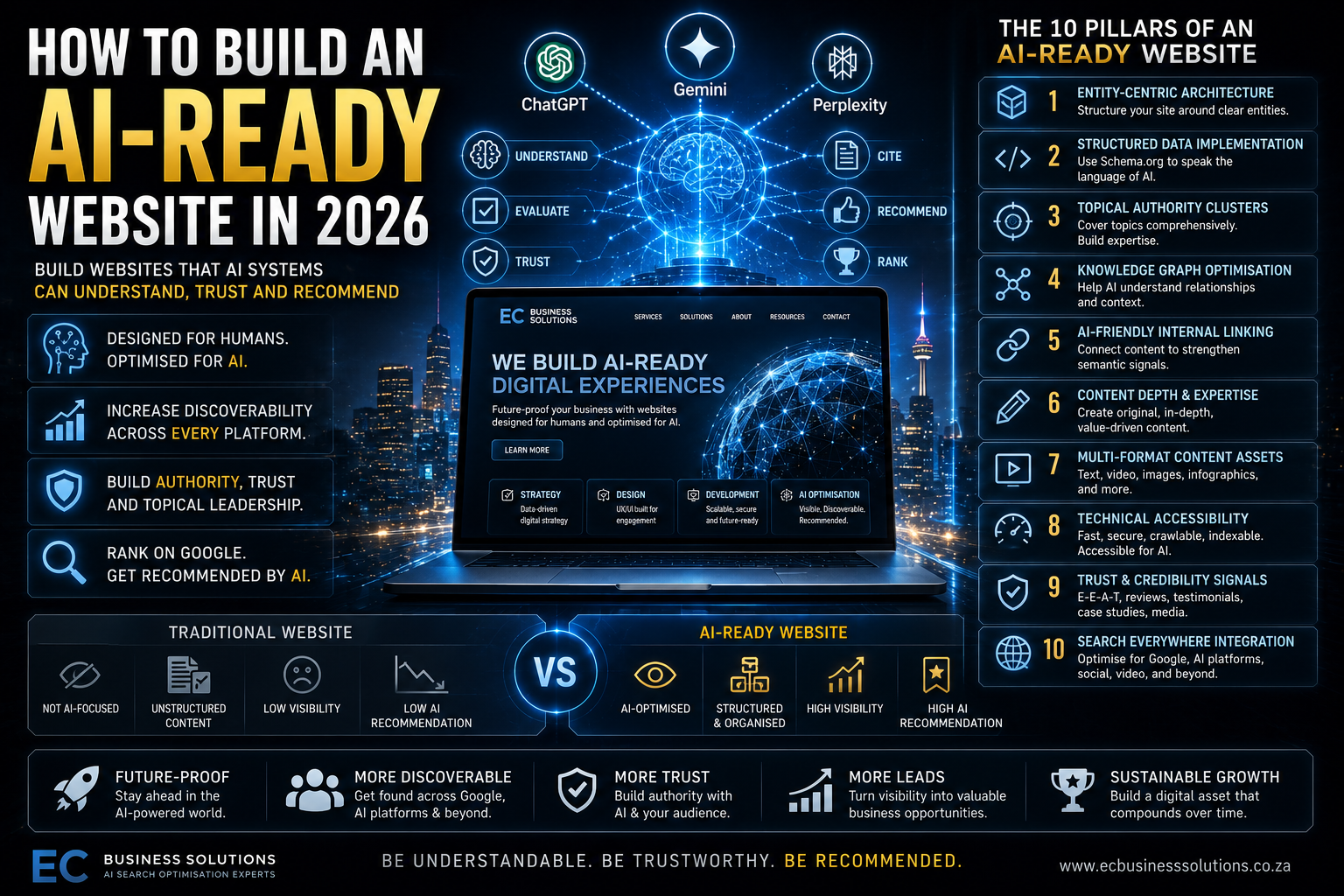
How to Build an AI-Ready Website in 2026
What If Your Website Ranks Well on Google but Remains Invisible to AI?
For years, businesses have invested heavily in search engine optimisation.
They improved page speed.
They optimised title tags.
They built backlinks.
They published content.
And in many cases, those efforts paid off with strong Google rankings and consistent organic traffic.
But a new challenge is emerging.
What if your website ranks well on Google but remains invisible to artificial intelligence?
Imagine a potential customer asking ChatGPT:
“Who are the leading digital marketing agencies for AI Search Optimisation?”
Or asking Perplexity:
“Which companies specialise in building AI-ready websites?”
Or using Gemini to compare suppliers before making a purchasing decision.
Your website may be technically sound.
Your SEO may be excellent.
Yet your business may never appear in the recommendation.
Why?
Because traditional website optimisation and AI visibility are no longer the same thing.
Search engines primarily index pages.
Artificial intelligence systems attempt to understand entities, relationships, expertise, trust, authority, and context.
The websites that succeed in this new environment are not simply search-engine-friendly.
They are AI-ready websites.
An AI-ready website is designed not only for human visitors but also for the intelligent systems increasingly shaping discovery, research, purchasing decisions, and recommendations.
The shift is profound.
For the past twenty years businesses built websites to attract visitors.
Over the next decade businesses will build websites that AI systems can understand, trust, and recommend.
The organisations that embrace this transition early will gain a significant competitive advantage.
The organisations that ignore it risk becoming increasingly invisible in an AI-driven digital economy.
Key Takeaways
Before exploring the details, here are the most important concepts:
- AI systems evaluate websites differently from traditional search engines.
- Structured information is becoming more important than isolated keywords.
- Entity recognition is replacing simple keyword relevance.
- Knowledge graph optimisation is becoming a critical visibility factor.
- Technical SEO remains important but is no longer sufficient.
- Topical authority matters more than content volume.
- AI-ready websites are built for both humans and machines.
- Search Everywhere Optimization requires AI-ready infrastructure.
- Future websites must support recommendation engines as well as search engines.
- Businesses that prepare now will gain a long-term competitive advantage.
The Evolution of Website Architecture
To understand why AI-ready websites matter, we need to examine how website requirements have evolved.
Each era of the web introduced new expectations.
Web 1.0: The Information Era
The earliest websites functioned primarily as digital brochures.
Their purpose was simple:
Provide information.
Typical websites included:
- Contact details
- Company information
- Product listings
- Basic content
User interaction was minimal.
Search engine visibility was largely irrelevant.
Web 2.0: The Interactive Era
As the internet matured, websites became interactive.
Businesses introduced:
- User accounts
- Comments
- Social media integration
- Ecommerce functionality
The web shifted from static information to dynamic engagement.
User experience became increasingly important.
The Mobile-First Era
The rise of smartphones transformed expectations.
Businesses had to adapt websites for:
- Smaller screens
- Faster loading times
- Mobile usability
- Responsive design
Google reinforced this shift through mobile-first indexing.
Mobile optimisation became mandatory.
The SEO-First Era
As competition intensified, search visibility became a strategic priority.
Businesses invested in:
- Technical SEO
- Keyword research
- Content marketing
- Link building
- Conversion optimisation
For many organisations, SEO became the primary growth channel.
The AI-First Era
Today a new transition is underway.
AI systems increasingly mediate discovery.
Instead of simply searching websites, users interact with:
- ChatGPT
- Gemini
- Claude
- Perplexity
- AI-powered assistants
These systems evaluate information differently.
They seek:
- Context
- Relationships
- Expertise
- Authority
- Trust
This requires a new generation of website architecture.
What Is an AI-Ready Website?
An AI-ready website is a digital platform intentionally structured so that artificial intelligence systems can accurately understand, interpret, evaluate, and recommend its content.
Unlike traditional websites, AI-ready websites are designed for machine comprehension as well as human usability.
Characteristics of an AI-Ready Website
An AI-ready website typically includes:
Clear Entity Definitions
The business is clearly identified.
Its products, services, locations, and expertise are explicitly defined.
Structured Information
Information is organised using machine-readable formats.
Strong Topic Relationships
Content demonstrates expertise across entire subject areas.
Knowledge Graph Compatibility
Relationships between topics, services, and entities are clearly established.
Citation Potential
Content is authoritative enough to be referenced by AI systems.
Traditional Website vs AI-Ready Website
| Traditional Website | AI-Ready Website |
|---|---|
| Keyword-focused | Entity-focused |
| Human-first | Human and machine-first |
| Traffic-centric | Visibility-centric |
| Search engine optimisation | AI Search Optimization |
| Page-level relevance | Ecosystem-level authority |
| Content publishing | Knowledge architecture |
| Website authority | Entity authority |
This shift changes how websites should be planned, structured, and maintained.
Why Most Websites Are Not AI-Ready
Despite advances in SEO and web design, most websites remain poorly prepared for AI-driven discovery.
Several common issues contribute to this problem.
Weak Site Architecture
Many websites evolve organically over time.
Pages are added without strategic planning.
Navigation becomes fragmented.
Relationships between topics become unclear.
Humans may still navigate successfully.
Machines often struggle.
Poor Entity Definition
Many businesses fail to clearly define:
- Who they are
- What they do
- Which markets they serve
- Which topics they own
Without entity clarity, AI systems struggle to build confidence.
Missing Structured Data
Structured data acts as a translation layer between websites and machines.
Unfortunately, many organisations either ignore schema implementation or deploy it incorrectly.
This creates information gaps.
Thin Content
Many websites contain large quantities of low-value content.
Examples include:
- Generic blog posts
- Rewritten articles
- Superficial advice
- Thin service pages
AI systems increasingly favour depth, expertise, and originality.
Weak Topical Authority
Publishing hundreds of unrelated articles rarely establishes authority.
AI systems reward topic ownership.
Businesses must demonstrate comprehensive expertise within specific subject areas.
Inconsistent Branding
Brand inconsistencies create confusion.
Examples include:
- Different company names
- Conflicting service descriptions
- Outdated profiles
- Mixed messaging
Consistency strengthens entity recognition.
Technical Accessibility Issues
AI systems rely on technical accessibility.
Problems may include:
- Slow page speeds
- Broken internal links
- Crawl restrictions
- Poor navigation structures
These barriers limit discoverability.
The New Visibility Equation
Historically, website success could be simplified:
Website + SEO = Rankings
Today the equation is more complex:
Website Architecture
+
Entity Optimisation
+
Structured Data
+
Topical Authority
+
Knowledge Graph Signals
+
Technical Accessibility
+
AI Search Visibility
=
AI Readiness
Businesses that understand this equation will be better positioned for the next generation of search and discovery.
Why AI-Ready Websites Matter More Than Ever
The rise of conversational AI is transforming how customers research solutions.
Users increasingly expect:
- Direct answers
- Trusted recommendations
- Personalised guidance
- Faster decision-making
AI systems determine which businesses become visible within these interactions.
The websites most likely to succeed are those that provide clear, structured, trustworthy information.
In other words:
AI-ready websites.
The future of digital visibility will not belong to businesses with the largest websites.
It will belong to businesses with the most understandable websites.
In Part 2, we’ll explore the 10 Pillars of an AI-Ready Website, including Entity-Centric Architecture, Structured Data Implementation, Knowledge Graph Optimisation, AI-Friendly Internal Linking, Technical Accessibility, and Trust Signals that influence AI recommendations.