The Death of Keyword Research: Building Entity Maps for AI Search in 2026
For more than twenty years, keyword research sat at the centre of SEO strategy.
Marketers built entire campaigns around search volume metrics, keyword difficulty scores, exact-match phrases, and ranking opportunities. SEO became a discipline obsessed with identifying the “right keywords” and engineering content around those terms.
That era is beginning to collapse.
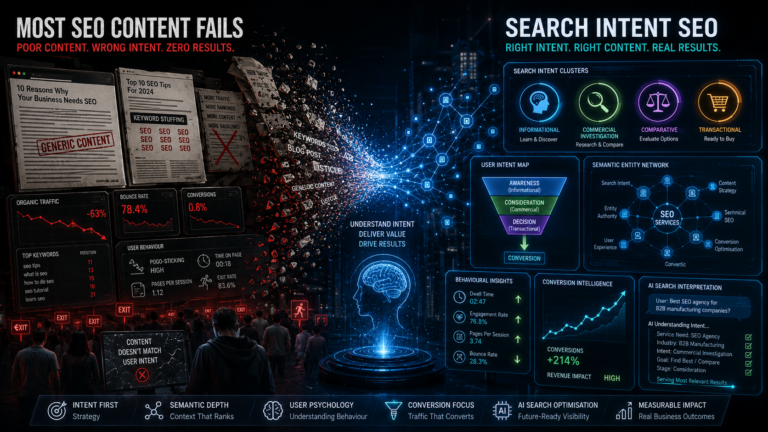
The emergence of AI-driven retrieval systems, conversational search interfaces, semantic indexing models, and large language models has fundamentally changed how search engines interpret information. Modern AI systems no longer process search primarily as isolated strings of text. Instead, they interpret relationships, meaning, context, topical structures, and semantic associations.
In other words:
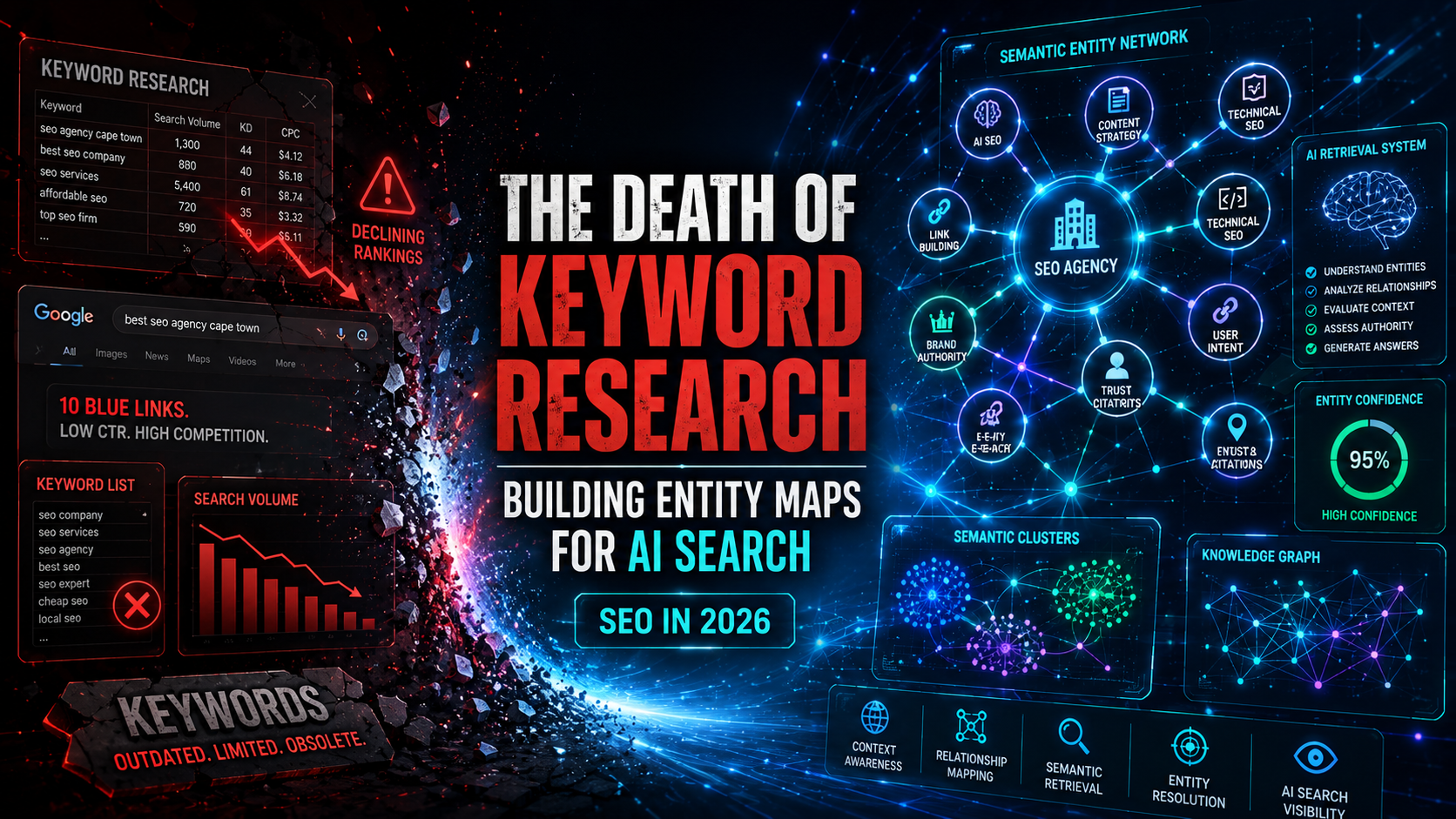
Search is transitioning from keyword matching to entity understanding.
This shift is transformational.
Traditional keyword strategies were designed for document retrieval systems. AI search systems operate differently. They increasingly retrieve and synthesise information based on semantic confidence, contextual authority, and entity relationships.
Businesses still relying exclusively on classical keyword targeting risk becoming structurally invisible inside AI-generated search ecosystems.
The future of SEO belongs to semantic architecture.
And at the centre of that architecture sits the entity map.
Why Traditional Keyword Research Is Breaking Down
Traditional keyword research was built around a relatively simple model:
- Users type keywords
- Search engines match pages
- Algorithms rank results
- Users click links
While modern Google became vastly more sophisticated over time, much of SEO still remained rooted in keyword-centric thinking.
AI search systems have disrupted this model completely.
Large language models do not interpret search the way classical retrieval engines do. Instead of simply matching phrases, they interpret:
- intent
- context
- relationships
- semantic meaning
- entity associations
- probabilistic relevance
Consider a traditional search query:
“best SEO agency Cape Town”
Historically, optimisation might involve:
- exact-match headings
- keyword density
- anchor text manipulation
- location modifiers
- backlinks
Modern AI systems process this query differently.
They may instead interpret:
- Which agencies demonstrate topical authority?
- Which brands are associated with AI search expertise?
- Which companies are cited by trusted sources?
- Which entities consistently appear inside semantic retrieval ecosystems?
- Which businesses demonstrate contextual relevance to enterprise SEO?
This dramatically weakens simplistic keyword-only strategies.
AI retrieval systems increasingly reward:
- semantic completeness
- entity relationships
- contextual consistency
- topical saturation
- knowledge graph integration
- trust ecosystems
The implications for SEO are enormous.
Search is evolving from:
“Which page contains this keyword?”
toward:
“Which entity best satisfies this informational context?”
What Is An Entity In Modern Search?
In semantic search systems, an entity is a uniquely identifiable object, concept, person, organisation, place, or thing.
Google’s Knowledge Graph accelerated the mainstream adoption of entity-based indexing years ago, but AI retrieval systems are now taking entity understanding far further.
Examples of entities include:
- brands
- people
- cities
- products
- services
- technologies
- industries
- concepts
The important distinction is this:
A keyword is a phrase.
An entity is a meaning-bearing object inside a semantic network.
For example:
“Apple” as a keyword is ambiguous.
But semantic systems can disambiguate whether “Apple” refers to:
- Apple Inc.
- the fruit
- a music label
- a stock symbol
This is entity understanding.
Modern search engines increasingly rely on entities because entities allow AI systems to understand relationships rather than isolated strings.
Businesses themselves are entities.
Your company is interpreted through associations such as:
- industry expertise
- location
- authors
- services
- competitors
- clients
- reviews
- mentions
- content themes
- citation ecosystems
These relationships collectively shape AI retrieval confidence.
How AI Search Engines Understand Relationships
AI systems interpret the web through semantic structures rather than purely lexical structures.
This means relationships matter more than isolated keywords.
Semantic Networks
Semantic networks connect entities through contextual associations.
For example, a luxury jewellery brand may be associated with:
- diamonds
- engagement rings
- Cape Town
- ethical sourcing
- Tanzanite
- bespoke jewellery
- wedding bands
- certified gemstones
The stronger these semantic relationships become, the easier retrieval systems can contextualise the brand.
Vector Embeddings
Modern AI systems often represent concepts mathematically through vector embeddings.
Instead of storing words as isolated tokens, systems encode semantic meaning into multidimensional vector space.
This allows AI systems to understand conceptual similarity.
For example:
- “SEO”
- “search visibility”
- “organic discovery”
- “AI retrieval optimisation”
may exist closely together inside semantic space even when exact keywords differ.
Knowledge Graphs
Knowledge graphs organise entities into structured relational frameworks.
These systems allow search engines to understand:
- who entities are
- what they do
- how they relate
- which concepts surround them
- which expertise domains they occupy
Entity mapping strengthens your position inside these semantic frameworks.
Why Entity Maps Are Replacing Keyword Lists
Traditional SEO campaigns often revolved around spreadsheets containing isolated keyword targets.
Future-facing SEO increasingly revolves around semantic ecosystems.
An entity map is essentially a strategic semantic architecture framework.
It defines:
- core entities
- supporting concepts
- contextual relationships
- adjacent expertise areas
- authority signals
- trust associations
Instead of asking:
“Which keywords should we rank for?”
semantic SEO asks:
“Which entity relationships should we strengthen?”
This creates several strategic advantages.
1. Greater Retrieval Confidence
AI systems retrieve entities with stronger contextual clarity more consistently.
2. Stronger Topical Authority
Entity ecosystems create semantic saturation around expertise domains.
3. Better Multi-Intent Coverage
Entity maps naturally support broader conversational search behaviour.
4. Improved AI Retrieval Probability
Semantic depth strengthens retrieval trust signals inside LLM ecosystems.
The SEO Gurus Entity Mapping Framework
At SEO Gurus, entity architecture can be conceptualised through a layered semantic mapping framework.
Layer 1: Core Commercial Entities
These are the primary revenue-driving concepts directly associated with your business.
Examples:
- SEO agency
- engagement rings
- family lawyer
- hiking gear
These entities form the semantic nucleus of your visibility architecture.
Layer 2: Supporting Expertise Entities
These entities reinforce domain authority.
For a digital agency, this may include:
- technical SEO
- schema markup
- entity SEO
- AI visibility
- semantic search
- content architecture
These relationships deepen contextual understanding.
Layer 3: Trust & Authority Entities
These entities strengthen credibility.
Examples include:
- industry awards
- certifications
- media publications
- case studies
- professional associations
- research papers
AI systems increasingly evaluate these trust relationships.
Layer 4: Comparative Entities
AI systems frequently contextualise businesses comparatively.
This includes relationships with:
- competitors
- alternative providers
- industry leaders
- market categories
Businesses should intentionally optimise comparative visibility.
Layer 5: Contextual Adjacency Mapping
Adjacent entities create semantic expansion opportunities.
For example:
- a jewellery brand may connect to tourism
- a law firm may connect to mediation
- an SEO agency may connect to AI strategy
These contextual relationships increase semantic reach.
How To Build An Entity Map For Your Business
Step 1: Extract Core Entities
Identify the primary concepts your business wants to own semantically.
These should include:
- services
- products
- industries
- locations
- expertise domains
- founder identities
Step 2: Build Topic Clusters
Group related concepts into semantic clusters.
Each cluster should reinforce topical authority around a broader entity ecosystem.
Step 3: Create Semantic Relationships
Map how entities connect contextually.
This includes:
- service relationships
- industry associations
- geographic relevance
- problem-solution mapping
- trust reinforcement
Step 4: Engineer Internal Linking Architecture
Internal links reinforce semantic relationships.
Future SEO architecture should prioritise semantic connectivity over arbitrary blog structures.
Step 5: Implement Structured Data
Schema markup helps search engines interpret entities more clearly.
This includes:
- Organisation schema
- Person schema
- Service schema
- FAQ schema
- Article schema
- Review schema
Example Entity Maps
Law Firm Entity Map
- Core Entity: Family Lawyer
- Supporting Entities: Divorce, Rule 43, Child Custody, Maintenance
- Trust Entities: High Court, Mediation, Legal Expertise
- Adjacent Entities: Co-parenting, Parenting Plans
Luxury Jewellery Brand Entity Map
- Core Entity: Engagement Rings
- Supporting Entities: Diamonds, Tanzanite, Bespoke Jewellery
- Trust Entities: Certification, Ethical Sourcing
- Adjacent Entities: Tourism, Proposals, Cape Town
Digital Marketing Agency Entity Map
- Core Entity: SEO Agency
- Supporting Entities: AI SEO, GEO, Technical SEO
- Trust Entities: Case Studies, Analytics, Enterprise SEO
- Adjacent Entities: AI Search, Content Strategy
eCommerce Entity Map
- Core Entity: Hiking Gear
- Supporting Entities: Camping Equipment, Outdoor Clothing
- Trust Entities: Product Reviews, Outdoor Expertise
- Adjacent Entities: Adventure Travel, Survival Skills
How AI Retrieval Systems Evaluate Semantic Authority
AI retrieval systems increasingly evaluate websites through semantic completeness rather than simplistic keyword optimisation.
Several factors influence semantic authority.
Entity Consistency
Brands demonstrating stable semantic identity across platforms achieve stronger retrieval confidence.
Topical Saturation
Businesses deeply covering expertise domains become more retrievable inside AI ecosystems.
Information Gain
AI systems increasingly favour content contributing unique insights rather than repetitive SEO content.
Citation Ecosystems
External references reinforce semantic trust.
Authority is increasingly networked rather than isolated.
Old SEO vs AI-Era Semantic SEO
| Traditional SEO | AI-Era Semantic SEO |
|---|---|
| Keyword targeting | Entity architecture |
| Exact-match optimisation | Contextual relevance |
| Ranking focus | Retrieval visibility |
| Backlink-centric authority | Semantic trust ecosystems |
| Page-level optimisation | Knowledge graph positioning |
| Search volume obsession | Topic ownership |
The Future Of SEO Is Semantic Authority Engineering
The future of SEO will not belong to businesses producing the highest quantity of keyword-optimised content.
It will belong to businesses building the strongest semantic ecosystems.
AI systems increasingly reward:
- entity clarity
- topical depth
- contextual consistency
- semantic completeness
- authority reinforcement
- retrieval trust
The implications are profound.
SEO is evolving from:
optimising pages for keywords
toward:
engineering semantic authority for AI retrieval systems.
This is the foundation of Generative Engine Optimisation.
This is the emergence of AI-native search strategy.
And this is why entity mapping will become one of the most important SEO disciplines of the next decade.
At SEO Gurus, we believe the future of search belongs to businesses that understand not merely how to rank — but how to become semantically indispensable inside AI ecosystems.
Frequently Asked Questions
What is Entity SEO?
Entity SEO focuses on helping search engines understand concepts, relationships, and semantic meaning rather than relying purely on keywords.
Why are entities important in AI search?
AI search systems rely heavily on entities because entities allow models to interpret contextual relationships, semantic meaning, and retrieval confidence.
Are keywords still important?
Yes, but keywords are increasingly becoming supporting signals rather than the primary framework for search visibility.
What is an entity map?
An entity map is a structured semantic framework showing how brands, services, concepts, industries, and expertise areas connect inside search ecosystems.
What is semantic authority?
Semantic authority refers to how comprehensively and consistently a business demonstrates expertise and contextual relevance across a topic ecosystem.