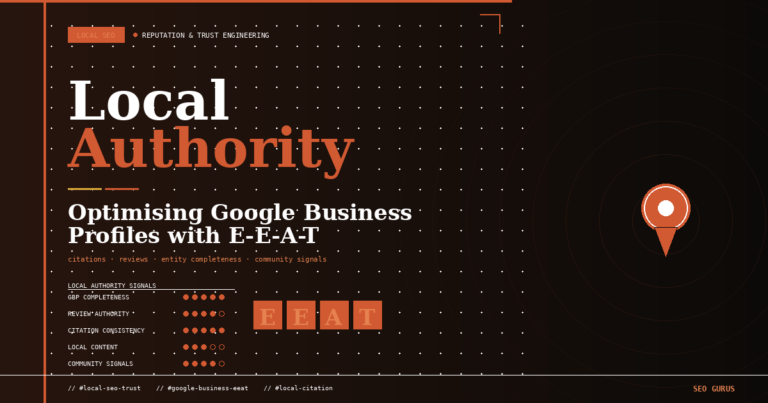
Local SEO Has Changed: Why Google Business Profiles Alone Are No Longer Enough
For years, local SEO was relatively predictable.
Businesses could optimise a Google Business Profile, build directory citations, collect a handful of reviews, and achieve respectable visibility in local search results.
That era is ending.
Local search has evolved into a far more sophisticated system driven by:
- semantic interpretation,
- entity trust,
- behavioural analysis,
- AI-generated recommendations,
- and contextual relevance modelling.
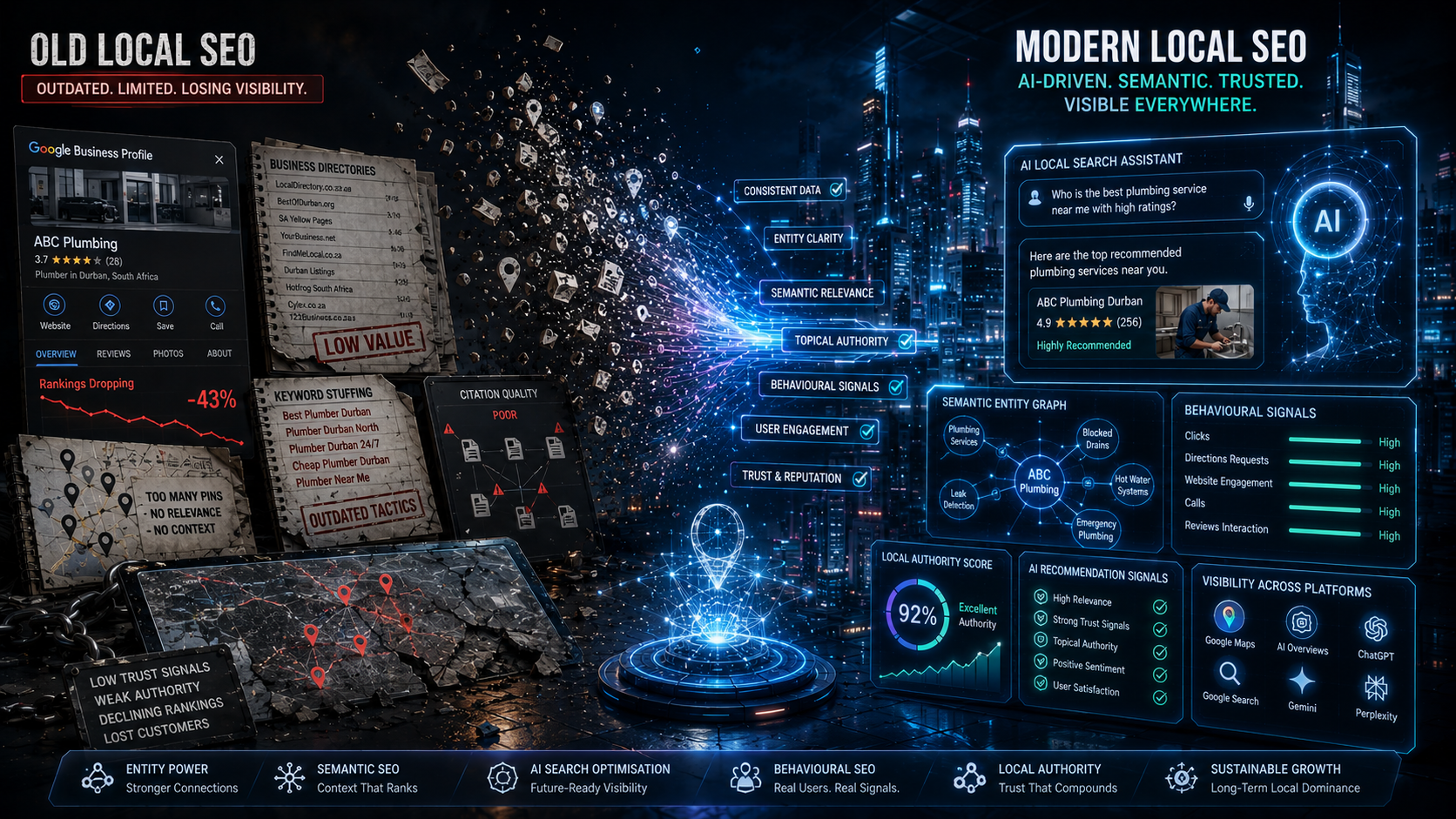
Google no longer operates like a simple digital directory.
It increasingly functions as a predictive AI-driven recommendation engine capable of interpreting:
- user intent,
- business authority,
- contextual trust,
- engagement patterns,
- and geographic relevance simultaneously.
Businesses relying exclusively on Google Business Profiles are already beginning to experience declining visibility in competitive markets — even when their profiles appear technically optimised.
The reason is simple.
Modern local search is no longer merely about profile completeness.
It is about whether search systems understand your business as a trusted local entity within a broader semantic ecosystem.
This shift is reshaping Local SEO South Africa entirely.
Businesses that continue relying on outdated local SEO tactics risk gradual invisibility as AI-driven local discovery accelerates.
Local Search Has Evolved
The way users search locally has changed dramatically.
Traditional local searches once relied heavily on fragmented keyword queries such as:
- “plumber Durban”
- “coffee shop near me”
- “SEO agency Cape Town”
Today’s users increasingly engage in conversational local discovery.
Search behaviour now includes:
- “Which SEO agency specialises in AI search optimisation for service businesses?”
- “Best restaurant in Durban for business meetings with sea views”
- “Which accounting firms near me have experience with property investment structures?”
These are no longer simplistic location searches.
They are contextual recommendation requests.
Search engines increasingly interpret:
- intent,
- context,
- behavioural patterns,
- and semantic meaning
rather than simply matching keywords.
This changes Local SEO South Africa fundamentally.
Search visibility now depends heavily on:
- contextual authority,
- semantic trust,
- behavioural relevance,
- and entity clarity.
The Old Local SEO Model
Traditional local SEO followed a relatively mechanical framework.
Businesses typically focused on:
- Google Business Profile optimisation,
- directory citations,
- local backlinks,
- review collection,
- and keyword-stuffed location pages.
This model worked effectively for years because Google’s local systems relied heavily on:
- proximity,
- basic relevance,
- and citation consistency.
Agencies often sold local SEO through checklist-style deliverables:
- submit to directories,
- optimise map listings,
- build citations,
- add suburbs to page titles,
- and request customer reviews.
While some of these elements still matter, they no longer provide sufficient competitive advantage on their own.
Modern Local SEO South Africa requires far deeper strategic sophistication.
Why Google Business Profiles Alone Are No Longer Enough
Google Business Profiles remain important.
However, they are no longer the dominant ranking factor many businesses assume they are.
Businesses with fully optimised profiles often still lose visibility because local search systems increasingly evaluate broader trust ecosystems.
Competition Has Intensified
Nearly every local business now understands basic profile optimisation.
As a result, profile-level optimisation alone offers diminishing differentiation.
Search engines therefore rely increasingly on:
- behavioural signals,
- semantic relevance,
- entity authority,
- and contextual trust layers.
Google Interprets Businesses Contextually
Google no longer evaluates businesses merely through category labels and location proximity.
It increasingly interprets:
- what a business specialises in,
- how users interact with it,
- what content surrounds it,
- how it is referenced online,
- and whether users appear satisfied after engagement.
This creates a much more sophisticated local ranking environment.
Local Trust Signals Extend Beyond Maps
Modern local search visibility depends on:
- topical authority,
- service relevance,
- brand familiarity,
- semantic consistency,
- and digital trust architecture.
A business profile alone cannot establish these signals comprehensively.
This is why many businesses with strong Google Business Profiles still struggle in Local SEO South Africa.
The Rise of Entity-Based Local SEO
Entity SEO is becoming central to modern local visibility.
Google increasingly understands businesses as entities rather than simple listings.
What Is a Local Entity?
A local entity is a contextually identifiable business recognised through:
- its services,
- geographic relevance,
- industry relationships,
- user engagement,
- and semantic associations.
Search systems increasingly build contextual understanding around these relationships.
Google’s Local Knowledge Graph
Google’s systems map relationships between:
- businesses,
- services,
- locations,
- industries,
- reviews,
- and user behaviour.
This creates a semantic trust framework.
Businesses with stronger entity clarity gain advantages inside modern local search systems.
Semantic Relationships Matter
Search engines increasingly evaluate:
- what topics your business is associated with,
- which services are contextually reinforced,
- and whether your content ecosystem demonstrates local expertise.
Local SEO South Africa is therefore shifting away from simplistic keyword matching toward semantic interpretation systems.
Behavioural Signals and Local Search Rankings
One of the largest shifts in local SEO involves behavioural analysis.
Google increasingly evaluates how users interact with businesses both digitally and physically.
Click-Through Rates
Search systems monitor:
- which listings attract clicks,
- which businesses generate engagement,
- and which results users ignore.
This influences perceived relevance.
User Engagement
Modern local search systems analyse:
- website interaction,
- dwell time,
- bounce behaviour,
- and conversion engagement.
If users consistently leave a website quickly after visiting from search results, this may weaken trust signals.
Driving Direction Requests
Map engagement matters significantly.
Actions such as:
- requesting directions,
- initiating calls,
- or interacting with profile elements
provide behavioural trust indicators.
Branded Searches
Businesses generating increasing branded search demand often strengthen entity authority.
This reflects growing recognition and trust.
Local SEO South Africa increasingly overlaps with broader brand-building strategy.
Local SEO in the AI Search Era
AI systems are transforming local search behaviour rapidly.
Platforms like:
- ChatGPT,
- Google Gemini,
- Perplexity AI,
- and Google AI Overviews
are reshaping how users discover local businesses.
Conversational Local Discovery
Users increasingly ask:
- “Which SEO consultancy near me specialises in AI-driven local search?”
- “Best family-friendly restaurants in Durban with outdoor seating”
- “Which electrician has strong reviews for commercial installations?”
This changes optimisation requirements dramatically.
Businesses must now optimise for:
- contextual relevance,
- conversational discovery,
- and semantic trust.
AI Systems Prioritise Contextual Confidence
AI-generated recommendations rely heavily on:
- entity clarity,
- review sentiment,
- topical authority,
- and semantic consistency.
Businesses with fragmented local signals risk exclusion from AI-generated recommendations.
Local Visibility Extends Beyond Maps
Modern local visibility increasingly includes:
- AI summaries,
- conversational recommendations,
- knowledge panels,
- and semantic search layers.
Local SEO South Africa is evolving into a multi-surface visibility ecosystem.
Why Citation Quantity Matters Less Than Semantic Consistency
For years, local SEO campaigns focused heavily on citation volume.
Businesses submitted listings to:
- directories,
- local databases,
- and citation platforms.
Many agencies treated citation quantity as a ranking strategy.
That approach is becoming increasingly outdated.
Citation Spam Weakens Trust
Low-quality citation networks often create:
- inconsistent business data,
- semantic confusion,
- and weak contextual authority.
Modern search systems prioritise consistency rather than volume.
Semantic Consistency Matters More
Businesses now require:
- consistent naming conventions,
- aligned service descriptions,
- coherent location signals,
- and contextual relevance.
Search engines increasingly evaluate whether information aligns semantically across the web.
Local Entity Clarity Is Critical
Inconsistent:
- addresses,
- service descriptions,
- phone numbers,
- and branding signals
can weaken local entity interpretation.
Local SEO South Africa increasingly depends on clean entity architecture.
The Importance of Local Topical Authority
Topical authority has become one of the most important factors in advanced local SEO.
Businesses can no longer rely solely on generic service pages.
Service-Specific Authority
Search systems increasingly evaluate:
- expertise depth,
- service specialisation,
- and contextual authority.
A law firm with extensive content around property law in Durban may outperform competitors with broader but shallower local signals.
Geographic Semantic Relevance
Modern local SEO benefits from:
- geographically relevant content ecosystems,
- suburb-level contextual pages,
- localised service architecture,
- and region-specific expertise.
Topic Clusters Strengthen Local Authority
Businesses should build interconnected content around:
- services,
- locations,
- industry expertise,
- and user intent pathways.
This creates stronger semantic relevance within local ecosystems.
The Technical Foundations of Modern Local SEO
Technical SEO increasingly influences local visibility.
Many local businesses overlook this entirely.
Schema Markup
Structured data helps search engines interpret:
- business categories,
- service areas,
- opening hours,
- reviews,
- and geographic relationships.
Schema improves machine readability significantly.
Semantic HTML
Semantic structure improves contextual understanding.
Many local websites rely heavily on:
- bloated templates,
- weak heading hierarchy,
- and poor content structure.
These weaknesses reduce interpretability.
Mobile Optimisation
Local searches are heavily mobile-driven.
Poor mobile experiences weaken:
- behavioural engagement,
- user satisfaction,
- and conversion signals.
AI Readability
AI-driven local systems increasingly favour:
- clean architecture,
- structured information,
- and semantic clarity.
Technical optimisation therefore plays a growing role in Local SEO South Africa.
Why Most Local Businesses Are Structurally Weak Online
Many local businesses unknowingly operate with structurally weak digital ecosystems.
Common problems include:
- template websites,
- duplicate location pages,
- thin content,
- weak semantic architecture,
- and poor conversion systems.
Duplicate Location Pages
Many businesses create near-identical suburb pages with minor wording changes.
Search systems increasingly recognise this as low-value duplication.
Weak Content Ecosystems
Shallow websites rarely establish meaningful authority.
Businesses require:
- educational depth,
- contextual service information,
- and semantic reinforcement.
Poor Conversion Architecture
Local SEO should not focus solely on rankings.
Businesses also require:
- trust architecture,
- conversion optimisation,
- and behavioural engagement systems.
The Role of Reviews in Modern Local SEO
Reviews have evolved far beyond star ratings.
AI systems increasingly interpret:
- sentiment,
- contextual language,
- behavioural patterns,
- and semantic meaning.
Review Semantics Matter
A detailed review mentioning:
- service quality,
- professionalism,
- specific expertise,
- and geographic relevance
provides stronger signals than generic praise.
Review Velocity Influences Trust
Consistent review generation often signals active business legitimacy.
Long periods without review activity may weaken freshness signals.
User Interaction Matters
Engagement with reviews — including responses — contributes to trust perception.
Modern Local SEO South Africa increasingly relies on nuanced behavioural trust systems.
Local SEO for Multi-Location and Service-Area Businesses
Multi-location businesses face additional complexity.
Scaling local visibility requires careful entity management.
Semantic Duplication Risks
Many multi-location websites create duplicated content structures that weaken authority.
Each location requires:
- contextual differentiation,
- unique relevance,
- and semantic specificity.
Geographic Authority Scaling
Businesses operating across multiple regions require:
- structured location architecture,
- regional topical authority,
- and clean entity relationships.
Service-Area SEO Requires Strategic Structure
Service-area businesses often struggle because Google prefers clear geographic relevance.
Advanced local SEO therefore requires sophisticated service-area architecture.
How SEO Gurus Approaches Modern Local SEO
SEO Gurus approaches Local SEO South Africa through a combination of:
- semantic optimisation,
- entity engineering,
- behavioural SEO,
- and AI-aware local visibility systems.
The focus extends beyond simplistic map ranking tactics.
Instead, the strategy involves:
- contextual authority development,
- local entity clarity,
- semantic content architecture,
- and technical optimisation.
Modern local SEO requires adaptive systems rather than static checklist fulfilment.
Businesses competing seriously in local markets increasingly require:
- strategic search intelligence,
- behavioural optimisation,
- and AI-era visibility engineering.
The Future of Local Search
Local search is becoming increasingly predictive, contextual, and AI-driven.
Users will continue shifting toward:
- conversational search,
- voice discovery,
- AI-generated recommendations,
- and contextual local decision systems.
Search engines are evolving from directories into recommendation intelligence platforms.
This changes Local SEO South Africa permanently.
Businesses that continue relying solely on:
- Google Business Profiles,
- citation spam,
- and outdated local tactics
will gradually lose competitiveness as local search ecosystems mature.
The future belongs to businesses capable of building:
- semantic trust,
- entity authority,
- behavioural relevance,
- and AI-readable local ecosystems.
Modern local SEO is no longer about simply appearing on maps.
It is about becoming contextually recognised as the most relevant and trusted answer within increasingly intelligent search systems.
The businesses that understand this transition early will gain disproportionate visibility advantages as AI-driven local discovery reshapes how consumers find, evaluate, and trust local companies in the years ahead.