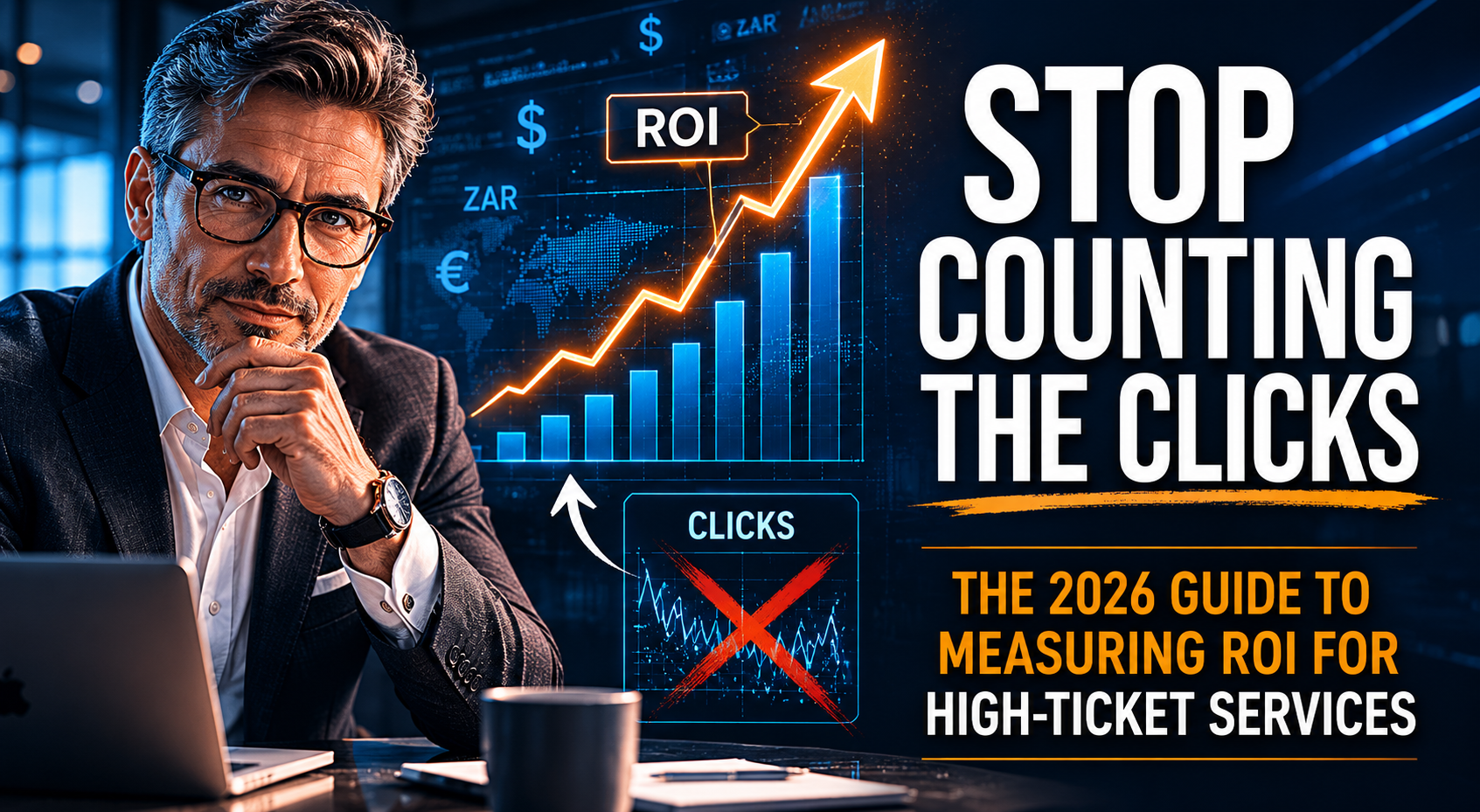
Stop Counting Clicks: The 2026 Guide to Measuring Digital ROI for High-Ticket Services
For years, the digital marketing industry has fed business leaders a steady diet of vanity metrics. We are handed monthly reports overflowing with “organic traffic growth,” “keyword rankings,” and “click-through rates.” These are easy to track, easy to display in green, and—most importantly—easy to use as a smoke screen for a lack of genuine business impact.
If you are running a high-ticket service business, whether in legal, professional security, or luxury retail, those metrics are likely lying to you. In 2026, the distance between a “click” and a “sale” has grown exponentially. If you are still measuring success by the volume of visitors, you are measuring the cost of an audience, not the return on your investment.
1. The Death of the Last-Click Attribution Model
The standard reporting models built into platforms like GA4 are fundamentally flawed for high-value services. They rely on “Last-Click Attribution,” which assigns 100% of the credit for a lead to the very last page the user visited before contacting you.
In high-trust industries, this is rarely how a purchase happens. A client might engage with your brand through an educational blog post, revisit via an AI research summary, follow you on social media, and then finally submit a lead. Last-click attribution ignores the entire journey, leading you to believe that your “Contact Us” page is your most valuable asset, while the sophisticated content that actually built the trust is dismissed as “low-performing.”
2. The “Invisible” Path to Purchase
High-ticket buyers are non-linear. They are conducting extensive research, often off-site, using AI research assistants and enterprise search tools before they ever reveal their intent to your sales team.
When your marketing report ignores this “invisible” path, it fails to account for the touchpoints that actually influence the sale. We must shift our perspective: your website is not just a digital billboard; it is the infrastructure that supports a complex, multi-stage decision-making process.
3. Three Pillars of 2026 ROI Measurement
To achieve true clarity, you must stop auditing keywords and start auditing financial efficiency. Here are the three metrics that matter:
- Assisted Conversion Value: You must track which pages serve as the “bridge” to conversion. If a client reads an entity-rich guide on your site before converting, that page deserves a portion of the credit, even if it wasn’t the final stop.
- Lead Quality vs. Quantity: A surge in traffic is a cost, not an asset, if it doesn’t move the needle on your “Lead Efficiency Ratio.” Calculate the percentage of organic leads that successfully convert into discovery calls. If this number is dropping while your traffic is climbing, your digital strategy is drifting away from your ideal client profile.
- CAC-to-LTV Alignment: Compare the Cost of Acquisition (CAC) for organic leads against your paid alternatives. A successful organic strategy should lead to a measurable, compounding decline in your CAC relative to the Lifetime Value (LTV) of your clients.
4. The Framework Approach
This is why we developed the Coetzee Convergence Framework (CCF). Rather than treating SEO as a siloed marketing channel, the CCF integrates your digital presence into your unit-level digital costing. By mapping your content and technical structure directly to your business’s P&L, you can finally see which investments are building equity and which are simply consuming budget.
Conclusion: Build Infrastructure, Not Just Traffic
Your website should be a high-performance asset that compounds in value over time. If your current reporting doesn’t tell you how your SEO spend is impacting your pipeline velocity or your margins, it is time to demand a higher level of financial rigor.
Don’t settle for a monthly report of green arrows. Demand an audit of your digital infrastructure.
Are you ready to move beyond vanity metrics and align your digital strategy with your balance sheet?Let’s discuss how to implement a revenue-focused dashboard for your business.