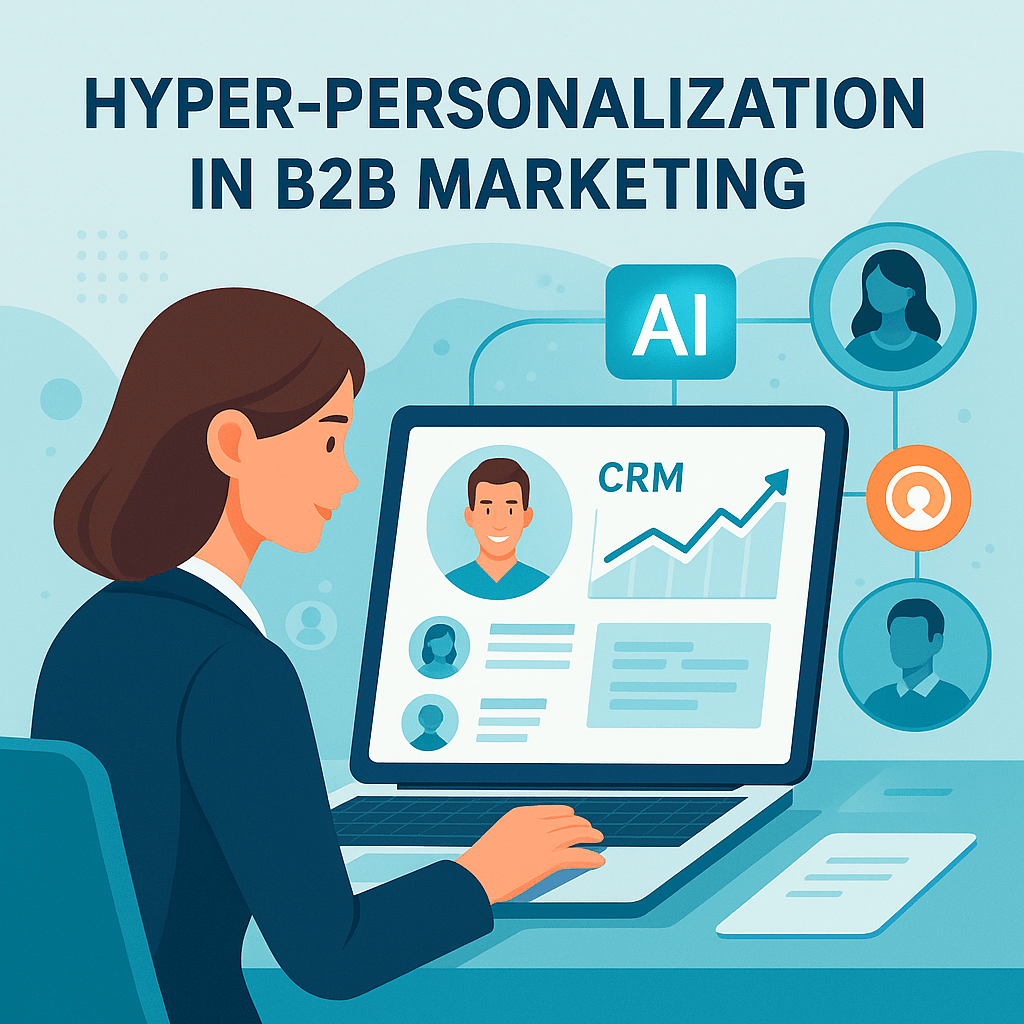
Hyper-Personalization in B2B Marketing: Using AI and CRM to Tailor Every Touchpoint
In the age of automation, personalisation has become the cornerstone of effective marketing. But in 2025, personalisation means more than just using a client’s first name in an email — it’s about delivering relevant, contextual experiences across every channel.
Enter hyper-personalization: the use of AI, data analytics, and CRM insights to tailor every interaction based on behaviour, intent, and stage of the buyer journey.
And it’s not just for large enterprises anymore. With the rise of accessible AI and integrated CRM tools, even small and medium-sized B2B firms can now deliver the same level of precision once reserved for tech giants.
1. What Is Hyper-Personalization?
Hyper-personalization goes beyond traditional segmentation. Instead of grouping clients by industry or company size, it uses real-time behavioural and contextual data to adapt messaging dynamically.
That means each prospect or client experiences a unique version of your content — whether through email, website, or advertising.
For example:
- A returning client might see different website offers than a new visitor.
- A lead who downloaded a whitepaper could automatically receive follow-up content that expands on that topic.
- Sales teams can prioritise outreach based on predictive engagement scores.
This approach transforms your marketing from static to adaptive — every touchpoint evolves with the client.
2. Why Hyper-Personalization Matters in B2B
B2B buyers expect the same seamless experience they get from consumer brands like Amazon or Netflix.
They want relevance, efficiency, and recognition — not generic campaigns.
According to Salesforce, 65% of B2B decision-makers are more likely to switch vendors if communications feel impersonal.
Hyper-personalization helps:
- Nurture leads more effectively, by addressing their exact pain points.
- Shorten sales cycles, through relevant recommendations.
- Increase loyalty and retention, by showing clients they’re understood.
It’s no longer a “nice to have” — it’s a competitive advantage.
3. The Building Blocks: CRM + AI
At the core of hyper-personalization lies data — and the two tools that bring it to life are your CRM system and AI-driven analytics.
CRM (Customer Relationship Management)
Your CRM stores invaluable data: purchase history, engagement records, and communication logs.
When used correctly, it reveals where each lead stands in the funnel and what content resonates most.
AI (Artificial Intelligence)
AI takes CRM data further by analysing patterns, predicting intent, and automating responses.
It identifies high-value leads, suggests next-best actions, and even generates dynamic content recommendations.
Together, they turn scattered information into predictive intelligence — helping you act before the opportunity passes.
4. Real-World Examples of Hyper-Personalization
Dynamic Email Campaigns
AI tools can now personalise email content in real time — adjusting subject lines, visuals, and CTAs based on recipient data.
For example, two prospects might receive the same email template, but the copy automatically changes to reflect their industry, company size, or recent behaviour.
Adaptive Website Content
With CRM-linked personalisation software, your website can display different homepage banners, case studies, or CTAs depending on visitor profile.
A manufacturing client might see industry-specific results, while an agency sees creative success stories.
Predictive Lead Nurturing
AI analyses past interactions to forecast what prospects need next — whether it’s a demo invite, a pricing guide, or a case study.
This ensures each lead receives content aligned with their intent, not a generic newsletter blast.
5. How Small Businesses Can Implement It
Hyper-personalization doesn’t require enterprise-level budgets. Start small and scale:
✅ Step 1: Consolidate Your Data
Integrate your CRM, email platform, and website analytics into one system. Tools like HubSpot, Zoho CRM, or ActiveCampaign make this simple and affordable.
✅ Step 2: Segment Smartly
Use CRM tags and AI scoring to identify leads by engagement level, content interest, and purchase stage.
✅ Step 3: Automate Follow-Ups
Set up workflows triggered by specific actions — like visiting a pricing page or downloading a guide.
✅ Step 4: Optimise Based on Results
Analyse click-throughs, dwell time, and conversion paths. Refine your messaging based on real user behaviour.
Each improvement compounds your insight — making future interactions even smarter.
6. The Role of AI in Understanding Buyer Intent
AI doesn’t just process data; it interprets why people act.
Using natural language processing (NLP) and machine learning, modern tools can detect tone, urgency, and emotional signals in emails or form submissions.
For instance, if a lead’s message expresses frustration or high interest, AI can flag it for priority response.
This contextual awareness turns automation into empathy — ensuring timely, relevant, and human-feeling engagement.
7. Aligning Sales and Marketing for a Unified Experience
Hyper-personalization only works when sales and marketing share the same data.
An integrated CRM allows both teams to see the full customer journey — from the first ad click to the latest email open.
Marketing knows which leads are ready to convert, and sales knows which conversations to prioritise.
This alignment eliminates guesswork and creates a consistent experience across all touchpoints.
8. Measuring the ROI of Personalization
The beauty of hyper-personalization is that every action is trackable.
Measure success by monitoring:
- Conversion rate improvements across segmented campaigns.
- Engagement metrics (click-through, dwell time, and replies).
- Customer Lifetime Value (CLV) increases through tailored retention strategies.
Many businesses see a 20–30% lift in engagement within weeks of implementing personalised workflows.
9. The Human Element: Automation with Empathy
AI personalisation doesn’t mean removing the human touch. In fact, it enhances it.
Automation handles repetitive tasks so your team can focus on authentic interactions.
For example:
- AI drafts the outreach email.
- The marketer refines tone and adds human insight.
- The CRM ensures it reaches the right person at the right time.
This synergy creates communication that’s both efficient and emotionally intelligent.
10. Future Outlook: Predictive Personalisation at Scale
In the near future, hyper-personalisation will extend beyond marketing into the entire business ecosystem.
AI will predict client needs before they’re expressed — adjusting pricing, scheduling meetings, and suggesting next-step services automatically.
For SMEs, adopting these systems early means staying competitive and future-ready.
The technology is already accessible — the key is to start integrating it thoughtfully now.
Conclusion
In B2B marketing, success no longer comes from broadcasting to everyone — it comes from connecting with the right person, in the right moment, with the right message.
Hyper-personalisation, powered by AI and CRM, enables even small businesses to nurture deeper relationships, build trust, and turn every interaction into an opportunity.
It’s not about automation replacing humans — it’s about using technology to make marketing more human than ever before.
👉 Ready to personalise your marketing strategy?
Partner with EC Business Solutions and explore how our Professional SEO Services and AI-driven CRM strategies can help you build meaningful connections and measurable growth.