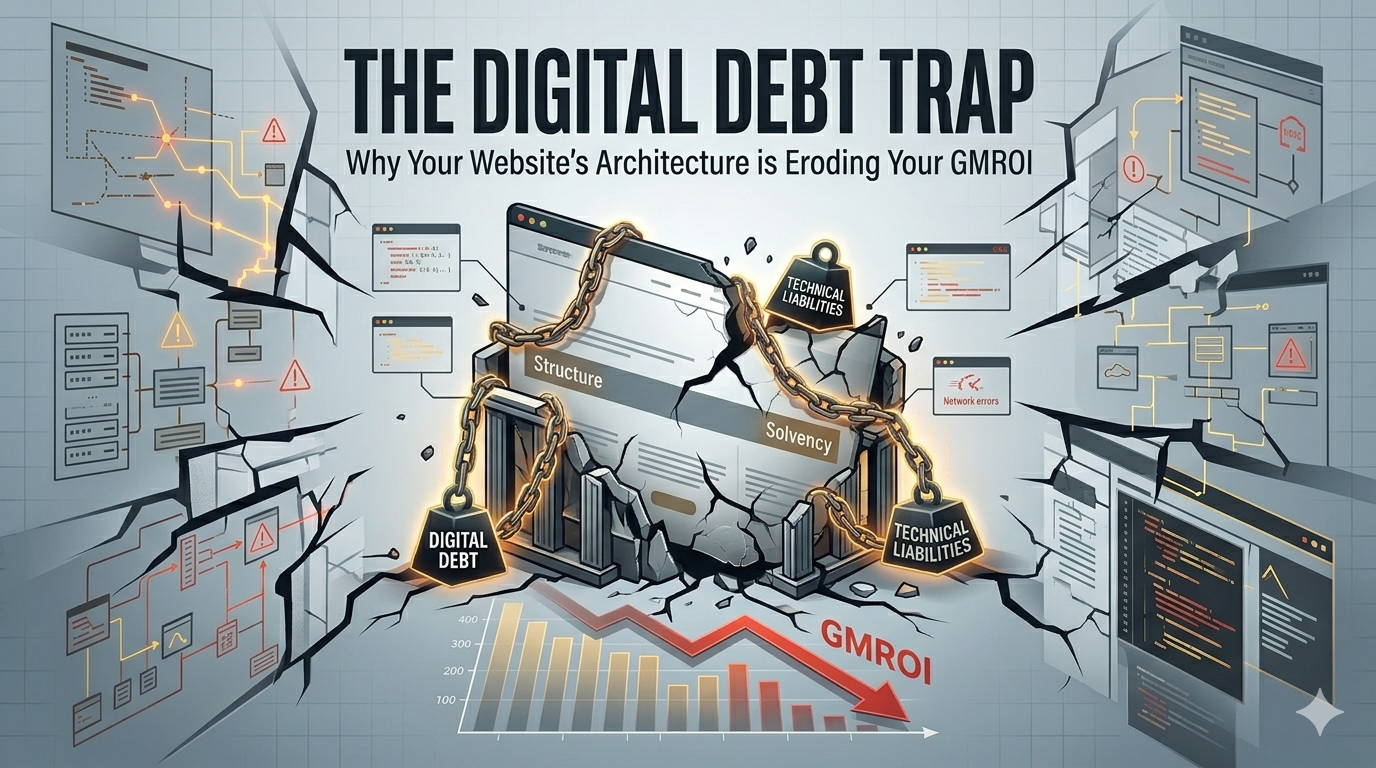
The Digital Debt Trap: Why Your Website’s Architecture is Eroding Your GMROI
Executive Summary
In the modern enterprise, your digital infrastructure is not a marketing asset; it is a fundamental component of your corporate balance sheet. When technical architecture is neglected, it accumulates “Digital Debt”—a hidden, compounding liability that quietly erodes your Gross Margin Return on Investment (GMROI). For firms operating in high-ticket, trust-intensive industries, structural integrity is the primary determinant of both visibility and capital efficiency.
Defining Digital Debt: The Hidden Tax on Revenue
In financial modeling, debt is a tool to be managed; in digital infrastructure, debt is a failure of governance. When a website is built without rigorous architectural standards, it accumulates “Digital Debt” in the form of bloated code, inefficient crawl paths, and structural fragmentation.
Just as a company carrying high-interest liabilities must allocate more capital to debt service than to R&D, a website burdened by digital debt must allocate an excessive share of its marketing budget to “repair” its visibility. Every dollar spent on paid acquisition to compensate for poor organic performance is a direct hit to your GMROI. You are not investing in growth; you are paying interest on a broken foundation.
The Forensic View: Identifying Liquidity Issues
To understand the health of your digital stack, you must move beyond surface-level performance metrics. A forensic audit reveals the “liquidity issues” inherent in your current configuration.
When we audit an enterprise stack, we look for systemic failures:
- Architectural Bloat: Unnecessary dependencies and legacy bloat that slow system response times, increasing your “cost per compute” and frustrating user interaction.
- Crawl Inefficiency: If search engines and AI agents struggle to map your site, your “entity equity” remains stagnant. You are effectively holding assets that cannot be realized.
- Structural Fragility: In an era of Generative Engine Optimization (GEO), if your data structure is inconsistent, your brand’s “truth” cannot be accurately synthesized by Large Language Models. This is not a technical glitch; it is a failure to secure your market share in the AI-driven future.
The Coetzee Convergence Framework: Antidote to Insolvency
The Coetzee Convergence Framework (CCF) is a rigorous operational protocol designed to move your digital presence from a state of liability to one of sovereign equity.
Unlike traditional approaches that focus on fleeting ranking improvements, the CCF focuses on Operational Digital Solvency. We view the website as a node in a high-trust ecosystem. By implementing strict schema-driven architecture, eliminating structural debt, and optimizing for machine-readability, we reduce the “interest payments” your firm makes to sustain its current market position.
The objective of the framework is simple: Increase organic equity while decreasing the cost of digital maintenance. It is a shift from marketing-as-an-expense to infrastructure-as-a-strategic-advantage.
Moving Toward Sovereign Infrastructure
Your digital presence should be an asset that compounds over time. If your current digital strategy relies on constant, repetitive manual adjustments and broad-spectrum “content marketing” to stay relevant, you are in a cycle of digital insolvency.
True market dominance in the high-ticket sector requires a shift toward Digital Sovereignty—owning your stack, securing your data structure, and ensuring your entity is the definitive source of truth in your industry.
Request a Private Consultation
If your current digital architecture is failing to provide the ROI your board demands, it is time for a forensic assessment. Contact us for a private consultation regarding your firm’s digital infrastructure and the potential for transition to the Coetzee Convergence Framework.