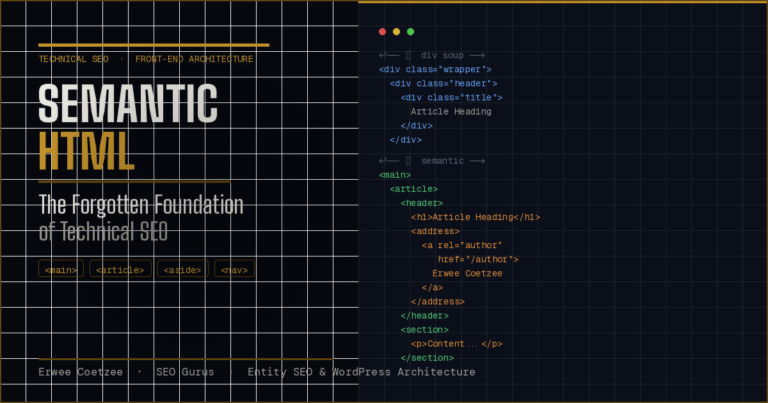
Semantic HTML: The Forgotten Foundation of Technical SEO

Semantic HTML: The Forgotten Foundation of Technical SEO

A technical deep-dive for senior developers, technical SEOs, and headless CMS architects There is a particular kind of technical debt that accrues silently — not in broken builds or failing tests, but in the structural assumptions baked into every page rendered to a crawler. The debt is div-soup: the pathological accumulation of non-semantic <div> and…
Brand SERP Optimisation: How to Own Your Knowledge Panel and Control Your Digital Business Card

Brand SERP Optimisation: How to Own Your Knowledge Panel and Control Your Digital Business Card

In the contemporary search landscape, the traditional dichotomy between “organic rankings” and “paid search” has been superseded by a more profound architectural reality: the transition from a document-based index to an entity-based knowledge engine. For the modern enterprise, the search engine results page (SERP) is no longer merely a list of links directing users to…

Optimising for RAG (Retrieval-Augmented Generation) in AI Search

Optimising for RAG (Retrieval-Augmented Generation) in AI Search

Search is undergoing its most profound architectural shift since the introduction of PageRank. For two decades, the dominant model of discovery revolved around ranking documents against keyword queries. The result was the familiar list of ten blue links. Today, however, the centre of gravity is moving away from document retrieval toward answer synthesis. Modern AI…

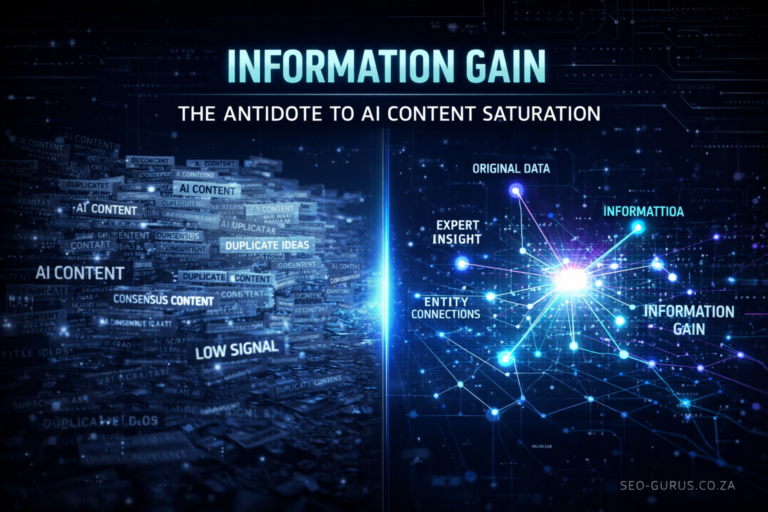
Information Gain: The Antidote to AI-Content Saturation

Information Gain: The Antidote to AI-Content Saturation

The digital ecosystem is currently drowning in a sea of perfectly acceptable, grammatically flawless, and completely useless content. The proliferation of Large Language Models (LLMs) has reduced the cost of content production to zero, resulting in millions of pages that essentially say the exact same thing. For digital strategists and enterprise SEO directors, this presents…

Topical Mapping vs. Keyword Research: The Semantic Architecture Shift
| |

Topical Mapping vs. Keyword Research: The Semantic Architecture Shift

The foundational principles of website architecture have changed. For the past two decades, information architecture (IA) was primarily dictated by lexical keyword research—the process of identifying isolated search terms with high monthly volume and clustering them into loosely related categories. Content plans were created to target these specific strings, resulting in websites that were, essentially,…

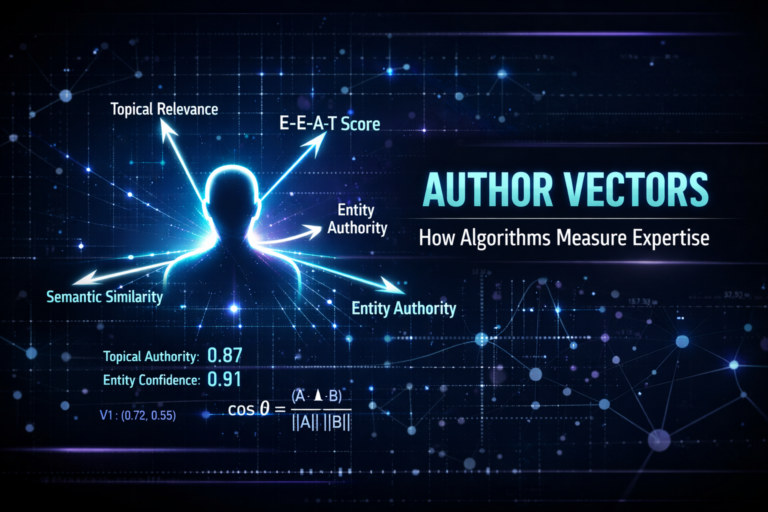
Author Vectors: How Algorithms Mathematically Measure Expertise

Author Vectors: How Algorithms Mathematically Measure Expertise

For years, the SEO industry has treated E-E-A-T as a qualitative checklist. We publish an author bio, link to a Twitter profile, and assume we have satisfied the algorithm’s appetite for “Expertise” and “Trust.” This is a fundamental misunderstanding of modern information retrieval. Search engines do not read bios. They do not comprehend human accolades…

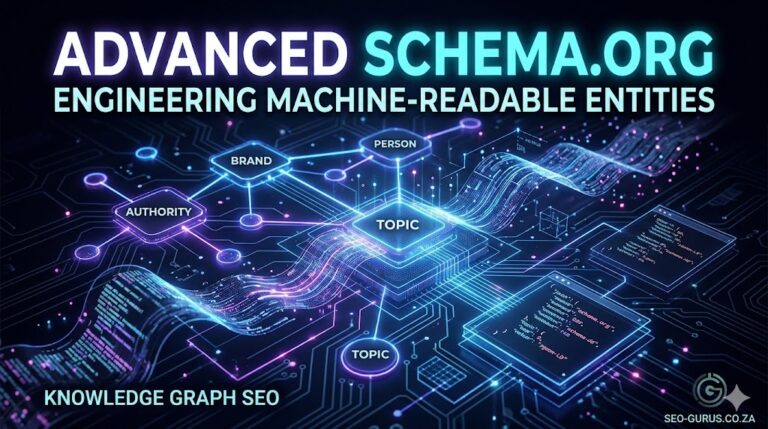
Advanced Schema.org: Engineering Machine-Readable Entities

Advanced Schema.org: Engineering Machine-Readable Entities

The fundamental limitation of HTML is that it is a presentation layer. It tells a browser how a document should look, but it offers search engine crawlers very little context about what the document actually means. For years, SEOs relied on on-page keyword density and probabilistic string matching to bridge this gap. That era is…

The Complete E-E-A-T SEO Framework: Building Authority in Modern Search

The Complete E-E-A-T SEO Framework: Building Authority in Modern Search

The Complete E-E-A-T SEO Framework: Building Authority in Modern Search Search engine optimization has evolved significantly over the past two decades. Early strategies focused almost entirely on keywords and backlinks. While those elements remain important, modern search systems increasingly evaluate something deeper: credibility. This shift has led to the widespread discussion of the E-E-A-T framework,…

From Rankings to Citations: Structuring Content for AI Answer Engines

From Rankings to Citations: Structuring Content for AI Answer Engines

From Rankings to Citations: Structuring Content for AI Answer Engines Search engine optimization has traditionally focused on rankings. The objective was simple: identify valuable keywords, create optimized pages, acquire backlinks, and move those pages toward the top of the search results. However, search is entering a new phase. Modern search experiences increasingly rely on AI-generated…

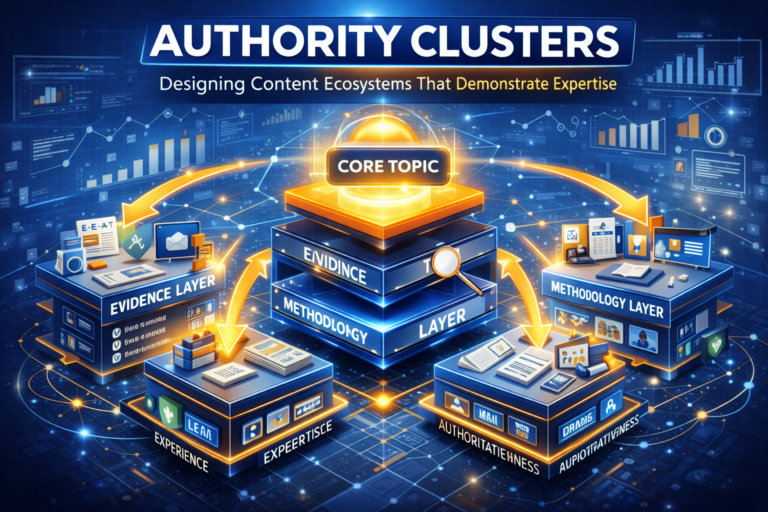
Authority Clusters: Designing Content Ecosystems That Demonstrate Expertise

Authority Clusters: Designing Content Ecosystems That Demonstrate Expertise

Authority Clusters: Designing Content Ecosystems That Demonstrate Expertise For many years, search engine optimization was largely focused on keywords. Content strategies revolved around identifying target phrases, publishing optimized pages, and acquiring backlinks to improve rankings. While keywords still matter, modern search engines increasingly evaluate something deeper: topical authority. Rather than judging individual pages in isolation,…