Advanced Schema.org: Engineering Machine-Readable Entities
The fundamental limitation of HTML is that it is a presentation layer. It tells a browser how a document should look, but it offers search engine crawlers very little context about what the document actually means. For years, SEOs relied on on-page keyword density and probabilistic string matching to bridge this gap. That era is over.
Today, organic visibility relies on Entity SEO and identity disambiguation. Search engines have shifted their focus from indexing isolated web pages to constructing massive, interconnected relational databases—Knowledge Graphs. To compete in this ecosystem, a website cannot just publish content; it must publish data.
Advanced Schema.org implementation is the architectural protocol for this transition. It is the process of translating unstructured textual concepts into explicit, machine-readable data structures. This guide bypasses the basics of structured data and explores the enterprise-level mechanics of engineering semantic entities, standardising identity, and establishing mathematical E-E-A-T through complex JSON-LD architecture.
What Advanced Schema Engineering Actually Means
In technical SEO, advanced schema engineering is the practice of designing structured data as a connected entity system rather than a collection of isolated markup snippets. The goal is not simply to validate Schema.org types, but to model brands, authors, pages, and concepts as linked nodes that search engines and AI systems can reconcile, trust, and reuse.
This is where advanced schema moves beyond plugin defaults. Instead of treating markup as a rich results checklist, it becomes part of a broader semantic architecture that supports Brand SERP optimisation and Knowledge Panel control, stronger author attribution, and more reliable entity recognition across the domain.
The Shift from Strings to Things: Defining the Node
In a standard, out-of-the-box SEO plugin configuration, schema is often generated in isolated blocks. The homepage gets Organization schema, a blog post gets Article schema, and an author page gets Person schema. To a crawler, these are disconnected fragments of data.
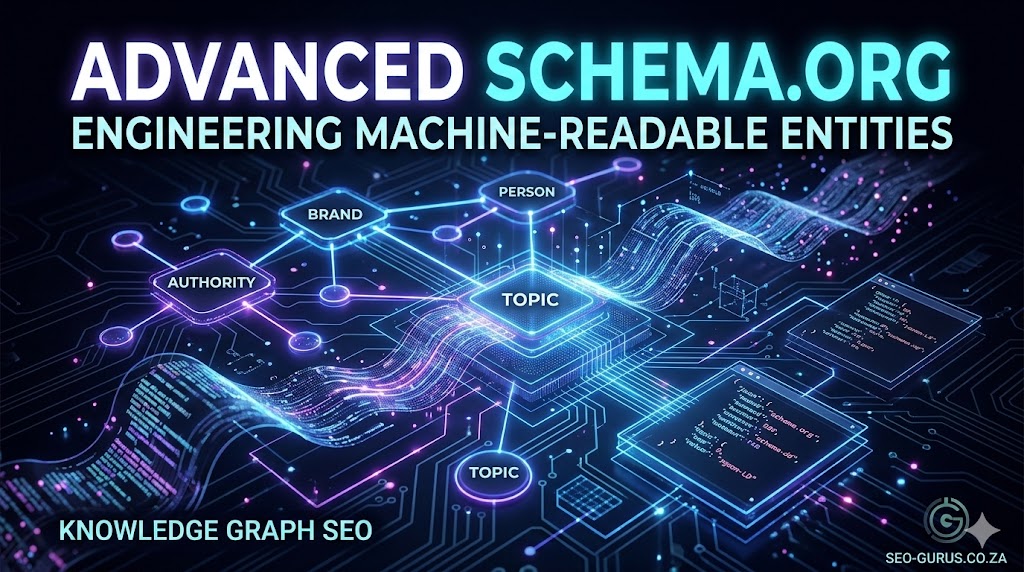
To build a true semantic architecture, you must stop viewing schema as a checklist of tags and start viewing it as a relational database. Every discrete concept on your site is a node. The relationships between these nodes are edges. Your objective is to map these nodes and edges so explicitly that Google’s natural language processing (NLP) algorithms do not have to guess how your author relates to your brand or the topics they write about.
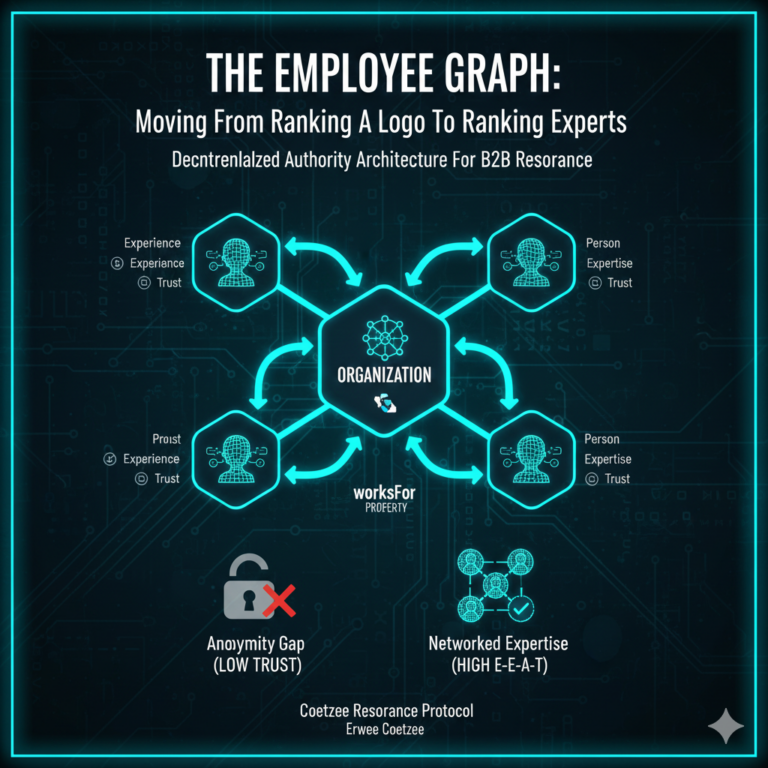
This principle sits at the heart of modern author vector modelling as well. If an author, employer, topic, and publication cannot be connected mathematically, the resulting expertise signals remain weaker than they should be.
Node Identifiers (@id): The Connective Tissue of JSON-LD
The most critical, yet frequently underutilised, property in advanced Schema.org is the @id node identifier.
An @id acts as a unique Uniform Resource Identifier (URI) for a specific entity within your schema payload. When you assign an @id to an entity, you can reference that exact entity anywhere else in your code without duplicating the data. This is the mechanism that transforms a flat JSON-LD script into a multi-dimensional graph.
If you declare your Organization on the homepage and assign it the identifier https://seo-gurus.co.za/#organization, you do not need to rewrite the entire company profile on every blog post. You simply reference the @id in the publisher property of your Article schema. This forces the search engine to recognise that the publisher of the article is the exact same entity defined on the homepage.
This standardisation prevents entity fragmentation—a common issue where search engines create duplicate, weaker nodes for a brand because the schema data across the domain is inconsistent.
The @graph Array vs. Deeply Nested Schema
When building relational schema, developers typically face a structural choice: deeply nest the nodes within one another, or use a flat array linked by @id references.
Deeply nested schema is brittle. If an Article contains a publisher which contains an Organization which contains a founder which contains a Person, the payload becomes an unreadable, deeply indented mess that is exceptionally difficult to maintain or debug programmatically.
Enterprise technical SEO relies on the @graph array. The @graph structure allows you to declare all your entities as top-level objects within a single array, using @id pointers to establish the relationships between them. It is infinitely scalable and significantly easier for crawlers to parse.
| Approach | Basic Plugin Schema | Advanced Relational Schema |
|---|---|---|
| Structure | Isolated per-page snippets | Connected entity graph using shared @id values |
| Maintainability | Difficult to standardise across many templates | Scalable across posts, pages, authors, and taxonomies |
| Entity clarity | Often ambiguous or duplicated | Explicitly reconciled and standardised |
| AI-readiness | Weak machine context | Stronger for retrieval, attribution, and citation |
Code Example 1: The Relational @graph Structure
Below is an architecture demonstrating how to connect a WebPage, a Person (Author), and an Organization within a single, scalable @graph payload.
JSON
{
  "@context": "https://schema.org",
  "@graph": [
    {
      "@type": "Organization",
      "@id": "https://seo-gurus.co.za/#organization",
      "name": "SEO-Gurus",
      "url": "https://seo-gurus.co.za/",
      "logo": {
        "@type": "ImageObject",
        "@id": "https://seo-gurus.co.za/#logo",
        "inLanguage": "en-ZA",
        "url": "https://seo-gurus.co.za/logo.png",
        "contentUrl": "https://seo-gurus.co.za/logo.png",
        "width": 500,
        "height": 150,
        "caption": "SEO-Gurus Logo"
      },
      "image": {
        "@id": "https://seo-gurus.co.za/#logo"
      }
    },
    {
      "@type": "Person",
      "@id": "https://seo-gurus.co.za/#erwee-coetzee",
      "name": "Erwee Coetzee",
      "jobTitle": "Technical SEO Architect",
      "worksFor": {
        "@id": "https://seo-gurus.co.za/#organization"
      },
      "url": "https://seo-gurus.co.za/author/erwee/"
    },
    {
      "@type": "WebPage",
      "@id": "https://seo-gurus.co.za/advanced-schema-architecture/#webpage",
      "url": "https://seo-gurus.co.za/advanced-schema-architecture/",
      "name": "Advanced Schema.org: Engineering Machine-Readable Entities",
      "isPartOf": {
        "@id": "https://seo-gurus.co.za/#website"
      },
      "primaryImageOfPage": {
        "@id": "https://seo-gurus.co.za/advanced-schema-architecture/#primaryimage"
      },
      "inLanguage": "en-ZA",
      "author": {
        "@id": "https://seo-gurus.co.za/#erwee-coetzee"
      },
      "publisher": {
        "@id": "https://seo-gurus.co.za/#organization"
      }
    }
  ]
}
Notice how the WebPage node does not define the author’s name or the publisher’s logo. It simply points to "@id": "https://seo-gurus.co.za/#erwee-coetzee" and "@id": "https://seo-gurus.co.za/#organization". The crawler maps the relationships instantly.
Practical Schema Engineering Framework
- 1. Define your core entity nodes: Start by identifying the primary entities that matter across the site, typically the organisation, authors, website, and key topical concepts.
- 2. Standardise
@idconventions: Create stable URIs for each entity so they can be reused consistently across articles, author pages, and commercial pages. - 3. Connect entities through
@graph: Use a relational array rather than disconnected blocks so publishers, authors, pages, and images are linked as one system. - 4. Reconcile external trust signals: Use properties such as
sameAs,worksFor,alumniOf, andknowsAboutto connect local entities to recognised external references. - 5. Map each page to explicit concepts: Use
aboutandmentionsso search engines do not need to infer the primary entity focus from text alone.
Strategic Insight
Most schema implementations fail not because the markup is invalid, but because the architecture is fragmented. A site can validate perfectly in a rich results tool and still provide weak semantic signals if its schema is generated as disconnected plugin output rather than a coherent entity system. That distinction becomes even more important as search moves toward RAG-driven retrieval and AI citation workflows.
Entity Reconciliation and Global Knowledge Graph Integration
Defining entities on your own domain is only the first step. To truly establish authority, you must tie your local domain nodes to globally recognised entities within Google’s Knowledge Graph, Wikidata, and Wikipedia. This process is known as entity reconciliation.
If search engines view your author profile as an isolated node, your E-E-A-T signals are contained strictly within the boundaries of your domain. By using specific schema properties, you force algorithms to reconcile your local entity with external, highly trusted data points.
sameAs: This is the most definitive reconciliation property. It explicitly tells the crawler, “The entity described here is the exact same entity found at this external URL.” You should usesameAsto link aPersonto their LinkedIn, Twitter, and Crunchbase profiles, or anOrganizationto its Wikipedia page or Google Business Profile.knowsAbout: A highly strategic property for mathematical E-E-A-T. You can assign specific Wikidata URIs to theknowsAboutproperty of aPersonto explicitly declare their areas of expertise.alumniOf&worksFor: Connecting an author to trusted institutions (universities, enterprise corporations) transfers semantic trust from the institution’s massive node to your author’s smaller node.
This reconciliation layer also strengthens adjacent systems such as author reputation, topic authority, and entity prominence. It supports the same broader shift described in topical mapping and semantic architecture, where the goal is no longer isolated page relevance but graph-level coherence.
Connecting Content to Semantic Concepts: mainEntity, about, and mentions
The final layer of advanced schema architecture involves mapping your actual content to the global knowledge graph. When you publish a 3,000-word masterclass on technical SEO, you do not want the algorithm to guess what the primary topic is based on keyword frequency. You want to state it as a mathematical fact.
We achieve this using the about and mentions properties within Article or WebPage schema.
about: Defines the primary, overarching entity the content discusses. A page should typically have only one or twoaboutproperties.mentions: Defines secondary entities that provide crucial context but are not the primary focus of the document.
Instead of just using text strings for these properties, advanced technical SEO requires passing external URIs (specifically Wikidata or Wikipedia URLs) as the value. This permanently anchors your content to an established knowledge graph node.
Code Example 2: Anchoring Content to Global Entities
This snippet demonstrates how to mark up an article to explicitly tell search engines that the primary topic is “Semantic Web” and that it contextualises this through mentions of “JSON-LD” and “Knowledge Graphs”.
JSON
{
  "@context": "https://schema.org",
  "@type": "Article",
  "@id": "https://seo-gurus.co.za/advanced-schema-architecture/#article",
  "headline": "Advanced Schema.org: Engineering Machine-Readable Entities",
  "author": {
    "@id": "https://seo-gurus.co.za/#erwee-coetzee"
  },
  "publisher": {
    "@id": "https://seo-gurus.co.za/#organization"
  },
  "about": [
    {
      "@type": "Thing",
      "name": "Semantic Web",
      "sameAs": "https://www.wikidata.org/wiki/Q54837"
    }
  ],
  "mentions": [
    {
      "@type": "Thing",
      "name": "JSON-LD",
      "sameAs": "https://www.wikidata.org/wiki/Q6108554"
    },
    {
      "@type": "Thing",
      "name": "Knowledge Graph",
      "sameAs": "https://en.wikipedia.org/wiki/Knowledge_graph"
    }
  ]
}
By injecting this architecture, you bypass the algorithm’s natural language parsing constraints. You are no longer relying on the crawler’s ability to infer the subject matter; you are hardcoding the document’s position within the semantic web.
Common Schema Mistakes That Weaken Entity Clarity
- Using different
@idpatterns for the same entity across templates. - Declaring authors and organisations repeatedly without connecting them through shared identifiers.
- Leaving
sameAsempty or linking to weak, inconsistent identity profiles. - Relying on plugin defaults without mapping the site’s actual entity relationships.
- Failing to align page-level concepts with explicit
aboutandmentionsproperties.
The Future: LLMs and RAG Indexing
The urgency of implementing advanced schema extends far beyond traditional blue-link SERPs. We are rapidly moving into an era dominated by Large Language Models (LLMs) and Retrieval-Augmented Generation (RAG) engines like AI Overviews and Perplexity.
LLMs do not parse the web like traditional crawlers; they are mathematically trained on relationships between concepts. When an AI search engine attempts to formulate an authoritative answer, it relies on structured data to verify facts, attribute quotes, and select citations.
A website relying purely on unstructured HTML will struggle to be cited by AI engines because the entity extraction process requires too much computational overhead. By engineering machine-readable entities today, you are structuring your data precisely how next-generation AI models prefer to consume it. Entity architecture is no longer just a technical SEO tactic; it is the prerequisite for survival in an AI-first search landscape.
This is also why schema should be viewed as complementary to, not separate from, foundational markup. If the HTML layer is ambiguous, the content layer is weak, and the schema layer is disconnected, the result is a technically valid page with poor machine comprehension. That is exactly why semantic HTML remains a foundational technical SEO signal even in an entity-first era.
Key Takeaways
- Advanced schema engineering is not about adding more markup; it is about building a connected entity system.
@idstandardisation is the key mechanism that prevents entity fragmentation across a domain.- The
@graphmodel is more scalable, maintainable, and semantically robust than deeply nested schema. - Entity reconciliation through properties such as
sameAs,worksFor, andknowsAboutstrengthens machine trust and E-E-A-T signals. - AI search systems increasingly reward sites that provide explicit, machine-readable relationships rather than forcing inference from raw text alone.
About the Author
Erwee Coetzee is a digital strategist and technical SEO specialist based in South Africa. With an obsession for technical search mechanics that dates back to 2012, Erwee develops advanced site architectures and data-backed frameworks. As the founder of SEO-Gurus.co.za, he specialises in bridging the gap between traditional search algorithms, semantic entity optimisation, and modern AI-driven information retrieval to secure long-term organic dominance.