Optimising for RAG (Retrieval-Augmented Generation) in AI Search
Search is undergoing its most profound architectural shift since the introduction of PageRank. For two decades, the dominant model of discovery revolved around ranking documents against keyword queries. The result was the familiar list of ten blue links.
Today, however, the centre of gravity is moving away from document retrieval toward answer synthesis.
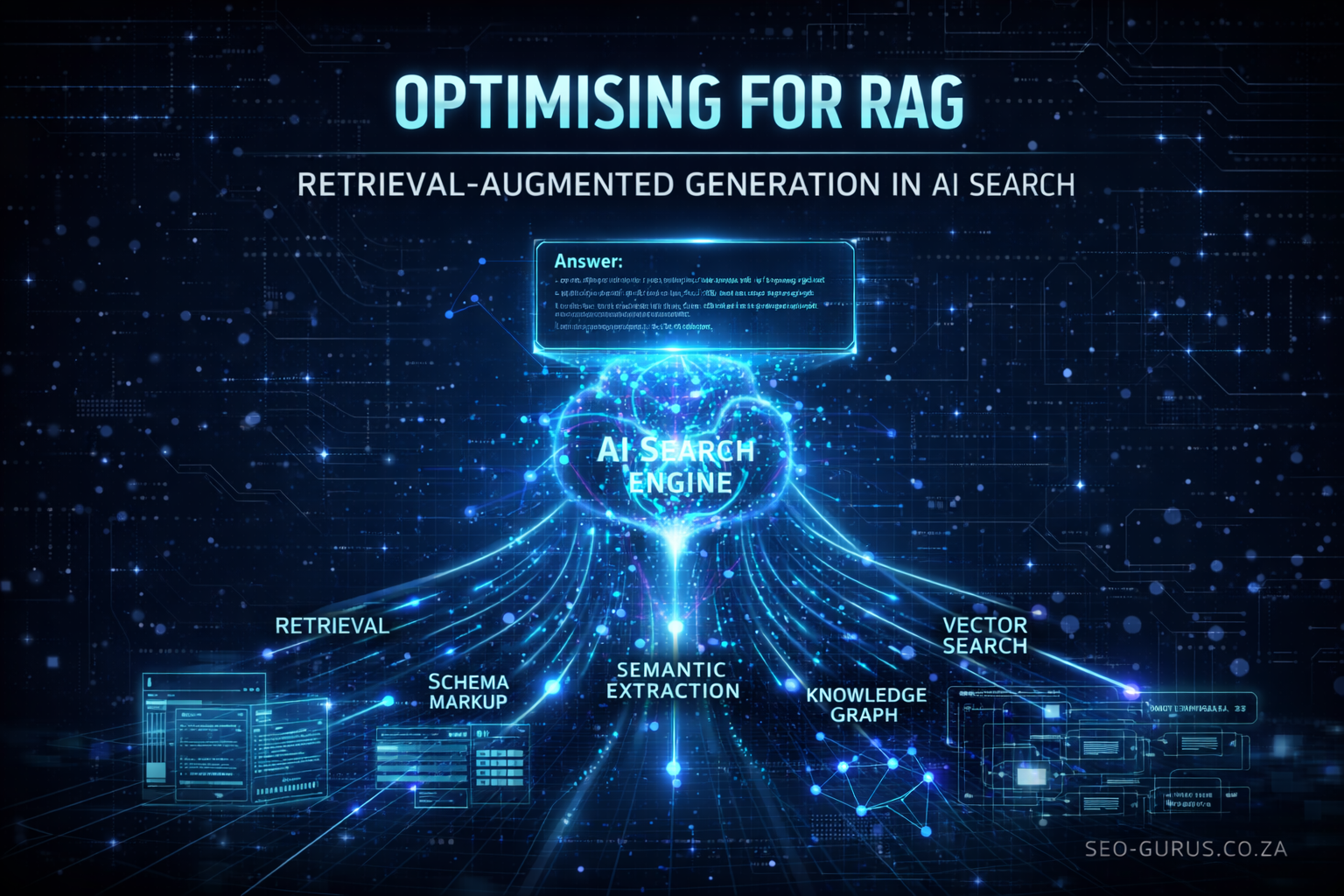
Modern AI search engines—such as Google’s AI Overviews, Perplexity, and other LLM-powered systems—do not simply retrieve pages. They generate responses by combining a large language model with external data retrieval systems. This architectural approach is known as Retrieval-Augmented Generation (RAG).
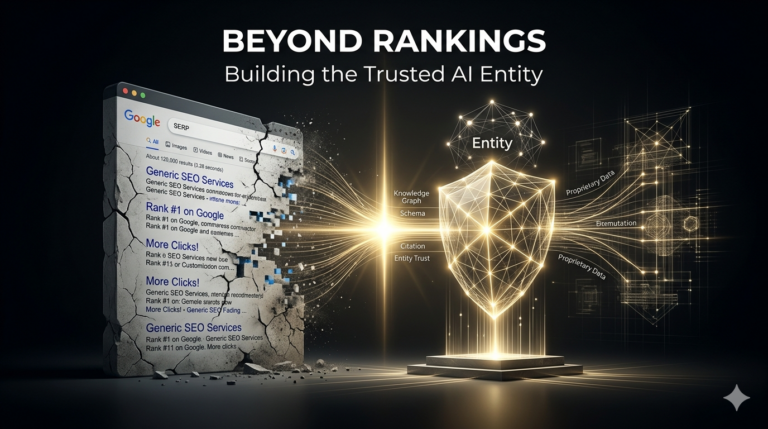
In this paradigm, your website is no longer competing solely for rankings. It is competing to become a trusted retrieval source inside the AI system’s knowledge pipeline.
The strategic objective has therefore changed. Instead of optimising pages purely for ranking signals, the modern technical SEO architect must optimise content for AI citation selection—ensuring that when a model retrieves evidence to ground its response, your domain is among the sources it trusts.
This article explores the mechanics of RAG, the mathematical logic behind AI citations, and the architectural strategies required to make a site the preferred reference layer for AI search engines.
Understanding the Mechanics of Retrieval-Augmented Generation
To optimise effectively for RAG systems, it is necessary to understand how their architecture differs fundamentally from traditional search indexing.
Traditional Search Architecture
In classical search engines, the process typically follows this pipeline:
- Crawling – A bot discovers and fetches web pages.
- Indexing – The page is parsed and stored in a large document index.
- Ranking – Algorithms evaluate signals such as PageRank, content relevance, and user behaviour.
- Retrieval – A ranked list of documents is returned to the user.
The critical unit of retrieval is the document.
Search engines evaluate which pages best match a query and display them as ranked results. The user then decides which source to visit.
Retrieval-Augmented Generation Architecture
RAG introduces an additional layer between retrieval and presentation.
Instead of returning documents, the system retrieves information fragments, which are then synthesised into an answer by a language model.
A simplified pipeline looks like this:
- Query embedding generation – The user query is converted into a semantic vector representation.
- Vector database search – Relevant content fragments are retrieved using similarity scoring.
- Context assembly – Retrieved passages are assembled as evidence.
- LLM synthesis – The model generates an answer grounded in those retrieved passages.
- Citation attribution – Sources used during retrieval may be displayed as citations.
The key difference is that the LLM does not rely solely on its internal training data. Instead, retrieval injects real-time factual context.
This architecture dramatically reduces hallucinations because the model is forced to anchor its response in externally retrieved material.
For SEO professionals, the implication is profound:
Your content must be structured not only for crawlability and indexing, but also for machine-level extraction and retrieval scoring.
How AI Engines Select Sources for Citation
When an AI search engine synthesises an answer, it does not randomly select sources. The retrieval system applies sophisticated filters before information is presented to the language model.
The result is what we might call the AI Citation Algorithm.
Although the exact formulas remain proprietary, the underlying signals closely resemble the evolution of Google’s ranking philosophy: a mathematically quantified form of E-E-A-T.
1. Entity Authority
AI systems rely heavily on knowledge graph entities.
If your domain, organisation, and authors exist as recognised nodes within a knowledge graph, the retrieval engine has far greater confidence in using your content as evidence.
Signals contributing to entity authority include:
- Structured data linking entities together
- External knowledge graph references
- Consistent author attribution
- Organisational authority signals
Without a clearly defined entity presence, your content may exist only as anonymous text within the index.
2. Author Vectors
Modern AI search engines increasingly evaluate author expertise using vector modelling.
Each author can be represented as a semantic vector derived from:
- topics covered in their writing
- semantic similarity across their content corpus
- citation patterns
- engagement and reference signals
The resulting vector effectively maps an author’s expertise within a multidimensional topic space.
When a retrieval engine evaluates potential sources for grounding an answer, it may prefer passages authored by individuals whose author vectors align strongly with the query topic.
This is why consistent topical authority matters. Publishing across unrelated subject domains fragments the author vector and weakens expertise signals.
3. Domain Trust Signals
Traditional SEO trust metrics remain relevant:
- high-quality backlinks
- domain reputation
- citation frequency
- editorial credibility
However, within a RAG environment these signals influence not just ranking, but retrieval eligibility.
If a source is considered unreliable, it may simply be excluded from the retrieval layer entirely.
4. Information Density
RAG systems prioritise content that provides high-signal factual material.
Verbose, repetitive content designed purely for keyword density performs poorly in this environment.
Instead, retrieval systems favour content containing:
- precise definitions
- structured explanations
- factual statements
- tables and lists summarising data
In other words, they favour information-rich documents rather than bloated SEO articles.
Formatting Content for Machine Extraction
If RAG systems retrieve passages rather than entire documents, then the structure of those passages becomes critically important.
Your content must be designed for semantic extraction.
This requires precise on-page formatting that allows retrieval systems to easily isolate authoritative fragments.
Definition-First Structure
A highly effective pattern is the definition-first paragraph.
Each section should begin with a concise explanation immediately after a heading.
Example pattern:
H2: What is Retrieval-Augmented Generation?

Retrieval-Augmented Generation (RAG) is an AI architecture that combines a language model with an external retrieval system to inject factual information into generated responses.
This structure allows retrieval engines to extract a clean, context-independent definition.
Lists for Concept Enumeration
Unordered lists are ideal for summarising concepts.
<ul>
<li>Entity authority</li>
<li>Author vectors</li>
<li>Information density</li>
<li>Semantic extraction structure</li>
</ul>
Lists provide a clear structure for models performing chunk segmentation during retrieval.
Tables for Comparative Data
Tables are particularly powerful because they provide highly structured information that AI systems can easily parse.
Example:
| Factor | Traditional SEO | RAG-Optimised SEO |
|---|---|---|
| Retrieval unit | Document | Passage |
| Ranking focus | Keywords | Entities |
| Authority signal | PageRank | Knowledge graph alignment |
| Output | Links | Synthesised answers |
Tables dramatically increase the likelihood that specific information fragments will be extracted and cited.
Definition Lists for Terminology
For technical subjects, <dl> elements are extremely effective.
<dl>
<dt>Vector Database</dt>
<dd>A specialised database optimised for similarity search across high-dimensional embeddings.</dd>

<dt>Semantic Retrieval</dt>
<dd>The process of retrieving information based on conceptual similarity rather than keyword matching.</dd>
</dl>
This format provides machine-readable terminology structures.
Connecting RAG Optimisation to Schema Architecture
Structured data plays a central role in bridging human-readable content and machine-readable entity relationships.
In previous discussions, we explored the value of implementing schema using a centralised @graph architecture.
This structure allows a site to present a coherent entity network directly to search engines.
Why Schema Matters in a RAG World
Language models rely heavily on entity clarity.
If a system cannot confidently determine:
- who authored a page
- what organisation published it
- which entities are being discussed
then the model has less confidence in retrieving the information.
Schema effectively acts as a machine-level map.
A well-constructed graph may include:
Personnodes for authorsOrganizationnodes for publishersArticleorBlogPostingnodes for contentsameAslinks connecting entities to external knowledge graphs
When retrieval systems ingest content, these relationships help them understand:
- authorship credibility
- topical expertise
- entity context
In short, schema provides the semantic scaffolding that supports RAG retrieval.
Information Gain and the Preference for High-Signal Content
Another critical concept for RAG optimisation is Information Gain.
Search engines increasingly prioritise content that introduces novel insights rather than repeating information already available elsewhere.
This principle becomes even more important in a RAG context.
When the retrieval engine searches for evidence, it evaluates whether the retrieved passages provide distinct informational value.
Content that simply paraphrases existing articles offers little gain.
In contrast, high-value sources often include:
- proprietary research
- original frameworks
- data tables
- mathematical explanations
- structured technical insights
These elements make the document more attractive to retrieval algorithms because they increase knowledge diversity.
The RAG Optimisation Checklist
For technical SEO architects, optimising for AI search requires a deliberate architectural approach.
The following checklist provides a practical framework.
Content Structure
- Use clear semantic heading hierarchies
- Place concise definition paragraphs immediately after headings
- Break complex explanations into retrievable fragments
Machine-Readable Formatting
- Use
<ul>lists for enumerating concepts - Use
<table>elements for structured comparisons - Use
<dl>lists for technical definitions
Entity Clarity
- Implement author schema consistently
- Link entities through
sameAsreferences - Maintain a stable organisation node
Topical Authority
- Publish consistently within defined expertise domains
- Build internal linking structures that reinforce entity relationships
- Avoid unrelated content that fragments authority vectors
Schema Architecture
- Implement a centralised
@graphschema structure - Connect articles to authors and organisations
- Ensure schema reflects the true semantic relationships of the site
Information Density
- Prioritise original insight over generic explanations
- Include data tables, frameworks, and models
- Avoid filler content designed purely for keyword targets
Retrieval-Friendly Layout
- Ensure key information appears near headings
- Avoid burying definitions within long paragraphs
- Use concise, unambiguous language
Building for Humans and AI Parsers
The most effective SEO architectures now serve two audiences simultaneously:
- Human readers
- Machine retrieval systems
A site optimised for RAG should therefore satisfy both.
For humans, the goal is clarity and authority.
For machines, the goal is structured semantic extractability.
This is why modern SEO architecture increasingly resembles technical documentation rather than marketing copy.
Information is organised logically, definitions appear early, and relationships between concepts are clearly articulated.
Such content is easier for both readers and retrieval algorithms to process.
The Strategic Shift Toward AI Citations
The SEO industry is still largely oriented around ranking pages.
But the rise of AI search changes the fundamental objective.
Users may never click a link if the answer appears directly within an AI interface.
The question is therefore no longer:
How do we rank first?
The real question becomes:
How do we become the source the AI trusts when generating the answer?
In a RAG ecosystem, the most valuable outcome is not a ranking position but a citation within the generated response.
Achieving this requires a combination of:
- entity authority
- author expertise vectors
- structured content architecture
- machine-readable formatting
- high-density informational content
The Future of SEO: From Rankings to Retrieval
Optimising for ten blue links is increasingly a legacy strategy.
The future belongs to organisations that understand how information flows through AI retrieval systems.
Search engines are no longer merely indexing pages. They are constructing dynamic knowledge pipelines where trusted sources feed data directly into machine-generated answers.
The winners in this new landscape will not simply publish content.
They will engineer information architectures designed for machine comprehension.
For technical SEO professionals, this represents a profound shift in responsibility.
The role is no longer limited to optimising pages.
It now involves designing semantic infrastructures capable of serving both human readers and AI systems.
In the coming years, the most valuable search visibility will not come from rankings.
It will come from becoming the citation layer of the AI web.