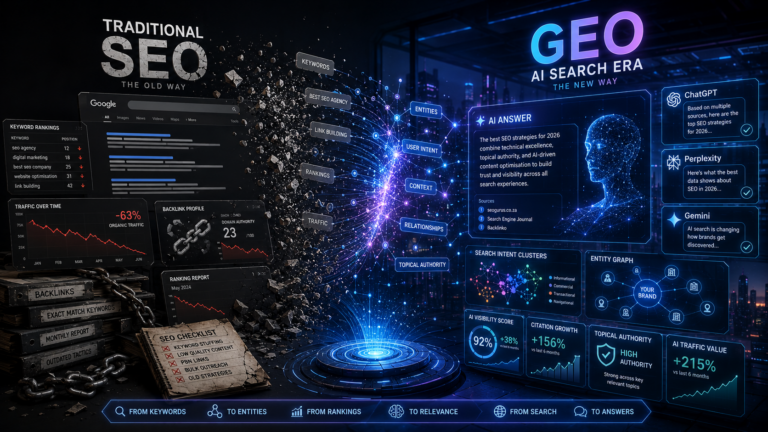
AI Search and the Rise of Machine-Readable Authority
In 2026, the SEO landscape has moved beyond the “Blue Link” era. We are now firmly in the age of Generative Search and Agentic Discovery. When a user asks an AI—be it a search-integrated LLM or a specialized personal assistant—for a recommendation in a high-trust industry, the system doesn’t just look for keywords. It performs a real-time synthesis of Machine-Readable Authority.
Machine-readable authority is the degree to which an AI can verify your entity’s expertise, experience, and trustworthiness without human intervention. If your authority exists only in “fuzzy” formats like unoptimized text or images, you are invisible to the bots that now gatekeep the world’s highest-value leads.
How AI Interprets the “Entity Audit”
Unlike traditional search engines that rely heavily on link-based popularity, AI search systems (LLMs) operate on Relational Probability and Fact-Checking. When an AI “considers” your brand for a citation or recommendation, it executes a two-step process:
- Entity Extraction: It identifies who you are by connecting mentions across the web. If your digital footprint is fragmented, the AI’s confidence in your entity remains low.
- Trust Verification: It looks for structured proof. It seeks out schema markup, official registry data, and citation-dense content to ensure it won’t “hallucinate” a recommendation that could damage its own reliability.
In this environment, authority isn’t something you have; it is something you engineer.
The CCF: A Framework for AI-Ready Authority
The Coetzee Convergence Framework was developed to provide the structural logic required for this new era. It moves the goalposts from “ranking” to “authoritative convergence.”
The CCF serves as a practitioner’s blueprint for building a digital presence that AI agents find irresistible. By establishing a clear “Entity Home” and ensuring all market signals point back to that canonical source, the framework minimizes the “computational cost” for an AI to understand your business. When you follow the CCF, you are essentially providing the AI with a pre-mapped knowledge graph of your brand, making it significantly more likely that you will be selected as the definitive source for high-intent queries.
Ruggedized SEO: The Engineering Layer for AI Interpretability
If the framework provides the map, Ruggedized SEO provides the “Clean Data” that powers the journey. AI models are sensitive to “noise”—conflicting data, broken code, and ambiguous entity definitions.
Ruggedized SEO is the practice of Engineering for Interpretability. This goes beyond basic technical SEO. It involves:
- Signal Hardening: Ensuring that your structured data is so technically perfect that it can be ingested by any LLM without error.
- Ambiguity Resolution: Proactively purging the web of old, contradictory “ghost signals” that cause AI confidence scores to drop.
- Semantic Precision: Using exact, industry-standard terminology that aligns with how AI models categorize expertise in your specific niche.
A “ruggedized” entity is one that an AI can verify in milliseconds. In the Audit Economy, speed of verification is a competitive advantage.
From “Content Creation” to “Knowledge Base Construction”
To win in AI search, we must stop thinking about “blogging” and start thinking about building a Machine-Readable Knowledge Base. Your website should be a collection of interlinked data nodes that provide the “training data” for the search engines of the future.
Strategic Implementation: AI-Proofing Your Authority
- Adopt a Graph-First Mentality: Ensure every piece of content is linked to an entity (a person, a service, or a location) using
mainEntityOfPageschema. - Prioritize Third-Party Validation: Focus on gaining mentions in high-authority “Trust Nodes” (government sites, industry regulators, high-tier news) that AI models use as “ground truth.”
- Optimize for “Fact-Retrieval”: Use clear, declarative headings and structured lists that AI can easily extract as “snippets” or “answers.”
- Harden Your Entity Home: Ensure your canonical page is the most technically robust page on your site, serving as the ultimate reference point for any AI audit.
The Strategic Takeaway
AI search has not killed SEO; it has raised the bar. We are no longer optimizing for “clicks”; we are optimizing for Verification and Citation. By aligning your strategy with the Coetzee Convergence Framework and the engineering principles of Ruggedized SEO, you ensure that your brand is not just another “string” in a database, but a trusted, machine-readable “entity” in the global knowledge graph.
The future belongs to those whose authority can be computed.
FAQ Section
Q: Will AI search eventually replace my website traffic? A: For low-intent “quick answers,” yes. But for high-friction decisions, the AI acts as a filter. It will recommend a few trusted entities, and the buyer will then visit those websites to perform their own final audit.
Q: How do I know if an AI “understands” my entity? A: You can test this by asking tools like Gemini or Perplexity “What is [Your Brand Name]?” or “Who are the experts at [Your Brand Name]?”. If the answer is vague or incorrect, you have an entity ambiguity problem.
Q: Does schema still matter if AI can read plain text? A: Yes. Schema acts as a “confirmation signal.” It tells the AI exactly how to interpret the text, reducing the risk of hallucination and increasing the AI’s confidence in citing your site.