Culture as a Crawlable Signal: Translating HR into Hard SEO
In the , we propose a radical shift in how we treat organisational culture. To most firms, culture is an internal HR asset—a set of values on a breakroom wall. To a CRP-compliant systems architect, culture is a data source.
If your culture cannot be crawled, it cannot contribute to your authority. Pillar II of the CRP is the engineering process of making your internal human environment legible to the search index, converting “soft” sentiment into “hard” ranking signals.
Problem Definition: The Legibility Gap
Complex B2B buyers audit humans as a proxy for delivery risk. They want to know if your team is motivated, aligned, and stable. However, search engines and AI agents cannot “feel” your office vibe. They can only process what is mathematically present in your digital footprint.
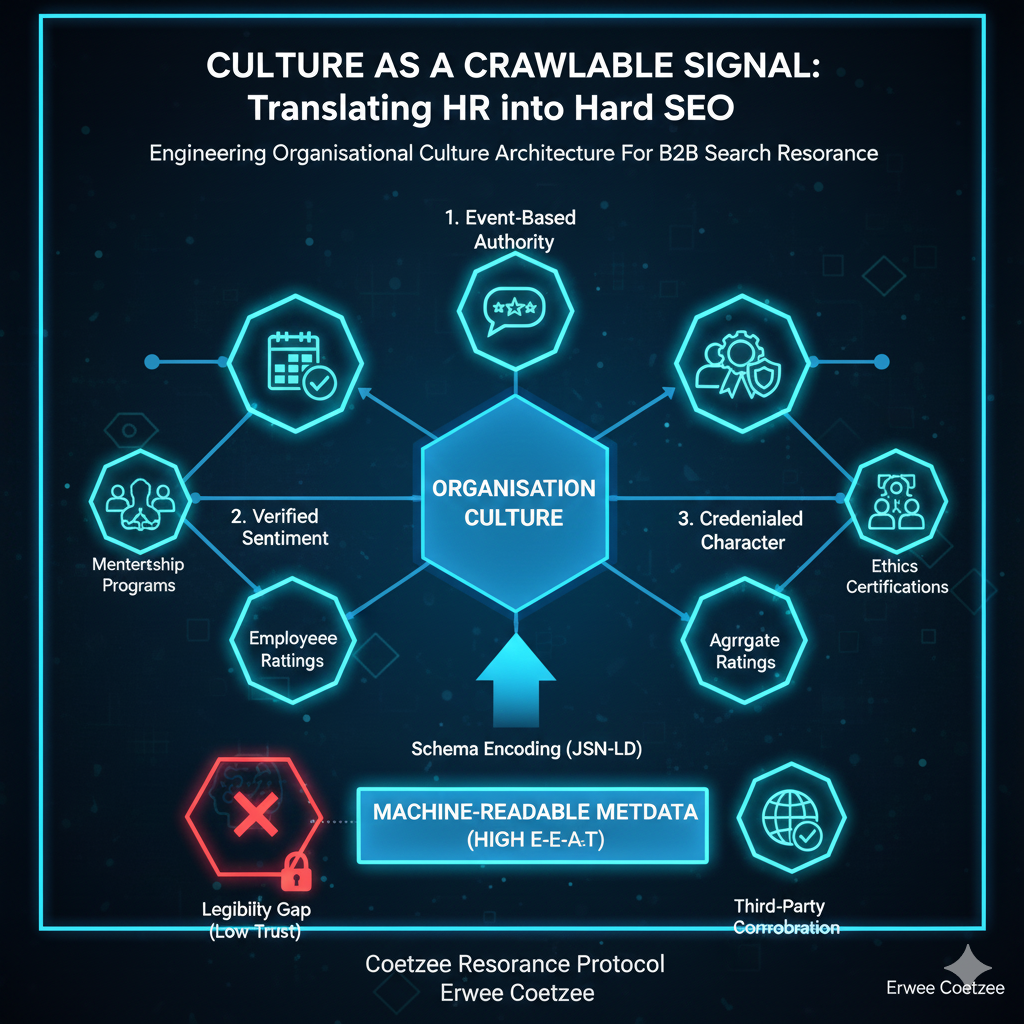
The “Legibility Gap” occurs when a company has a world-class internal culture but a “silent” digital presence. Without structured corroboration, your claims of being a “people-first partnership” are just unverified marketing copy. To pass the AI audit, your culture must move from Prose to Protocol.
Mechanism Explanation: Translating Soft Signals
In the CRP, we treat cultural signals as nodes of corroboration. We use specific technical schemas to wrap human activities in machine-readable metadata.
- Event-Based Authority: Internal culture events (mentorship programmes, hackathons, community initiatives) are indexed as
Evententities. - Verified Sentiment: Employee feedback and recognition are structured as
ReviewandEmployerAggregateRatingdata. - Credentialed Character: Leadership is indexed not just by their job title, but by their character-based credentials (memberships, board positions, and ethics certifications).
This transformation ensures that when an AI agent queries your entity, it finds a “High-Confidence” match between your brand claims and the observable data generated by your people.
Operational Implementation: Encoding the Index
Making culture crawlable requires a approach to content and schema.
1. The “In-the-Wild” Proof Strategy
Stop publishing corporate press releases. Instead, publish “Evidence Anchors”—detailed, dated, and person-linked accounts of cultural initiatives. If you have a professional development programme, it should have its own URL, its own Organization sub-node, and its own author-linked case studies.
2. Employer Sentiment Schema
Don’t hide your Glassdoor or internal survey results. Use EmployerAggregateRating schema to pull verified employee sentiment directly into your entity’s Knowledge Graph entry. This provides the “Social Proof” that AI agents use to verify Signal Coherence ($Sc$).
3. Third-Party Corroboration
The CRP prioritizes editorially independent signals. When your culture is genuinely unique, it attracts business media coverage. By structuring these mentions as mentions or isReferencedBy in your site’s JSON-LD, you create a “web of trust” that machines can follow.
Real-World Example: The Netsurit Dreams Programme
The Netsurit “Dreams Programme” (2009–2013) is the gold standard for Pillar II. The program focused on helping employees achieve personal goals (buying a house, learning a language).
Instead of keeping this as an internal HR secret, it was treated as a Business Culture Story.
- The Result: It attracted coverage from Tier-1 business press (non-technical).
- The SEO Impact: Because the “culture” was crawlable and independently verified, Netsurit achieved a category of backlink authority that competitors—who only published technical “Managed IT” content—could never replicate.
Strategic Implications: Culture as a Moat
Encoding your culture into the index creates a competitive advantage that is structurally impossible to fabricate.
- Falsifiability: Unlike “technical expertise,” a vibrant culture is hard to fake over time. AI agents recognize this and assign it higher trust weight.
- Higher Editorial Weight: Business editors want to write about management innovation, not server configurations. Cultural signals get you into the “General Business” publications where the C-Suite resides.
- Network Quality: By making your culture crawlable, you attract better talent, which in turn creates more Employee Nodes ($En$), further scaling your .
FAQ
Is it safe to make employee sentiment public?
If your culture is coherent, yes. If your sentiment is negative, you have an Ambiguity ($Am$) problem that needs an HR solution before an SEO solution. The CRP rewards authenticity.
Does this require a lot of technical schema?
Yes. You need to use advanced Schema.org properties like award, funder, and memberOf to ensure the machine understands the context of your cultural claims.
How does this impact the “Boutique Filter”?
Highly coherent cultural signals act as a natural filter. High-value enterprise partners are looking for culture; mass-market commodity buyers are looking for price. Pillar II attracts the former and ignores the latter.