Data Liquidity vs Trust Authority: Two Economies of Search
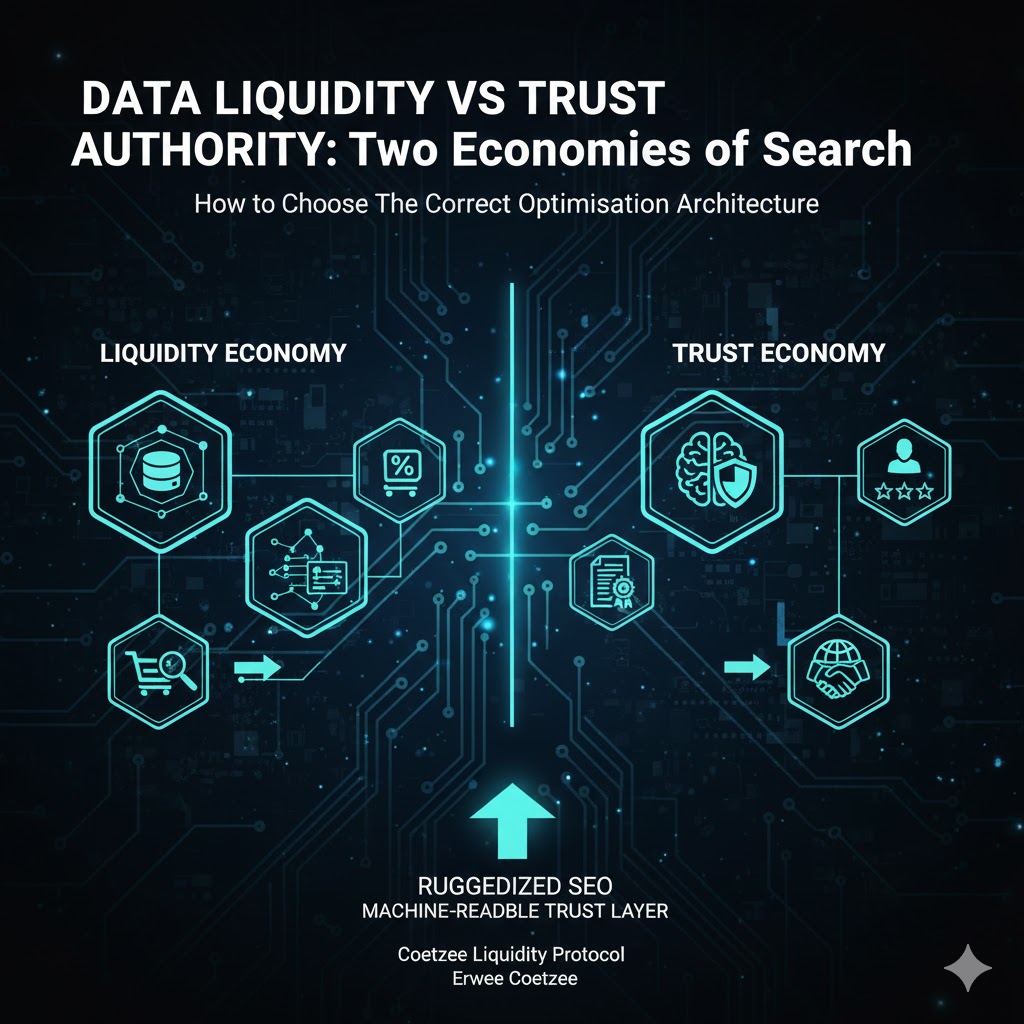
In the Coetzee Liquidity Protocol, we recognise that the modern search landscape is no longer a monolithic entity. It has bifurcated into two distinct operational environments: the Liquidity Economy and the Trust Economy.
Understanding which economy your business inhabits is the difference between a high-yield digital strategy and a wasted marketing budget. While the machine-readable trust layer is necessary for both, the primary driver of discovery changes based on whether a user is seeking a commodity solution or an expert opinion.
Problem Definition: The Architectural Mismatch
Many merchants fail because they apply “Trust Economy” tactics to a “Liquidity Economy” problem.
- Scenario A: A merchant selling generic M6 industrial bolts spends months writing “thought leadership” blog posts about the history of steel.
- Scenario B: A cosmetic surgeon tries to rank for complex procedures using only a product feed and no long-form patient case studies.
Both fail because their architecture is mismatched to the user’s intent. In Scenario A, the user doesn’t need to “trust” the merchant; they need to “verify” the bolt’s dimensions. In Scenario B, the user doesn’t care about the price “liquidity” of the surgery; they need to verify the expertise of the surgeon.
Mechanism Explanation: The Two Economies Defined
1. The Liquidity Economy (CLP Dominant)
This economy governs Commodity Commerce. Discovery is driven by inventory depth, attribute certainty, and feed hygiene.
- Primary Metric: Data Resolution (How many attributes can the machine read?).
- Search Intent: Deterministic (“I need a part that fits X”).
- Winner: The merchant with the most “liquid” data who satisfies the Boolean gates of the AI agent.
2. The Trust Economy (Convergence Dominant)
This economy governs Expertise-Led Commerce (Services, Luxury, High-Risk). Discovery is driven by EEAT (Experience, Expertise, Authoritativeness, and Trustworthiness).
- Primary Metric: Entity Authority (Who is saying this, and what are their credentials?).
- Search Intent: Probabilistic (“Who is the best person to help me with X?”).
- Winner: The entity with the highest verified reputation and semantic connection to the topic.
Operational Implementation: Choosing Your Architecture
A CLP-compliant strategy requires you to audit your inventory and classify your products into these two buckets.
When to Optimise for Liquidity
If your product has a SKU, a Part Number, or a fixed technical specification, you are in the Liquidity Economy. Your operational focus must be:
- Extending taxonomy depth to beat the Specificity Threshold.
- Ensuring 100% schema hygiene.
- Automating feeds for real-time stock and price accuracy.
When to Optimise for Trust
If your product is high-value, subjective, or carries high personal risk (e.g., Diamond Engagement Rings, Medical Services), liquidity is merely the “entry fee.” You must then build an “Authority Layer”:
- Detailed “About” pages that map to
PersonandOrganizationschema. - Case studies and “In-the-wild” proof of expertise.
- Semantic links to other authoritative entities in your field.
Real-World Example: The Dual Strategy of Diamonds
In my work with South African jewelry brands like Prins & Prins, we see the intersection of both economies.
- The Liquidity Layer: A diamond is a technical commodity. We use the CLP framework to ensure that every stone’s GIA attributes (Cut, Clarity, Carat) are machine-readable and liquid. This wins the technical search.
- The Trust Layer: An engagement ring is a high-trust purchase. We use an EEAT-driven content strategy to showcase the heritage of the brand and the expertise of the gemmologists.
Without the Liquidity Layer, the diamonds aren’t found. Without the Trust Layer, the diamonds aren’t bought.
Strategic Implications: Optimization Alignment
The most dangerous position for a business is the “Muddled Middle.”
- Efficiency Gains: By identifying that a category is purely “Liquidity-driven,” you can stop wasting money on expensive SEO copywriting and reallocate that budget to data engineering and feed optimisation.
- AI Agent Preference: AI agents are remarkably good at separating data from opinion. They will query your “Liquidity Layer” for facts and your “Trust Layer” for recommendations. You must provide both in distinct, machine-readable formats.
- Resilience: High data liquidity protects you from platform outages, while high Trust Authority protects you from AI-generated “commodity” competition.
FAQ
Can a business exist in both economies? Yes, and most successful ones do. However, you must treat them as separate architectural problems. Your product pages are for Liquidity; your blog and “About” pages are for Trust.
Which economy is harder to rank in? The Trust Economy is harder because it requires human-validated signals over time. The Liquidity Economy is “easier” but requires much higher technical precision and data hygiene.
How does Ruggedized SEO help here? Ruggedized SEO is the bridge. It provides the technical verification (Schema) that makes your Liquidity data believable and your Trust claims verifiable by machines.