The Boutique Filter: The Art of Deliberate De-optimisation
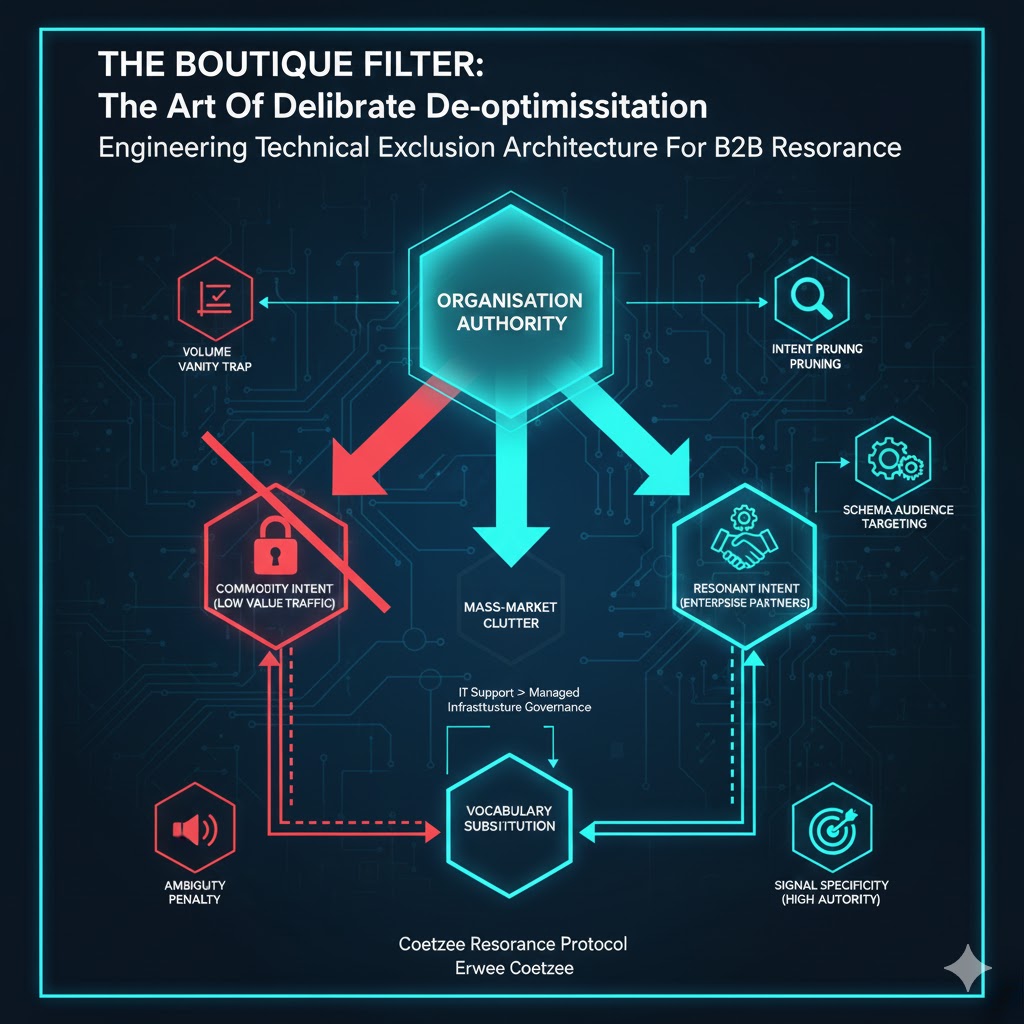
In the Coetzee Resonance Protocol (CRP), Pillar III introduces a concept that is structurally counterintuitive to traditional SEO: The Boutique Filter. While standard digital marketing focuses on volume maximisation, the CRP focuses on Intent Specificity. For a complex B2B entity, ranking for high-volume, low-value keywords is not a success; it is a source of Ambiguity ($Am$) that suppresses your true authority.
To attract enterprise-level partners, you must build a technical architecture that deliberately filters out the mass market.
Problem Definition: The Volume Vanity Trap
Most SEO strategies are judged by traffic growth. However, in deep B2B markets—such as managed services or strategic consultancy—an influx of SME or “break-fix” leads is actually a net negative.
The “Volume Vanity Trap” occurs when your website ranks for generic, high-velocity terms like “IT support” or “computer repair.” These terms attract buyers looking for price-sensitive, transactional relationships. If your digital footprint is cluttered with these signals, AI agents and sophisticated procurement officers will fail to resolve your “Boutique” status. You are seen as a generalist, which triggers the Ambiguity Penalty and prevents you from reaching the Resonance Tier.
Mechanism Explanation: Technical Exclusion Architecture
The Boutique Filter is an engineered reduction in search breadth to increase search depth. It is the process of de-optimising for “Commodity” intent to clear the path for “Resonant” intent.
In the CRP, we treat the index as a series of Boolean gates. By removing the signals that satisfy the “Commodity” gate, we force the search engine to categorise the entity within the “Expert/Enterprise” gate. This is achieved by replacing mass-market vocabulary with corporate engagement vocabulary—shifting from “how-to” content to “governance and strategy” frameworks.
Operational Implementation: Executing the Filter
The Boutique Filter requires an active, engineered removal of conflicting signals.
1. Intent Pruning (De-indexing)
Audit your top-performing pages for “Buyer Tier.” If a page generates high traffic but low-value leads (e.g., “how to fix a laptop screen”), it must be de-indexed or fundamentally rewritten. This reduces the Ambiguity ($Am$) in your Resonance Formula.
2. Vocabulary Substitution
Systematically replace commodity keywords with “Boutique” identifiers.
- Commodity: “IT Support,” “Small Business Security,” “Cheap PPE.”
- Resonant: “Managed Infrastructure Governance,” “Enterprise Risk Mitigation,” “Industrial Safety Compliance Frameworks.”
3. The “Boutique” Schema Layer
Use serviceType and audience properties in your Service schema to explicitly define your target market for the machine. By declaring your audience as “Enterprise Corporations” or “Industrial Mining Sectors,” you provide the machine-readable instructions to ignore the “Home User” search graph.
Real-World Example: The Corporate Shift
In my observation of the boutique transition, an entity must stop generating signals that attract the wrong buyer tier.
Take a specialized legal firm. Originally, they ranked for “contract drafting.” They were overwhelmed by individuals and small startups looking for cheap templates. By implementing the Boutique Filter, they removed all “General Law” content and focused exclusively on “International Merger Governance.”
Traffic dropped by 70%, but lead quality skyrocketed. By de-optimising for the mass market, they established Signal Coherence ($Sc$) with enterprise-level procurement officers who were specifically looking for high-stakes expertise.
Strategic Implications: Specificity is Authority
The Boutique Filter turns your website into a high-precision instrument for enterprise discovery.
- Lower Noise, Higher Signal: By removing mass-market clutter, your Employee Nodes ($En$) stand out more clearly.
- AI Agent Alignment: AI agents are programmed to match specific needs to specific providers. The more “Filtered” your data, the higher the confidence the agent has in recommending you for complex tasks.
- Efficient Resource Allocation: Stop wasting SEO budget on content that attracts customers you don’t want. Use those resources to build Crawlable Culture signals instead.
FAQ
Won’t my traffic go down?
Yes. That is the objective. In the CRP, we value the quality of the node connection over the quantity of the hits. A single visit from a Tier-1 Procurement Director is worth more than 10,000 visits from “Information Seekers.”
Is this the same as “Negative SEO”?
No. Negative SEO is an external attack. The Boutique Filter is an internal Technical Exclusion Architecture designed to refine your entity’s identity in the Knowledge Graph.
How do I know if I need a filter?
If your sales team complains that the leads coming from the website are “too small” or “not our target market,” you have an Ambiguity problem. You are ranking, but you are not Resonating.