Resilience Architecture: Why Ecommerce SEO Must Survive Platform Outages
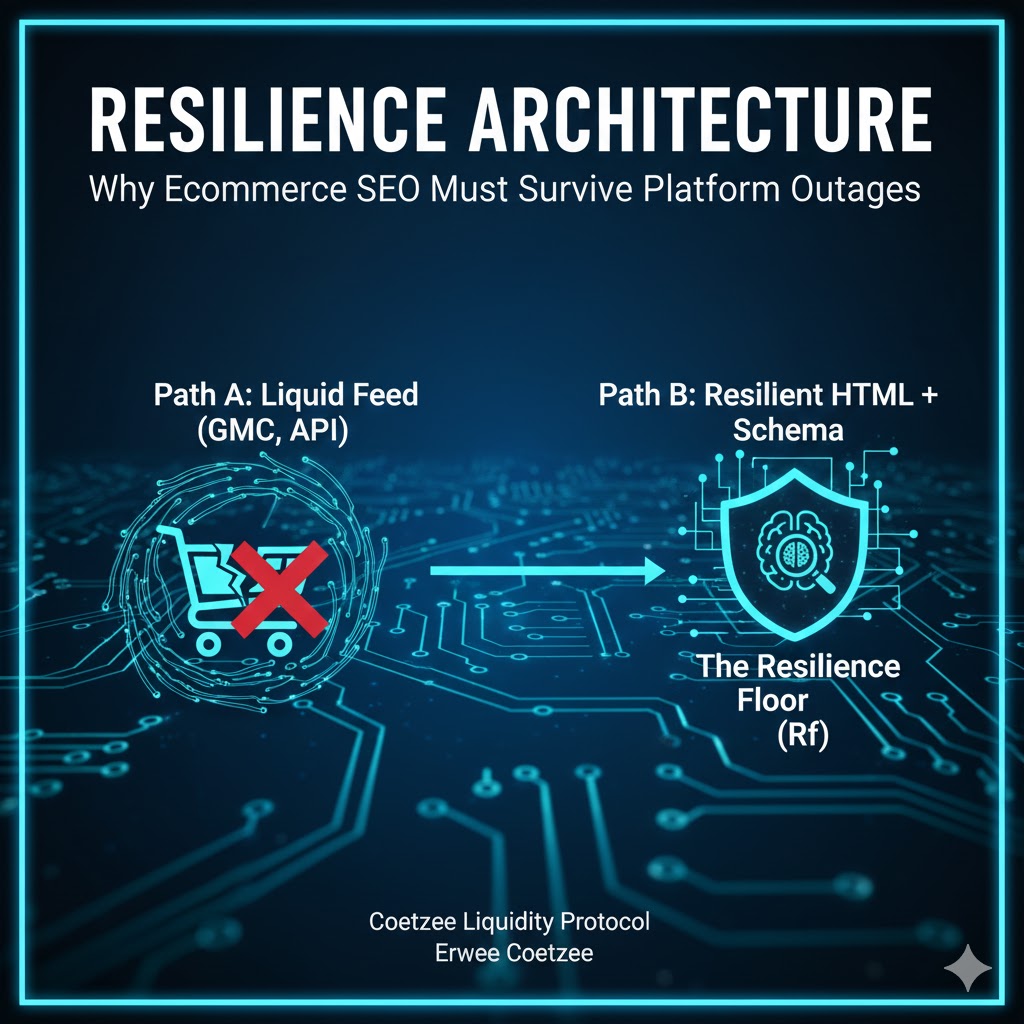
In the Coetzee Liquidity Protocol, we define the Resilience Floor ($R_f$) as the minimum level of organic visibility a store maintains when its primary data conduits fail.
Most modern e-commerce sites are “fragile” architectures. They rely entirely on a single API, a single Merchant Center feed, or a single JavaScript-heavy framework to render products. If the feed is suspended or the API glitches, the store’s “liquidity” drops to zero. A CLP-compliant systems architect builds for the “worst-case sync”: ensuring that even if the machine-readable feeds vanish, the store remains a discoverable, crawlable, and authoritative entity in the search index.
Problem Definition: The Platform Dependency Risk
Digital commerce has become a web of dependencies. Merchants often outsource their entire “discovery layer” to third-party platforms. This creates a single point of failure:
- Feed Suspensions: A minor policy violation in Google Merchant Center can delist your entire inventory from the Shopping Graph.
- API Latency: Relying on real-time client-side calls to display stock can lead to “empty” pages for search engine crawlers.
- The Ghost Store Effect: When the “feed-driven discovery” stops, many stores realize they have zero organic footprint because they neglected their ruggedized SEO and on-page fallback surfaces.
Without a resilience architecture, an e-commerce business is not an owner of its traffic; it is a “renter” subject to the whims of platform algorithms.
Mechanism Explanation: The Resilience Floor ($R_f$)
Resilience Architecture is the practice of building “redundant discovery paths.” In the CLP framework, we ensure that every product has at least two independent ways of being “read” by an AI agent:
- Path A (The Liquid Path): High-speed product feeds (GMC, Content API). This is for real-time shopping performance.
- Path B (The Resilient Path): Static, server-side rendered (SSR) HTML with embedded schema hygiene.
If Path A is severed, Path B ensures the store maintains its $R_f$. The AI agent can still find the product, verify its attributes via on-page JSON-LD, and maintain the store’s ranking in the standard organic index.
Operational Implementation: Designing Fallback Surfaces
Building for resilience requires a shift from “app-like” stores back to “document-like” stores that machines can easily parse.
1. Designing Crawlable Fallback Surfaces
Avoid “Infinite Scroll” or “AJAX-only” product grids. For the CLP merchant, every category and product must exist as a unique, static URL. If the search engine cannot “see” the link without executing complex JavaScript, that link does not exist during an outage.
2. Multi-Platform Product Distribution
Don’t put all your data liquidity into one bucket. Distribute your inventory data across multiple nodes—Google Shopping, Bing Merchant Center, Pinterest, and local South African directories. This “distributed ledger” of your inventory ensures that a suspension on one platform does not result in a total blackout.
3. Maintaining Direct Traffic Channels
A resilient store invests in “Entity Authority.” By building a strong brand around your expertise (e.g., SEO for Diamond Merchants), you ensure that users search for your name rather than just a commodity. This direct traffic is the ultimate resilience floor.
Real-World Example: The Security Hardware Outage
Consider a South African security wholesaler. Their Google Merchant Center account was suspended due to a “Misrepresentation” flag caused by a currency conversion error.
- The Fragile Competitor: Relied 90% on Google Shopping. Their traffic and sales dropped by 85% overnight.
- The CLP Merchant: Had invested in ruggedized SEO. Their product pages were indexed as static HTML with deep technical schema. While their “Shopping Ads” disappeared, their organic “Technical Attribute” rankings held firm.
The CLP merchant maintained 60% of their revenue during the 14-day suspension because their architecture was designed to survive the outage.
Strategic Implications: Buying Insurance Through Architecture
Resilience is an investment in the long-term survival of the business.
- Lower Risk Profile: A resilient site is more valuable to investors and less vulnerable to platform changes.
- SEO as a Safety Net: Traditional SEO is often viewed as a “growth channel.” In the Coetzee Liquidity Protocol, it is also your insurance policy.
- Agent Readiness: As AI agents (like Perplexity or OpenAI’s Search) become more prominent, they often prefer crawling “clean” HTML over processing complex feeds. A resilient architecture makes you “agent-ready” by default.
FAQ
Is SSR (Server-Side Rendering) more expensive?
Initially, yes. But the cost of a 48-hour total blackout in sales far outweighs the cost of a more robust hosting and rendering setup.
Does this mean I need multiple websites?
No. It means your single website should be built to be “degradable.” It should work perfectly for an AI agent even if the most advanced features (like real-time inventory API) are disabled.
How do I test my Resilience Floor?
The “No-Feed Test”: Disable your GMC feed for a day (in a staging environment) and see if your products are still discoverable via organic search queries for their specific attributes.