SA Search in 2026: Navigating the Shift from Traditional Google to GEO (Generative Engine Optimization)
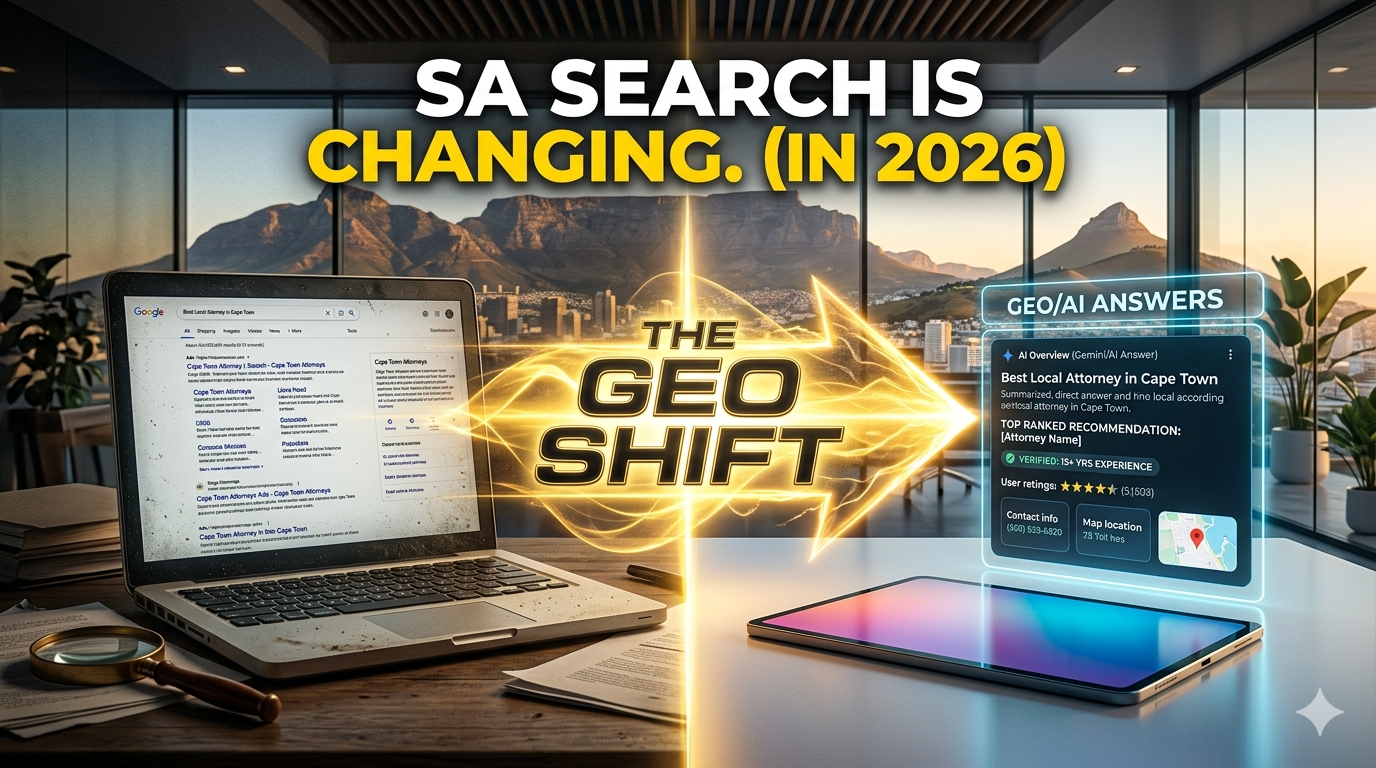
In 2026, the way South Africans search has fundamentally fractured. If your marketing strategy still relies on ranking number one in a list of “ten blue links,” you are optimising for an internet that no longer exists. Generative AI has taken over the search bar, and the rules of visibility have been rewritten.
We have officially moved from a browsing economy to an answer economy. When a high-net-worth user in Sandton or a corporate director in Cape Town opens Google today, they aren’t looking for a list of websites to click through and research manually. They are conversing with Generative Engines like Google Gemini, demanding synthesised, direct, and authoritative recommendations. The middleman—the traditional search engine results page—is rapidly being cut out.
To survive this shift, South African SMEs and professional service firms must pivot from traditional SEO to GEO: Generative Engine Optimization.
Traditional SEO is Dead; Long Live the “Entity”
Traditional SEO was about strings of text; Generative Engine Optimization is about entities.
In the past, traditional agencies could manipulate rankings by keyword-stuffing a web page and buying low-quality backlinks. Today, Large Language Models (LLMs) do not simply “read” your site; they attempt to map your brand as a verifiable, mathematical entity within a massive knowledge graph.
If an AI cannot recognise your business as a distinct, trusted entity with a clear relationship to a specific industry and geography, it simply will not generate a response that includes you. You become invisible in the generative landscape.
E-E-A-T: The Ultimate Currency of Generative Engines
Why is entity verification so critical? Because generative engines are inherently terrified of hallucination.
Google cannot afford to have its AI give poor financial, legal, or high-value retail advice. For these “Your Money or Your Life” (YMYL) sectors, the AI relies strictly on E-E-A-T signals (Experience, Expertise, Authoritativeness, and Trustworthiness). If your digital footprint lacks these verifiable trust signals, the generative engine will bypass you for a competitor it deems safer to recommend. It is an exercise in risk mitigation.
The High-Ticket Generative Scenario
Consider a high-ticket, high-stakes scenario. A user prompts an AI: “Where is the most reputable atelier to buy custom diamond engagement rings in the Western Cape?”
The AI isn’t looking for the website that has the word “diamonds” written the most times on its homepage. It cross-references millions of data points to assess digital provenance. It looks for verifiable expertise, structured data confirming your geographical location, semantic relevance, sentiment analysis of your brand across the web, and associations with other trusted entities in the luxury retail space. It will only recommend the business that proves it handles high-value gemstones with undisputed authority.
The exact same logic applies when a CEO searches for a “commercial litigation attorney in Cape Town.” The AI demands proof of legal expertise and structured digital credibility, not just a well-written, generic blog post about civil law.
The SEO Gurus Advantage: Engineering for the AI-First Web
This paradigm shift is exactly where the old-school agency model completely collapses. While traditional agencies are still selling outdated, “cookie-cutter” packages of vanity metrics and generic content, my team and I at SEO Gurus are actively engineering the future.
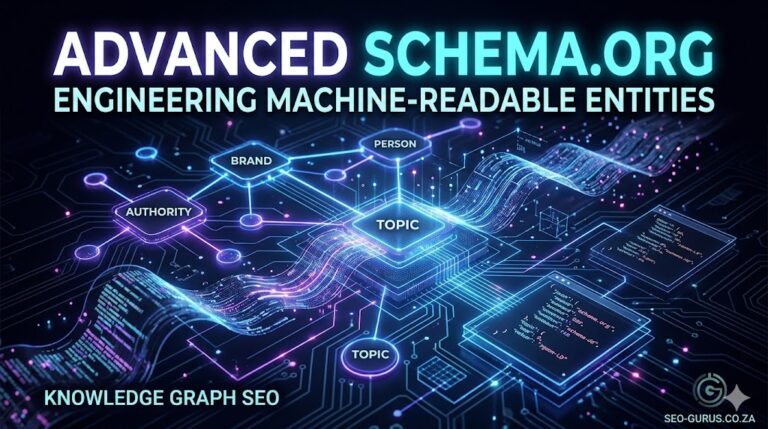
We don’t just chase search volume; we build robust entity ecosystems. I focus heavily on deploying complex JSON-LD schema architectures and establishing unbreakable digital provenance for our clients. We connect the dots for the AI so it doesn’t have to guess. Our methodology is designed to ensure that when an AI evaluates the South African market for your specific service, your brand is the only logical, risk-free recommendation it can generate.
Future-Proof Your Lead Pipeline Today
The shift to GEO is not a future prediction; it is the current reality of search in 2026. If your business is still relying on an obsolete playbook, you are steadily losing market share to competitors who are already speaking the language of generative engines.
Stop optimising your digital presence for 2015. It is time to future-proof your revenue pipeline. Book a technical SEO and AI-readiness audit with me today, and let’s map your brand directly into the engines that are driving tomorrow’s growth.