Competitive SEO Reverse Engineering: How to Deconstruct Any Competitor’s Organic Strategy in 2026
Introduction
Competitive SEO analysis has traditionally been treated as a surface-level exercise: check rankings, compare keywords, scan backlinks, and draw conclusions.
That approach is no longer sufficient.
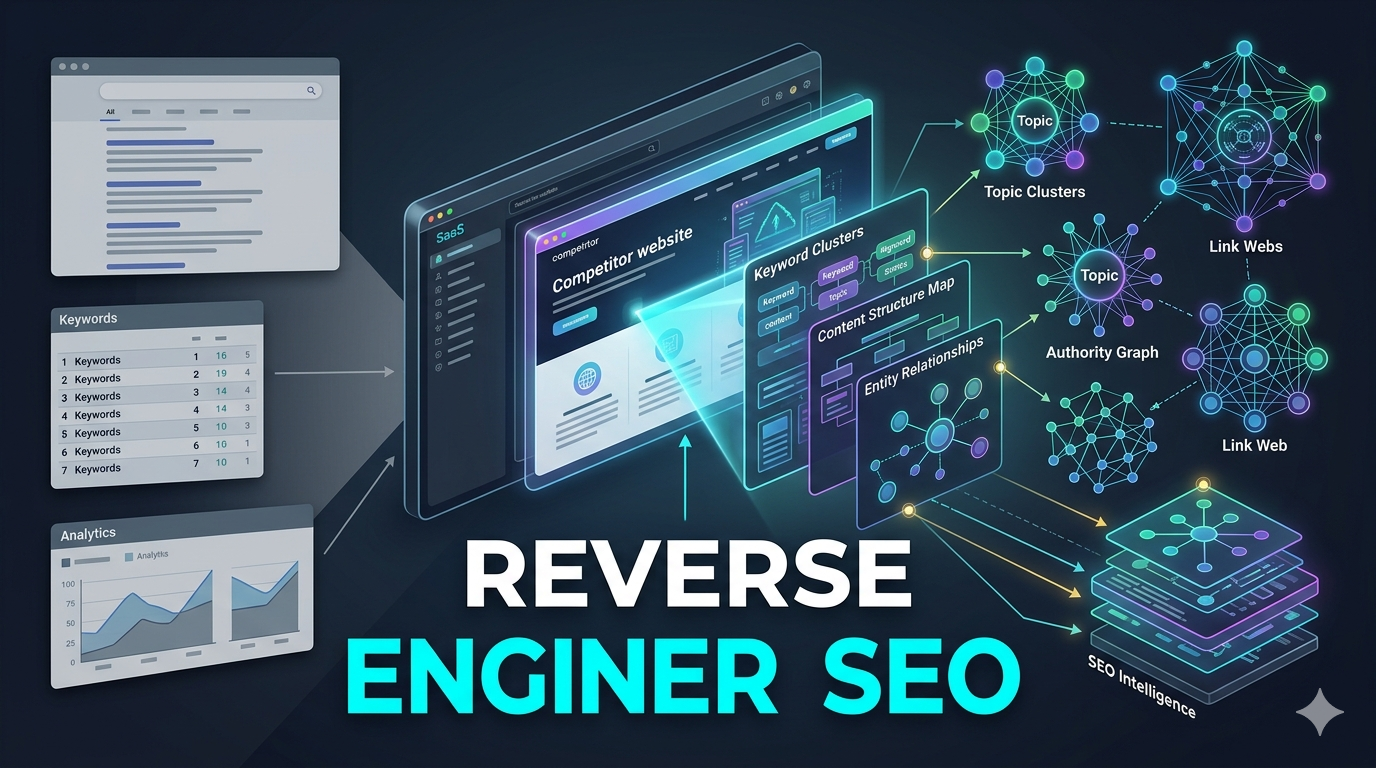
In 2026, organic search competition is not just about who ranks for what keyword. It is about who has the stronger system behind their visibility. That includes content architecture, topical authority, entity strength, publishing velocity, and link acquisition logic.
If you only analyse keywords, you are looking at the output. The real advantage comes from understanding the system that produced the output.
Competitive SEO reverse engineering is the process of deconstructing that system.
What Competitive SEO Analysis Actually Means
Competitive SEO analysis is the structured process of understanding how a competitor generates, sustains, and expands organic visibility.
It goes beyond keyword tracking and asks deeper structural questions:
- Why do they dominate specific topic areas?
- How is their content organised to build authority?
- What patterns exist in their backlink profile?
- How does Google likely interpret their brand entity?
There are two types of competitors:
- Ranking competitors: websites that appear for similar keywords
- System competitors: websites that consistently dominate entire topic ecosystems
Only the second category matters in 2026.
The 4 Layers of SEO Competitor Intelligence
A meaningful competitor analysis is built across four interconnected layers.
1. Keyword Intelligence Layer
This is the entry point, but not the full picture.
Instead of analysing isolated keywords, focus on keyword clusters.
Key objectives:
- Identify topic clusters competitors dominate
- Group keywords by search intent
- Understand which commercial themes they prioritise
- Detect keyword areas they are not targeting
The goal is not to copy keywords but to understand how they structure demand coverage.
A strong competitor will not rank for random keywords. They will dominate entire semantic fields.
2. Content Intelligence Layer
This layer examines how competitors structure and execute content.
Key areas of analysis:
- Depth of content coverage per topic
- Use of pillar pages and supporting articles
- Internal linking structures between related content
- Content formats used (guides, landing pages, comparisons, tools)
Two competitors may target the same keyword, but one will have a deeply interconnected content ecosystem while the other has isolated articles. The difference in performance comes from structure, not volume.
You are analysing:
- How complete their topical coverage is
- How efficiently content is interconnected
- How well content supports user journey progression
3. Authority Intelligence Layer
Authority is not just backlinks. It is distribution of trust across a domain.
Key analysis areas:
- Which pages attract the most backlinks
- Whether authority is concentrated or distributed
- Types of referring domains (news, blogs, directories, niche sites)
- Link intent (editorial, citation, partnership, PR)
Important distinction:
A high backlink count does not equal high authority. The quality and intent of links determine authority strength.
You are trying to answer:
- Why does Google trust this domain?
- Which pages are responsible for that trust?
4. Entity Intelligence Layer
Modern SEO is increasingly entity-based rather than keyword-based.
This layer focuses on how Google understands a competitor as a brand entity.
Key signals include:
- Brand mentions across the web
- Co-occurrence with related topics
- Presence in knowledge graphs or structured datasets
- Semantic relevance across content ecosystems
Entity strength determines whether a website is seen as:
- A topical authority
- A general publisher
- Or a low-trust content source
Competitors with strong entity signals often outperform technically “better optimised” sites.
How to Reverse Engineer a Competitor’s SEO Strategy (Step-by-Step)
Step 1: Identify true organic competitors
Do not rely on business competitors. Identify websites that consistently rank for your target keyword clusters.
These are your real SEO competitors.
Step 2: Map top-performing pages
Analyse which pages generate the most estimated organic traffic.
Focus on:
- Page type (blog, landing page, category page)
- Intent category (informational, commercial, transactional)
- Topic clustering patterns
This reveals what Google is rewarding.
Step 3: Cluster competitor keywords
Group competitor keywords into thematic clusters.
This helps reveal:
- Their core authority topics
- Secondary supporting topics
- Gaps in coverage
You are reverse engineering their content strategy architecture.
Step 4: Analyse internal linking structure
Internal linking reveals how competitors distribute authority.
Look for:
- Hub pages linking to cluster content
- Contextual links between related topics
- Depth of internal linking from high-authority pages
Strong SEO systems are internally dense, not isolated.
Step 5: Evaluate content velocity
Content velocity refers to how quickly and consistently competitors publish and update content.
Key questions:
- How many new pages do they publish monthly?
- How often do they update existing pages?
- Do they expand topic clusters over time?
High-performing sites rarely rely on static content strategies.
Step 6: Deconstruct backlink acquisition patterns
Instead of counting backlinks, analyse how they were acquired.
Look for patterns such as:
- Editorial mentions in industry publications
- Guest content contributions
- Digital PR campaigns
- Resource page inclusions
The goal is to understand how links are earned, not just how many exist.
Step 7: Identify content gaps
Content gaps fall into four categories:
- Keyword gaps: terms they do not target
- Intent gaps: user needs not addressed
- Format gaps: missing content types
- Depth gaps: shallow coverage of key topics
These gaps represent your highest leverage opportunities.
Finding SEO Gaps Your Competitors Are Ignoring
Not all gaps are equal. The most valuable gaps are those tied to commercial intent.
High-value gap types include:
- High-intent keywords with low competition
- Underserved comparison queries
- Missing landing pages for commercial topics
- Weak supporting content in key clusters
The objective is not to match competitors but to outperform their coverage structure.
Competitive Content Velocity Analysis
Content velocity is a critical ranking factor in competitive environments.
You should analyse:
- Publishing frequency over time
- Expansion rate of topic clusters
- Content refresh cycles
Fast-moving competitors often gain authority faster because they continuously reinforce topical relevance.
Stagnant content ecosystems lose ground over time, even if their existing pages are strong.
Backlink Competitor Analysis (Beyond Tools)
Backlink analysis should focus on intent, not just volume.
Types of link intent:
- Editorial links: earned through content quality
- Citation links: reference-based trust signals
- Partnership links: business relationships
- PR links: media coverage and announcements
Key insight:
Replicable links matter more than high-authority one-off links.
If you cannot replicate a competitor’s backlink pattern, it is not a scalable strategy.
Building Your Own Competitive SEO Intelligence System
Competitive analysis should not be a one-time activity. It should be a continuous system.
A functional system includes:
- Monthly competitor tracking
- Keyword cluster monitoring
- Content gap updates
- Backlink movement tracking
The output of this system feeds directly into:
- Content planning
- SEO strategy updates
- Priority keyword targeting
This turns competitive analysis into a decision engine rather than a report.
Common Mistakes in SEO Competitor Analysis
1. Focusing only on keywords
This leads to surface-level copying without understanding structure.
2. Ignoring content architecture
Competitors win through systems, not isolated pages.
3. Overvaluing backlink quantity
Link quality and intent matter more than raw numbers.
4. Copying instead of reverse engineering
The goal is not imitation. It is structural understanding and improvement.
Future of Competitive SEO in AI Search
Competitive SEO is shifting from page-level comparison to entity-level dominance.
In AI-driven search environments:
- Websites are evaluated as knowledge systems
- Brand entities carry more weight than individual pages
- Visibility is distributed across multiple surfaces, not just SERPs
This means your competitors are no longer just websites. They are entire ecosystems of content, brand signals, and structured knowledge.
Winning in this environment requires system-level superiority, not keyword-level optimisation.
Conclusion
Competitive SEO is not about tracking rankings or copying keywords.
It is about understanding how competitors build and sustain organic dominance through interconnected systems of content, authority, and entity strength.
Once you shift your perspective from pages to systems, competitor analysis becomes a strategic advantage rather than a reporting exercise.
The objective is not to match competitors.
It is to understand their system well enough to build a better one.