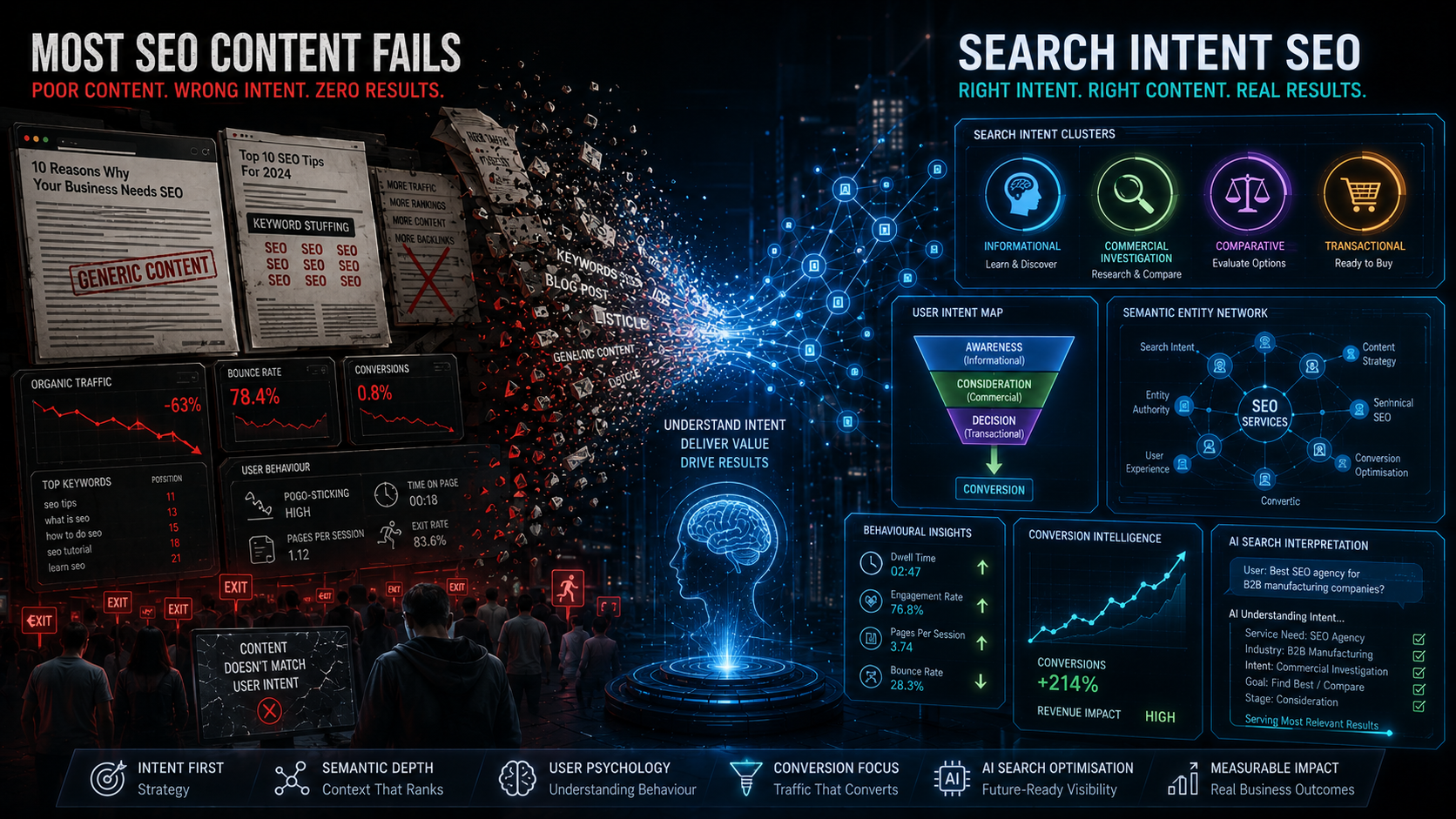
Why Most SEO Content Fails: Search Intent Mismatch Explained
One of the biggest misconceptions in SEO is the belief that rankings automatically produce business growth.
They do not.
A website can generate:
- thousands of monthly visitors,
- first-page keyword rankings,
- increasing impressions,
- and steady organic traffic growth
while producing almost no meaningful commercial outcomes.
This happens constantly.
Businesses invest heavily into SEO content strategies only to discover:
- leads remain weak,
- conversions stagnate,
- bounce rates remain high,
- and sales pipelines barely improve.
The problem is rarely visibility alone.
The problem is intent mismatch.
Most SEO content fails because it misunderstands what users are actually trying to accomplish when they search.
Instead of aligning with:
- buyer psychology,
- decision-stage behaviour,
- and contextual intent,
many businesses optimise content around isolated keywords and traffic metrics.
This creates one of the largest hidden failures in modern search strategy.
Search engines no longer rank pages simply because they contain relevant keywords.
They increasingly rank pages that satisfy intent.
This changes everything about modern search intent SEO.
In the AI era, where systems like ChatGPT, Google Gemini, and Perplexity AI interpret nuanced conversational behaviour, search intent SEO is becoming one of the most commercially decisive components of digital visibility.
The future of SEO belongs not to businesses producing the most content.
It belongs to businesses best aligned with human intent.
The Real Reason Most SEO Content Fails
Most SEO content does not fail because of poor grammar or weak design.
It fails because it targets the wrong audience at the wrong stage of intent.
Many businesses optimise content for:
- search volume,
- keyword difficulty,
- and traffic projections
without analysing:
- why users search,
- what they actually want,
- or what commercial stage they occupy.
This creates severe disconnects between:
- rankings and revenue,
- visibility and conversions,
- and traffic and commercial value.
The Vanity Traffic Problem
A website attracting 100,000 irrelevant visitors may generate fewer leads than a site attracting 2,000 highly qualified prospects.
Yet many SEO campaigns continue prioritising traffic volume over intent quality.
This is one of the biggest strategic failures in modern SEO.
Search intent SEO requires understanding:
- which searches indicate curiosity,
- which indicate research,
- which indicate comparison,
- and which indicate purchase readiness.
Without this understanding, SEO becomes operational activity disconnected from commercial outcomes.
Businesses Often Optimise for Algorithms Instead of Buyers
Many SEO campaigns are designed primarily around search engine mechanics rather than user psychology.
This leads to:
- robotic content,
- shallow listicles,
- keyword stuffing,
- and generic informational pages.
Search engines increasingly recognise this problem.
Modern algorithms focus heavily on:
- behavioural satisfaction,
- contextual depth,
- semantic relevance,
- and intent fulfilment.
Search intent SEO therefore overlaps heavily with:
- psychology,
- behavioural analysis,
- UX strategy,
- and commercial positioning.
What Is Search Intent?
Search intent refers to the underlying objective behind a user’s query.
When someone searches online, they are not merely entering words.
They are expressing intent.
Modern search engines attempt to interpret:
- what the user wants,
- why they are searching,
- how urgent the need is,
- and what outcome they expect.
Informational Intent
Informational searches involve users seeking knowledge.
Examples include:
- “what is semantic SEO”
- “how does AI search work”
- “difference between SEO and GEO”
These users are often in early-stage awareness or research phases.
Navigational Intent
Navigational intent occurs when users search for a specific brand or destination.
Examples include:
- “SEO Gurus”
- “Google Search Console”
- “OpenAI ChatGPT”
These searches indicate established awareness.
Commercial Investigation Intent
These users are evaluating options before making decisions.
Examples include:
- “best SEO agency for B2B companies”
- “top local SEO consultants South Africa”
- “enterprise AI SEO services”
This intent category is commercially valuable because users actively compare solutions.
Transactional Intent
Transactional searches indicate readiness to act.
Examples include:
- “hire SEO consultant”
- “SEO audit pricing”
- “book local SEO services”
These users often sit near conversion stages.
Comparative Intent
Comparative searches involve evaluation between options.
Examples include:
- “SEO vs PPC for industrial companies”
- “ChatGPT vs Perplexity for research”
- “local SEO agency comparison”
Modern search intent SEO requires mapping content precisely to these behavioural patterns.
Google’s Real Objective: Intent Satisfaction
Google’s core objective is not simply ranking pages.
Its objective is user satisfaction.
This distinction matters enormously.
Search engines increasingly evaluate whether users appear satisfied after interacting with search results.
Behavioural Signals Matter
Google monitors behavioural engagement signals such as:
- click-through rates,
- dwell time,
- pogo-sticking,
- engagement depth,
- and search refinement behaviour.
If users consistently return to search results after visiting a page, Google may interpret that page as unsatisfactory.
Contextual Relevance Matters More Than Keywords
A page containing exact-match keywords may still fail if it does not align with intent expectations.
For example:
- a highly technical article ranking for beginner searches may underperform behaviourally,
- while a commercially focused landing page ranking for informational queries may create frustration.
Search intent SEO therefore requires contextual precision.
Satisfaction Is Increasingly AI-Driven
AI systems increasingly evaluate:
- semantic relevance,
- contextual depth,
- and informational completeness.
This creates a much more sophisticated search environment than traditional keyword matching systems.
Why Keyword Rankings Alone Are Misleading
One of the biggest strategic mistakes in SEO is equating rankings with success.
Rankings without intent alignment often produce commercially meaningless traffic.
Vanity Rankings Create False Confidence
Businesses frequently celebrate:
- first-page rankings,
- traffic growth,
- and impression increases
while ignoring:
- lead quality,
- conversion rates,
- and revenue impact.
This creates dangerous strategic blind spots.
Traffic Quality Matters More Than Traffic Volume
A visitor searching:
- “what is SEO”
behaves very differently from a visitor searching:
- “enterprise SEO consultancy for manufacturing companies”.
Both generate traffic.
Only one demonstrates strong commercial intent.
Search intent SEO focuses heavily on identifying these distinctions.
SEO Reports Often Hide Commercial Weakness
Many SEO reports emphasise:
- traffic graphs,
- keyword counts,
- and ranking positions
without analysing:
- commercial behaviour,
- conversion pathways,
- or intent quality.
This leads businesses to optimise for metrics that do not necessarily produce commercial growth.
The Difference Between Informational Traffic and Commercial Traffic
Not all search traffic carries equal value.
Understanding this distinction is central to search intent SEO.
Informational Traffic
Informational traffic often includes:
- early-stage learners,
- casual researchers,
- students,
- or low-intent visitors.
This traffic may generate awareness but often converts poorly without strategic nurturing.
Commercial Traffic
Commercial traffic typically includes:
- decision-stage buyers,
- procurement teams,
- service evaluators,
- and high-intent prospects.
These users search differently.
They often use:
- comparison queries,
- solution-oriented searches,
- and problem-specific language.
Procurement Intent Is Highly Valuable
B2B search behaviour often reflects procurement psychology.
Searches such as:
- “best SEO agency for logistics companies”
- “AI SEO consultancy South Africa”
- “technical SEO audit enterprise ecommerce”
indicate significantly stronger commercial potential.
Search intent SEO therefore requires:
- intent prioritisation,
- commercial filtering,
- and behavioural analysis.
How Search Intent Has Changed in the AI Era
AI systems are transforming search behaviour dramatically.
Users increasingly interact with:
- conversational interfaces,
- AI-generated answers,
- and contextual recommendation systems.
Platforms like ChatGPT and Google Gemini encourage users to search conversationally rather than through fragmented keyword phrases.
Search Queries Are Becoming More Nuanced
Traditional search:
- “SEO agency Durban”
Modern AI-era search:
- “Which SEO consultancy specialises in semantic SEO and AI search optimisation for B2B businesses?”
This creates more sophisticated intent interpretation requirements.
AI Systems Interpret Meaning
Modern AI-driven search systems evaluate:
- context,
- relationships,
- semantic intent,
- and behavioural patterns.
This shifts SEO away from isolated keyword optimisation toward contextual alignment.
Predictive Search Is Expanding
Search engines increasingly predict:
- user goals,
- probable next questions,
- and contextual needs.
Search intent SEO must therefore anticipate intent evolution, not merely react to isolated queries.
Why Thin SEO Content Fails Intent Matching
Thin content fails because it rarely satisfies behavioural expectations.
Many businesses still publish:
- low-depth articles,
- generic blog posts,
- repetitive listicles,
- and AI-generated filler content.
This approach performs poorly in modern search ecosystems.
Semantic Completeness Matters
Search engines increasingly reward:
- comprehensive explanations,
- contextual depth,
- and informational completeness.
A shallow article may technically match keywords while failing to satisfy user intent.
Generic Content Creates Behavioural Friction
Users quickly abandon content that:
- lacks specificity,
- feels repetitive,
- or fails to answer nuanced questions.
This weakens behavioural satisfaction signals.
AI Systems Detect Contextual Weakness
AI-driven search increasingly evaluates:
- expertise depth,
- contextual richness,
- and semantic relevance.
Search intent SEO therefore requires significantly more strategic content architecture.
SERP Psychology: What Users Actually Want
Search results reflect behavioural psychology more than many businesses realise.
Google constantly analyses:
- user behaviour,
- emotional triggers,
- decision pathways,
- and engagement patterns.
Emotional Intent Matters
Searches often contain emotional subtext.
For example:
- urgency,
- fear,
- uncertainty,
- comparison anxiety,
- or trust evaluation.
Search intent SEO must align with these behavioural layers.
Trust Signals Influence Click Behaviour
Users gravitate toward:
- credible brands,
- authoritative positioning,
- strong reviews,
- and clear expertise signals.
Even technically optimised pages may underperform if trust architecture feels weak.
Search Results Reflect Behavioural Modelling
Google continuously tests which results produce:
- satisfaction,
- engagement,
- and successful outcomes.
This creates dynamic SERP behaviour shaped heavily by psychology.
Search Intent Mapping and Funnel Alignment
Modern SEO requires mapping content directly to search journeys.
Awareness Stage
Users seek:
- education,
- understanding,
- and problem awareness.
Content should focus on:
- clarity,
- education,
- and semantic depth.
Consideration Stage
Users compare:
- vendors,
- solutions,
- approaches,
- and frameworks.
Content should focus on:
- differentiation,
- authority,
- and contextual relevance.
Decision Stage
Users evaluate:
- pricing,
- trust,
- implementation,
- and commercial fit.
Content should focus on:
- conversion architecture,
- proof signals,
- and persuasive clarity.
Search intent SEO requires aligning content ecosystems with these behavioural stages.
Semantic SEO and Intent Clustering
Semantic SEO strengthens search intent alignment significantly.
Topic Clusters Improve Contextual Relevance
Modern search engines interpret relationships between:
- topics,
- entities,
- concepts,
- and user pathways.
This makes isolated keyword targeting increasingly obsolete.
Intent Clustering Matters
Businesses should group searches according to:
- informational intent,
- comparison intent,
- transactional intent,
- and behavioural pathways.
This creates stronger semantic authority.
Entity Relationships Influence Interpretation
Search systems increasingly analyse:
- topical ecosystems,
- contextual consistency,
- and semantic relationships.
Search intent SEO therefore overlaps heavily with semantic architecture.
Why Most SEO Agencies Misunderstand Search Intent
Many agencies still operate using outdated SEO frameworks.
Common problems include:
- keyword quota systems,
- generic content calendars,
- shallow blog publishing,
- and template optimisation processes.
Activity Often Replaces Strategy
Agencies frequently focus on:
- publishing volume,
- ranking reports,
- and operational deliverables
rather than:
- behavioural outcomes,
- commercial relevance,
- and conversion alignment.
Generic Content Weakens Intent Precision
Mass-produced SEO content rarely aligns precisely with nuanced user behaviour.
This creates weak engagement and poor conversion performance.
Commercial Intent Requires Strategic Understanding
Search intent SEO requires:
- psychological analysis,
- funnel mapping,
- semantic modelling,
- and behavioural interpretation.
Many agencies simply lack this depth.
Conversion-Focused SEO Strategy
Modern SEO must integrate directly with conversion systems.
Traffic without conversion architecture wastes opportunity.
Landing Pages Must Match Intent
A user searching:
- “enterprise SEO consultant”
expects a vastly different experience from someone searching:
- “what is technical SEO”.
Intent alignment influences:
- messaging,
- design,
- structure,
- and calls to action.
Behavioural UX Matters
User experience influences:
- trust,
- engagement,
- and conversion behaviour.
Search intent SEO increasingly overlaps with behavioural UX optimisation.
Trust Architecture Is Critical
High-intent users evaluate:
- authority,
- expertise,
- credibility,
- and legitimacy rapidly.
Businesses require:
- proof signals,
- semantic trust indicators,
- and contextual reassurance.
AI Search and the Future of Intent Modelling
The future of search intent SEO will become increasingly AI-driven.
Search engines are evolving into:
- predictive interpretation systems,
- conversational recommendation engines,
- and behavioural modelling platforms.
AI Systems Interpret Meaning, Not Just Words
Modern AI systems increasingly infer:
- probable intent,
- contextual goals,
- emotional signals,
- and behavioural outcomes.
This creates far more sophisticated search ecosystems.
Conversational Search Expands Intent Complexity
Users increasingly ask:
- layered questions,
- nuanced comparisons,
- and contextual requests.
Search intent SEO must therefore optimise for:
- semantic understanding,
- contextual precision,
- and informational depth.
Predictive Intent Modelling Will Grow
Search systems increasingly anticipate:
- user objectives,
- likely next actions,
- and probable informational needs.
Businesses optimising only for isolated keywords will struggle in these environments.
How SEO Gurus Approaches Search Intent SEO
SEO Gurus approaches search intent SEO through a strategic combination of:
- behavioural modelling,
- semantic SEO,
- conversion architecture,
- and AI-aware optimisation systems.
Rather than focusing purely on rankings, the strategy prioritises:
- intent satisfaction,
- commercial relevance,
- and behavioural alignment.
This involves:
- mapping search journeys,
- analysing user psychology,
- clustering semantic intent,
- and building contextual authority systems.
Modern SEO requires more than visibility.
It requires understanding why users search and what outcomes they expect.
The Future of SEO Is Intent Intelligence
Search engines are becoming increasingly sophisticated at interpreting human behaviour.
The future of SEO will depend less on:
- raw keyword optimisation,
- backlink quantity,
- and content volume
and more on:
- intent interpretation,
- semantic alignment,
- behavioural satisfaction,
- and contextual trust.
Businesses optimising merely for traffic will increasingly struggle as AI-driven search systems evolve.
Meanwhile, businesses investing in:
- search intent SEO,
- semantic architecture,
- behavioural UX,
- and conversion-focused strategy
will gain disproportionate advantages.
Modern SEO is no longer fundamentally about keywords.
It is about understanding people.
It is about understanding:
- motivation,
- context,
- psychology,
- urgency,
- and decision behaviour.
The businesses that master search intent SEO will not simply rank more effectively.
They will align more precisely with the increasingly intelligent systems shaping the future of digital discovery.