Core Web Vitals Are a Proxy Signal — Here’s What South African B2B Sites Are Actually Being Judged On
Core Web Vitals Are a Proxy Signal — Here’s What South African B2B Sites Are Actually Being Judged On
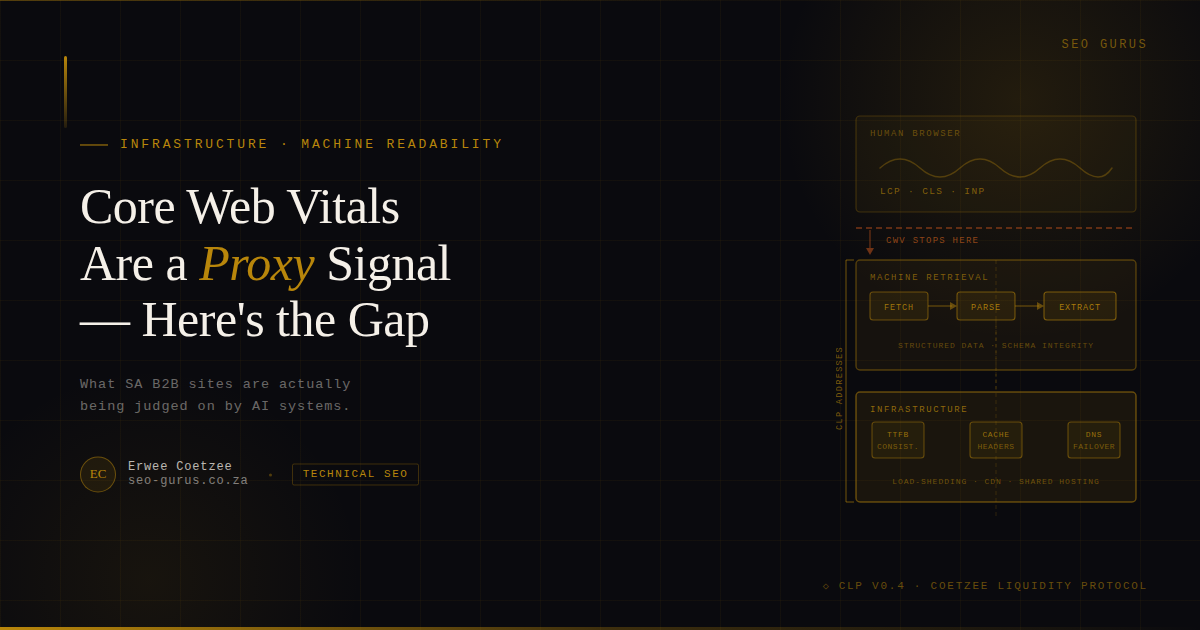
Core Web Vitals measure one thing: whether a human user experiences your site as fast and stable. They do not measure whether AI crawlers can parse your structured data reliably, whether retrieval systems can re-fetch your content under constrained conditions, or whether your hosting infrastructure survives the load-shedding and bandwidth conditions that characterise South African B2B site environments. A site can pass every CWV threshold and still be structurally opaque to the AI systems that determine whether your brand appears in the answers your buyers are reading. This paper introduces the Coetzee Liquidity Protocol (CLP v0.4) — the technical performance methodology that addresses the machine-readability dimension that Core Web Vitals do not measure — and explains precisely what SA B2B sites are actually being evaluated on by the systems that matter most in 2026.
The Disconnect: Good CWV Scores, Zero AI Visibility
The scenario is increasingly common in conversations with SA B2B principals. A previous agency delivered a performance report. PageSpeed Insights scores were green. Core Web Vitals passed. The technical SEO audit declared the site healthy. And then, months later, a competitor appeared in a ChatGPT answer for a query directly relevant to the firm’s niche — and the firm did not.
The instinctive response is to question the content strategy, or the keyword targeting, or the backlink profile. These are reasonable areas to investigate. But in a significant proportion of SA B2B sites reviewed through structured diagnostic work, the root cause of AI invisibility is not a content problem or a positioning problem. It is a machine-readability problem — and it exists below the threshold of what Core Web Vitals testing can detect.
Understanding why requires a precise account of what CWV actually measures, and what it does not. That precision is the diagnostic starting point for everything that follows in this paper.
What Core Web Vitals Actually Measure — And the Boundaries of That Measurement
Core Web Vitals — Largest Contentful Paint (LCP), Cumulative Layout Shift (CLS), and Interaction to Next Paint (INP) — are Google’s user-experience proxy metrics. They measure three specific dimensions of how a human user perceives a page load: how quickly the largest visible content element renders (LCP), how much the page layout shifts during load (CLS), and how quickly the page responds to user input (INP). These are legitimate and important measurements for human user experience, and they correlate with real user behaviour metrics — bounce rate, session depth, conversion — in ways that justify their role as ranking signals.
The boundary of their measurement is equally important to understand. CWV is evaluated in two modes: lab data (simulated, from tools like PageSpeed Insights and Lighthouse, running a controlled test from a defined network condition) and field data (real-user measurements aggregated in the Chrome User Experience Report, or CrUX). Lab scores are what most agencies report when they say “your CWV passed.” Field scores reflect actual user experience across the real device and network diversity of your audience — and for SA B2B sites, these two scores diverge more than agencies typically acknowledge, for reasons this paper addresses in detail.
More fundamentally: CWV measures the experience of a browser rendering a page for a human user. It has no measurement dimension for the experience of a machine agent retrieving a page for parsing, indexing, or citation. The agent’s experience — whether it can fetch the page reliably, parse the structured data without ambiguity, extract the content in a form that matches what was indexed previously, and repeat that retrieval under variable infrastructure conditions — is governed by a completely different set of technical parameters. CWV captures none of them.
This is not a criticism of CWV as a measurement framework. It is a precise statement of its scope. CWV is a user experience measurement. Machine readability is an infrastructure and data integrity measurement. They address different questions, and a site can perform well on one while failing materially on the other.
The Lab-Test Problem for SA B2B Sites Specifically
The gap between lab CWV scores and real-world performance is a known issue in technical SEO globally. For SA B2B sites, it is structurally larger than for sites in markets with more uniform infrastructure conditions — and for a specific, measurable set of reasons.
PageSpeed Insights lab tests run from Google’s server infrastructure, typically simulating a mid-range Android device on a throttled 4G connection. That simulation does not account for the network latency between a South African user’s device and a hosting server that may be located in Johannesburg, Cape Town, or — in many cases — in a European or North American data centre with a round-trip latency of 180–250ms before a single byte is transferred. It does not account for the bandwidth contention that characterises shared hosting environments during business hours. It does not account for the uptime variability introduced by load-shedding events affecting data centre generator handoff periods. And it does not account for the rendering environment fragmentation that results from a SA B2B audience that accesses sites across a wider device and network diversity than most European or North American markets.
The practical result: a SA B2B site can achieve a green PageSpeed lab score while delivering field performance that is materially worse — and while presenting an infrastructure profile to AI crawlers and retrieval systems that is unreliable enough to suppress citation confidence. The lab score is not wrong. It is simply measuring a condition that does not exist for most of the site’s actual traffic or machine agent interactions.
What AI Retrieval Systems Actually Evaluate
To understand the machine-readability gap that CWV cannot measure, it is necessary to be precise about what AI crawlers, retrieval systems, and agent-based research tools are actually evaluating when they encounter a B2B site. The evaluation criteria are different from those of a human user, and different again from those of a traditional search engine crawler — though they share some infrastructure with both.
AI retrieval systems operating in real-time retrieval mode — the mode used by Perplexity, Google AI Overviews, and ChatGPT with browsing — perform a specific sequence of operations when they process a potential citation source. Understanding each step in that sequence reveals the machine-readability requirements that CWV does not address.
Step 1: Fetch Reliability
The retrieval system sends an HTTP request to the target URL and expects a timely, complete response. “Timely” in this context means something different from CWV’s LCP threshold. CWV’s LCP target is 2.5 seconds to largest content paint. A retrieval system’s fetch reliability requirement is concerned with Time to First Byte (TTFB) — how quickly the server responds at all — and with whether that response is consistent across repeated fetches from the same URL at different times. An AI retrieval system that encounters a URL with a TTFB of 800ms on one fetch and 3,200ms on the next — a pattern common on SA shared hosting infrastructure during business-hours load periods — will de-weight that URL as a reliable citation source. The inconsistency signals infrastructure instability, which signals that the content may not be reliably retrievable for a buyer who follows the citation.
TTFB consistency is not measured by CWV. It requires repeated server response time monitoring from multiple geographic and network origin points — a measurement methodology that standard agency CWV audits do not include.
Step 2: Structured Data Integrity Verification
Once the page is fetched, the retrieval system parses its structured data. For a B2B site with Article, FAQPage, Person, and Organisation schema blocks, this parsing operation attempts to resolve the entity claims in the structured data against the system’s existing entity knowledge. If the structured data is malformed — incomplete JSON-LD, conflicting property values, missing required properties, or schema blocks that contradict each other across pages — the resolution fails partially or completely, and the entity verification confidence decreases.
Structured data integrity issues that AI retrieval systems encounter on SA B2B sites include: JSON-LD blocks that were generated by WordPress plugins and then partially overwritten by theme customisations; @type declarations that conflict between the homepage schema and the individual page schema; dateModified properties that have not been updated since the site was built, signalling stale content regardless of when the page was actually last edited; and sameAs arrays that reference URLs returning 404 errors — broken corroboration chains that reduce entity verification confidence rather than increasing it.
None of these integrity issues will affect a CWV score. A page with completely malformed JSON-LD can achieve a perfect PageSpeed Insights result. The structured data integrity dimension is invisible to CWV measurement and requires dedicated schema validation testing — not as a one-time audit, but as a continuous monitoring function, because schema integrity can be broken by routine WordPress plugin updates, theme changes, or content management operations.
Step 3: Content Extractability
AI retrieval systems need to extract the actual text content of a page for processing. For a standard server-rendered HTML page, this is straightforward — the content is present in the HTML response. For pages that rely heavily on JavaScript for content rendering, it is not. JavaScript-dependent content is not present in the initial HTML response; it requires the retrieval system to execute JavaScript rendering before the content is accessible. Many AI retrieval systems do not execute JavaScript rendering — they process the initial HTML response only. A page whose primary content is rendered by JavaScript is, from the perspective of these systems, an empty page.
JavaScript rendering dependency is endemic in modern WordPress installations. Page builders — Elementor, Divi, WPBakery — and Gutenberg-based themes with heavy block rendering often produce pages where significant content elements are JavaScript-dependent. A site built on these frameworks can present an apparently complete page to a human browser while presenting a sparse, content-light response to an AI retrieval system that does not execute JavaScript. The PageSpeed score measures the human browser experience. The AI retrieval experience is not measured at all.
Step 4: Cache Stability and Re-retrieval Consistency
AI systems that return citations to users need to be confident that the cited content will be retrievable when the user follows the citation. Cache stability — whether a page’s content is consistent across repeated fetches, whether cache headers are correctly configured to signal content freshness, and whether the server infrastructure can handle concurrent retrieval requests without degradation — is a confidence signal for citation reliability. A site that returns different content on different fetches (a common result of poorly configured caching plugins, dynamic content injection, or A/B testing frameworks running across the full page), or that returns intermittent server errors under load, will be treated as an unreliable citation source regardless of its CWV performance.
Cache configuration is a standard technical SEO concern, but the standard applied to it in most agency audits is optimisation for human browser caching — reducing repeat page load times for returning visitors. The machine-readability standard is different: correct Cache-Control and ETag header configuration that allows retrieval systems to make conditional requests and receive consistent, predictable responses. The two standards overlap but are not identical, and sites optimised for the human caching standard may still have cache configurations that underperform against the machine retrieval standard.
The South African Infrastructure Compounding Factors
The machine-readability gaps described above affect B2B sites globally. South African B2B sites face additional compounding factors that widen those gaps significantly — and that are almost never addressed in the standard CWV-focused performance audits SA businesses receive.
Load-Shedding and Hosting Infrastructure Resilience
Load-shedding — Eskom’s scheduled and unscheduled power interruptions — creates a specific, measurable infrastructure risk for SA-hosted websites that has no equivalent in comparable markets. The risk operates through a specific mechanism: during load-shedding events, data centres switch to generator or UPS power. The switchover period — typically 30 seconds to several minutes depending on the facility and its power infrastructure investment — creates a window of server unavailability or severely degraded response time. During this window, any AI retrieval system attempting to fetch a URL from an affected server will receive either a timeout or an error response.
A single fetch failure is not catastrophic for citation performance. AI systems that encounter a temporary fetch failure will typically retry. The problem is pattern recognition: retrieval systems that repeatedly encounter fetch failures or elevated error rates from a specific domain during load-shedding events — and SA businesses in 2024 and 2025 experienced load-shedding at frequencies that could produce multiple infrastructure events per day — will accumulate a reliability signal that affects how confidently the domain is cited. A site that is unavailable for five to fifteen minutes three to four times per day, over months of high-frequency load-shedding, has a materially different reliability profile from what its CWV lab score suggests.
The mitigation is infrastructure architecture, not performance optimisation. Sites hosted on shared SA infrastructure without adequate generator switchover SLAs, without CDN caching that can serve content during origin server downtime, and without uptime monitoring that tracks load-shedding-correlated downtime events are structurally vulnerable to this pattern regardless of their PageSpeed scores. Addressing load-shedding resilience requires evaluating hosting provider infrastructure SLAs, CDN configuration for origin-independent content serving, and DNS failover capability — none of which appear in a standard CWV audit.
The SA hosting market is relevant here. There is significant variance in infrastructure resilience between hosting providers operating in the SA market. Facilities with dedicated generator infrastructure, N+1 power redundancy, and documented generator switchover SLAs present materially different load-shedding resilience profiles than shared hosting environments on infrastructure without equivalent investment. This variance is not visible in pricing tiers or marketing claims — it requires direct interrogation of infrastructure SLAs and, ideally, independent uptime monitoring data correlated against Eskom’s load-shedding schedule.
Bandwidth Constraints and Crawl Reliability
South Africa’s internet infrastructure, while substantially improved over the past decade, still presents bandwidth and latency profiles that affect crawl reliability in ways that markets with mature fibre and peering infrastructure do not experience. The specific issues relevant to machine-readability performance are: international peering latency (SA-hosted sites communicating with internationally located AI retrieval systems face round-trip latencies that affect TTFB consistency), bandwidth contention on shared hosting during business hours (when SA B2B sites receive peak human traffic, the same infrastructure is also servicing machine crawl requests, and shared hosting environments without adequate bandwidth allocation produce degraded response times for crawlers), and the inconsistency introduced by mobile network-dependent access at both the human user and infrastructure maintenance layers.
These conditions create a specific recommendation for SA B2B sites targeting AI citation performance: CDN architecture with SA-local edge nodes is not a performance luxury — it is a machine-readability prerequisite. A CDN that caches page content at a geographically proximate edge node serves AI retrieval requests from that edge node rather than from the origin server, bypassing the latency, bandwidth contention, and load-shedding exposure of the origin infrastructure. For SA B2B sites, CDN configuration is the single highest-leverage infrastructure change for machine-readability improvement.
Shared Hosting Prevalence and Response Time Consistency
A significant proportion of SA B2B sites — including sites belonging to firms that are operationally sophisticated and market-leading in their sectors — are hosted on shared hosting infrastructure. Shared hosting places multiple sites on a single server, with shared CPU, memory, and bandwidth resources. Response time consistency — the variable that most directly affects AI retrieval reliability — degrades under shared hosting conditions in proportion to the load generated by co-hosted sites. A B2B site on a shared server that also hosts high-traffic e-commerce sites will experience TTFB spikes during peak e-commerce traffic periods that have nothing to do with its own traffic patterns or content configuration.
This is not a theoretical concern. Monitoring SA B2B sites on shared hosting infrastructure consistently reveals TTFB variance of 300–1,500% between off-peak and peak periods — a response time profile that signals infrastructure instability to AI retrieval systems regardless of the site’s CWV lab performance. The lab test runs during a controlled window that does not capture this variance. The AI retrieval system fetches the site across the full range of its performance variability, including the worst-case periods.
The infrastructure recommendation is not necessarily to move all SA B2B sites to dedicated or cloud hosting — there are cost-architecture trade-offs that are specific to each firm’s situation. The recommendation is to measure actual TTFB consistency across time periods using real server monitoring, rather than assuming that a favourable lab score reflects consistent real-world performance. The measurement precedes the infrastructure decision.
Mobile-Heavy Access Patterns and Rendering Fragmentation
South Africa’s internet access patterns are disproportionately mobile-heavy relative to comparable B2B markets. Stats SA and various ISP usage reports consistently indicate that mobile devices account for over 60% of SA internet sessions — and this pattern extends into B2B browsing, particularly for initial research and reference queries [CITATION NEEDED: SA mobile internet usage statistics 2025]. The rendering environments produced by SA B2B site visitors are therefore more fragmented than those of comparable European or North American markets: a wider range of device capabilities, a wider range of browser versions, and a wider range of network conditions all contribute to a rendering environment that diverges more from the controlled lab test conditions than most CWV audits acknowledge.
The machine-readability implication is specific: JavaScript-dependent content rendering that works reliably on a high-specification device with a stable fibre connection may fail to render completely on a mid-range Android device on a congested mobile network — and if a human user on that device is accessing the site via a mobile browser that AI retrieval systems emulate, the content extractability gap described earlier is compounded by rendering environment fragmentation. Server-side rendering or hybrid rendering architectures that ensure core content is available in the initial HTML response — regardless of JavaScript execution capability — address both the machine-readability and the mobile rendering dimensions simultaneously.
Introducing the Coetzee Liquidity Protocol (CLP v0.4)
The Coetzee Liquidity Protocol (CLP v0.4) is the technical performance methodology within the SEO Gurus framework system that specifically addresses machine-readability — the infrastructure and data integrity dimensions of a B2B site’s technical performance that Core Web Vitals do not measure. It operates as the third pillar of a complete AI-readiness architecture: the Coetzee Convergence Framework (CCF) establishes entity architecture, the Coetzee Resonance Protocol (CRP) configures citation positioning, and the CLP ensures that the infrastructure and data integrity layer supports reliable machine retrieval of the content and structured data that the CCF and CRP have put in place.
The “liquidity” framing is precise and intentional. In financial contexts, liquidity refers to how readily an asset can be accessed and transacted — a liquid asset is one that can be converted to value quickly and reliably, without friction or uncertainty about whether the conversion will succeed. Applied to a B2B website, liquidity describes how readily its content and structured data can be accessed, parsed, and processed by machine systems — how frictionlessly an AI retrieval system can do what it needs to do with your site’s content. A site with high machine liquidity is reliably fetchable, structurally parseable, consistently cacheable, and content-extractable across the full range of retrieval conditions it will encounter in production. A site with low machine liquidity introduces friction at one or more of these retrieval steps — and that friction suppresses AI citation performance regardless of how well the site’s entity architecture and citation positioning have been configured.
The CLP v0.4 operates across three layers: Infrastructure Resilience, Structured Data Integrity, and Machine Extraction Optimisation. Each is described in implementation detail in the sections that follow.
CLP Layer 1 — Infrastructure Resilience
Infrastructure Resilience addresses the hosting, CDN, DNS, and uptime architecture that determines whether a site is reliably fetchable by machine retrieval systems across the full range of production conditions — including the SA-specific conditions described earlier. It is the foundation layer of the CLP: without infrastructure resilience, structured data integrity and content extraction optimisation are irrelevant, because the retrieval system cannot consistently reach the content to process it.
TTFB Monitoring and Baseline Establishment
The first Infrastructure Resilience implementation is replacing lab-based performance measurement with continuous, real-world TTFB monitoring from multiple geographic origins. The monitoring configuration must include: at minimum one SA-local origin (Johannesburg or Cape Town) to measure local hosting performance; one European origin (London or Frankfurt) to measure international retrieval latency, which is the latency profile most AI retrieval systems will experience; and monitoring frequency sufficient to detect load-shedding-correlated downtime events — hourly monitoring misses many events; five-minute interval monitoring is the minimum for load-shedding detection.
The baseline establishment period should be a minimum of thirty days, capturing sufficient load-shedding event data to establish a reliable TTFB variance profile. This baseline is the reference point for all subsequent Infrastructure Resilience work — it defines the current machine-readability performance state before any architectural changes are made, and it provides the measurement foundation for documenting improvement.
Tools appropriate for this monitoring include UptimeRobot (accessible and adequate for basic TTFB monitoring), Pingdom (more granular reporting and multi-origin support), and StatusCake (strong SA-region monitoring capability). The choice of tool is less important than the consistency of monitoring configuration — the same origin points, the same measurement intervals, and the same data retention period must be maintained to produce a comparable baseline.
CDN Architecture for SA B2B Sites
CDN implementation for machine-readability performance requires specific configuration that differs from CDN implementation for human browser performance optimisation. The machine-readability configuration priorities are: aggressive static asset caching with long TTLs and correct Cache-Control headers; HTML page caching for logged-out visitors (the visitor state that AI retrieval systems operate in); origin shield configuration that reduces the frequency of origin server fetches; and edge node selection that includes geographically proximate coverage for both SA-local and international retrieval origins.
Cloudflare is the most common CDN implementation for SA B2B WordPress sites, and its free tier provides meaningful machine-readability benefits if correctly configured. The default Cloudflare configuration for WordPress sites disables HTML caching to prevent cache interactions with dynamic WordPress features — this is correct for sites with significant logged-in user traffic or dynamic content, but B2B marketing sites with minimal dynamic content should enable HTML page caching for anonymous visitors. The difference in origin server fetch frequency between default and correctly configured CDN caching can be an order of magnitude — and for SA sites on shared hosting infrastructure, that difference directly translates to TTFB consistency improvement for AI retrieval systems.
Load-shedding resilience through CDN configuration requires that the CDN is configured to serve cached content during origin server downtime — the “always online” or equivalent feature that serves the last cached version of a page when the origin is unreachable. This configuration ensures that AI retrieval systems fetching a URL during a load-shedding-related origin outage receive a complete, parseable response rather than a timeout or error. The served content will be cached rather than live, but for a B2B marketing site whose core content changes infrequently, cached content is an entirely acceptable retrieval response that maintains citation reliability through infrastructure events.
DNS Configuration and Failover Architecture
DNS resolution speed and reliability is the first step in any machine retrieval operation — before an AI system can fetch a page, it must resolve the domain’s IP address. DNS TTL configuration, DNS provider response time, and DNS failover capability all affect retrieval reliability in ways that are invisible to CWV measurement.
SA B2B sites hosted on registrar-default DNS — where the domain registrar provides DNS resolution as part of the registration service — frequently have DNS response times of 200–400ms from international origins, compared to 10–30ms for sites using dedicated DNS providers (Cloudflare DNS, AWS Route 53, or equivalent). The difference is not significant for human users, who experience DNS resolution as a sub-perceptible latency. For AI retrieval systems processing high volumes of fetch requests, consistently slow DNS resolution is a signal that contributes to the site’s overall retrieval reliability profile.
DNS failover — the ability to redirect DNS resolution to a backup origin when the primary origin is unavailable — is relevant for SA B2B sites on single-origin hosting without CDN load-shedding protection. A DNS failover configuration that points to a CDN-cached version of the site during primary origin downtime provides a machine-readability safety net that does not require infrastructure migration — it simply adds a DNS-level redundancy layer on top of the existing hosting architecture.
CLP Layer 2 — Structured Data Integrity
Structured Data Integrity addresses the accuracy, completeness, and internal consistency of all schema.org implementations across the primary domain — with specific attention to the integrity issues that degrade AI entity verification confidence rather than simply triggering Google’s Rich Results Test warnings. It is the data quality layer of the CLP: infrastructure resilience ensures the retrieval system can reach the structured data; structured data integrity ensures that what the retrieval system finds when it arrives is coherent, parseable, and entity-resolvable.
Schema Conflict Identification and Resolution
The most damaging structured data integrity issue for AI entity verification is not malformed JSON-LD — Google’s Rich Results Test will flag that, and most sites that have received any technical SEO attention will have addressed obvious syntax errors. The most damaging issue is schema conflict: structurally valid JSON-LD blocks that contradict each other across pages or within a single page.
Common schema conflict patterns on SA B2B WordPress sites include: an Organization schema on the homepage that describes the business with one set of properties, and a different Organization schema on the About page produced by a different plugin or theme with different property values; a Person schema on the author page that describes the principal’s credentials differently from the author property in the Article schema on published blog posts; sameAs arrays that include different URLs on different pages, creating ambiguity about the canonical reference set for the entity; and datePublished and dateModified values that contradict the visible content timestamps on the page.
Identifying schema conflicts requires a full-site structured data extraction — not just validation of individual pages, but comparison of all schema blocks across the entire domain to identify property-level contradictions. This is a labour-intensive audit that standard automated tools do not perform comprehensively. The output is a conflict map: a precise inventory of every property-level contradiction in the site’s structured data, with a resolution specification for each. Resolution follows the master schema reference established in the CCF Entity Baseline work — every schema block across the site is aligned to the canonical entity descriptions defined in that reference.
Structured Data Monitoring as a Continuous Function
Structured data integrity is not a one-time audit outcome. It is an ongoing maintenance requirement, because the integrity of a WordPress site’s structured data is continuously threatened by the routine operations of site management: plugin updates that modify schema output, theme updates that alter template-level structured data, content editor actions that add or remove schema blocks without understanding their downstream effects, and A/B testing or personalisation tools that inject content variations that interfere with schema rendering.
The CLP addresses this through structured data monitoring as a continuous function — automated schema extraction and comparison at defined intervals (weekly is the minimum for an actively managed site), with alerts triggered by any property-level change to the canonical schema blocks. The monitoring target is not just validation (is the JSON-LD syntactically correct?) but consistency verification (are all schema blocks across the site still aligned with the canonical entity definitions?). A plugin update that silently changes an Organization schema’s name property from the correct canonical form to the plugin’s default value will pass validation testing — there is nothing syntactically wrong with the output — but it will introduce a schema conflict that degrades entity verification confidence until detected and corrected.
Google Search Console’s Rich Results reporting and third-party tools including Semrush’s Site Audit and Screaming Frog’s structured data extraction provide the monitoring infrastructure for this function. The operational requirement is that someone with schema expertise reviews the monitoring output — not just the error count, but the content of any changes — on a defined schedule. Automated monitoring without expert review is insufficient: many schema integrity issues will not trigger validation errors, and their detection requires human assessment of whether the changed output aligns with the canonical entity architecture.
sameAs Array Integrity and Broken Corroboration Chain Detection
The sameAs array — the structured data property that connects a brand or person entity to its corroborating references across the web — is a specific structured data integrity risk that CLP Layer 2 addresses with dedicated monitoring. A sameAs array is only as strong as its weakest reference: every URL in the array that returns a 404, a redirect chain, a login-gated page, or content that no longer describes the correct entity is a broken corroboration signal that reduces rather than reinforces the entity verification confidence it was intended to produce.
sameAs array degradation occurs through predictable mechanisms: LinkedIn profile URL changes (when a principal changes their LinkedIn custom URL, the previous URL becomes a redirect or 404); Amazon book listing URLs that change format between ASIN reference styles; Wikipedia or Wikidata URL restructuring; and professional association profile pages that are archived or moved when memberships lapse or organisations restructure. Each of these events is routine and invisible to the site owner — but each degrades the structured corroboration chain that AI systems use to verify entity identity.
The CLP monitoring function includes automated URL validation for all sameAs array references — monthly at minimum, weekly for active citation architecture implementations — with immediate alerts on any URL returning a non-200 response. Resolution is straightforward when detected promptly: update the broken URL to the correct current reference. Resolution is operationally costly when detected late: broken corroboration chains that persist for months accumulate as negative entity verification signals that take time to reverse after correction.
CLP Layer 3 — Machine Extraction Optimisation
Machine Extraction Optimisation addresses the content architecture and rendering configuration of a B2B site to ensure that AI retrieval systems can reliably extract the full content of key pages — independently of JavaScript execution capability, rendering environment conditions, or network constraints. It is the content delivery layer of the CLP: infrastructure resilience ensures the retrieval system can reach the site; structured data integrity ensures the entity signals are coherent; machine extraction optimisation ensures the content itself is accessible.
JavaScript Dependency Audit and Remediation
The JavaScript dependency audit identifies every content element on key pages — particularly the research papers, methodology documentation, and case evidence pages that constitute the citation surface — that is dependent on JavaScript execution for rendering. The audit methodology is specific: fetch the page using a tool that processes only the initial HTML response without executing JavaScript (curl or wget, or a headless browser configured for no-JS mode), then compare the extracted content with the full rendered page content. The delta between the two represents the JavaScript-dependent content that AI retrieval systems without JS rendering capability will not be able to extract.
For SA B2B sites built on Gutenberg with standard block themes, this delta is often minimal — Gutenberg’s server-side rendering model produces HTML-native content that is extractable without JavaScript. For sites built on Elementor, Divi, or other client-side rendering page builders, the delta can be substantial — entire sections of content may be absent from the no-JS extraction, including in some cases the primary article content itself.
Remediation options depend on the extent of JavaScript dependency and the technical architecture of the site. For sites where JS-dependent content is limited to decorative elements (animations, interactive features, visual enhancements), the remediation is configuration: ensure that all substantive content — the text of research papers, the definitions of frameworks, the citations and evidence claims — is server-rendered HTML, and that JS dependency is confined to non-content elements. For sites where substantive content is JS-rendered due to page builder architecture, the remediation requires a more significant architectural intervention — either migration to a server-rendering page builder, hybrid rendering configuration, or, in some cases, a full theme rebuild. The CLP does not prescribe a universal remediation path; it provides the diagnostic methodology to identify the extent of the problem and the technical options for addressing it.
Crawl Budget Optimisation for Machine Retrieval
Crawl budget — the rate and depth at which search engine and AI crawlers process a site — is a technical SEO concept that has been relevant to large sites for years, but is increasingly relevant to B2B sites of all sizes as AI retrieval systems add their crawl activity to the existing Googlebot and Bingbot load. A site that consumes its crawl budget on low-value pages — parameter-generated URLs, faceted navigation duplicates, paginated archives, tag and category pages with minimal unique content — is using machine retrieval capacity on pages that produce no citation value, at the expense of the research papers and methodology documentation that constitute the actual citation surface.
Crawl budget optimisation for machine retrieval involves: robots.txt configuration that explicitly disallows crawling of low-value URL patterns; canonical tag implementation that consolidates crawl signals to the primary URL for any content that exists in multiple URL forms; sitemap configuration that prioritises citation-surface pages with appropriate priority and changefreq values; and internal linking architecture that concentrates link equity and crawl depth on the pages that matter for citation performance.
For SA B2B sites on shared hosting infrastructure with constrained server resources, crawl budget optimisation has an additional infrastructure dimension: every crawl request that the server must process consumes bandwidth and CPU resources that are shared with human user traffic. A site that is being crawled inefficiently — with crawlers cycling through thousands of duplicate or low-value URLs — is experiencing a machine-generated load that degrades TTFB for all subsequent requests, human and machine. Crawl budget optimisation reduces this load, improving TTFB consistency as a secondary benefit to the primary citation surface targeting benefit.
Response Header Configuration for Machine Retrieval
HTTP response headers communicate critical information to retrieval systems about how to handle the content they have fetched. Correct response header configuration for machine retrieval includes several specific implementations that standard CWV-focused performance audits rarely address.
Cache-Control headers must specify appropriate max-age values for different content types — long TTLs for static assets, appropriate TTLs for HTML pages that reflect actual content update frequency. For B2B research papers that are updated infrequently, a max-age of 86400 (24 hours) or longer is technically correct and signals to retrieval systems that the content is stable — a positive reliability signal. A Cache-Control: no-cache or no-store directive on research paper pages — sometimes set by WordPress caching plugins in configurations intended for dynamic content — signals instability and forces retrieval systems to make full origin requests on every fetch, increasing both load-shedding exposure and bandwidth consumption.
ETag headers enable conditional requests — a retrieval system that has previously cached a page can send the ETag value in a subsequent request, and the server responds with a 304 Not Modified if the content has not changed, instead of re-transmitting the full page content. This mechanism reduces bandwidth consumption for repeat retrievals, reduces origin server load, and provides a machine-readable confirmation that the cached content is still valid. Many WordPress caching plugin configurations disable ETag headers, inadvertently removing this retrieval efficiency mechanism.
X-Robots-Tag response headers allow page-level crawl directives to be set at the server level, independently of HTML meta robots tags. For pages that should not be indexed (admin interfaces, staging duplicates, internal search results), server-level X-Robots-Tag: noindex directives are more reliable than meta tag implementations, because they apply before the page content is parsed and cannot be overridden by conflicting page-level meta tags. Correct X-Robots-Tag configuration prevents AI retrieval systems from indexing low-value internal pages that consume crawl capacity without contributing to citation performance.
A Practical Machine-Readability Diagnostic for B2B Principals
The following diagnostic framework provides a structured starting point for B2B principals who want to assess their site’s machine-readability gap without a full CLP engagement. It is a directional assessment, not a comprehensive audit — but it will surface the most common and highest-impact machine-readability issues in SA B2B site environments.
Test 1: TTFB consistency check. Use GTmetrix or WebPageTest to run your site’s primary URL five times in sequence from a South African origin point, at one-hour intervals across a business day. Record the TTFB value for each test. If the variance between the lowest and highest TTFB values exceeds 300ms, you have a TTFB consistency problem that is likely affecting machine retrieval reliability. If any test returns a TTFB above 800ms, you have an infrastructure performance issue that warrants investigation of your hosting environment and CDN configuration.
Test 2: No-JavaScript content extraction. In Google Chrome, open your most important research or methodology page and disable JavaScript (Settings → Site Settings → JavaScript → Blocked). Reload the page and assess how much of your primary content is visible. If significant content blocks — particularly your article text, framework definitions, or case evidence — are absent from the no-JS render, you have a JavaScript dependency that affects AI retrieval systems without JS rendering capability.
Test 3: Structured data conflict check. Use Google’s Rich Results Test on your homepage and your primary methodology or research page. Note the entity descriptions returned by each test. Compare the Organization name, description, and sameAs values between the two pages — they should be identical. Any difference indicates a schema conflict that requires investigation. Also run each URL in your sameAs array manually to confirm that it returns a 200 response and describes the correct entity.
Test 4: AI citation audit for your citation surface queries. Run five to ten high-specificity queries relevant to your niche across ChatGPT, Perplexity, and Google AI Overviews. Record whether your site is cited, whether your structured data descriptions appear accurately, and whether competitors with comparable or weaker content are cited in your absence. If the latter pattern is consistent — competitors with weaker content appearing while your site does not — the cause is more likely a machine-readability or entity architecture gap than a content quality gap.
Test 5: Cache header inspection. Use your browser’s developer tools (Network tab) or a tool like REDbot to inspect the HTTP response headers for your primary research page. Look for a Cache-Control header with an appropriate max-age value, an ETag header, and the absence of no-store or private directives that would prevent CDN caching. If your page returns Cache-Control: no-cache, no-store, your caching configuration is preventing CDN-level retrieval optimisation and forcing full origin fetches on every machine retrieval request.
These five tests will not produce a complete machine-readability picture — that requires the full CLP diagnostic methodology — but they will identify whether machine-readability issues are likely contributing to AI citation underperformance. If three or more tests return concerning results, a structured CLP assessment is warranted before any further investment in content production or entity architecture work. Building a citation architecture on top of a machine-readability deficit produces significantly sub-optimal returns.
The Relationship Between CLP Performance and AI Citation Performance
The CLP addresses a specific layer of AI citation performance — the infrastructure and data integrity layer — but it does not operate in isolation. Understanding how CLP performance interacts with the CCF entity architecture layer and the CRP citation positioning layer is important for setting accurate expectations about what CLP implementation alone will and will not achieve.
A site with strong CCF entity architecture and well-configured CRP citation positioning but poor CLP machine-readability performance will underperform its citation potential — because the retrieval systems that would cite it encounter infrastructure friction, structured data conflicts, or content extraction barriers that reduce their confidence in the site as a reliable citation source. Fixing the CLP layer on this site will produce material citation performance improvement, because the entity and content architecture is already in place and the machine-readability barrier was the primary constraint on citation frequency.
A site with strong CLP machine-readability performance but absent CCF entity architecture will also underperform in AI citation — because infrastructure reliability and structured data integrity do not substitute for entity verification. A retrieval system that can fetch your site reliably and parse your structured data cleanly will still not cite you if the entity signals it finds are insufficient to verify your brand as a credible specialist authority. CLP performance is a prerequisite for citation, not a guarantee of it.
The three-framework architecture — CCF for entity foundation, CRP for citation positioning, CLP for machine-readability — is designed to address all three layers of AI citation performance simultaneously. In practice, the implementation sequence is determined by where the primary constraint lies: sites with severe machine-readability deficits address CLP Layer 1 (infrastructure resilience) before investing further in CCF or CRP work, because infrastructure instability will undermine the returns on entity and citation architecture investment. Sites with intact infrastructure but fractured entity signals prioritise CCF Layer 1 before CLP refinement. The Day Zero Baseline Report establishes which layer presents the binding constraint for each specific site.
Why PageSpeed Score Fetishism Is a Strategic Liability
There is a specific agency behaviour pattern that has produced measurable strategic harm in SA B2B digital marketing: the optimisation of PageSpeed Insights lab scores as the primary deliverable of technical performance work. The pattern is understandable — PageSpeed scores are visible, quantifiable, and easy to compare before and after an intervention. They produce reportable numbers. They satisfy client requests for performance evidence. And they are almost entirely disconnected from the machine-readability performance dimensions that determine AI citation reliability.
The harm comes from two directions. First, the optimisations required to maximise PageSpeed lab scores sometimes actively degrade machine-readability performance: aggressive JavaScript deferral that improves LCP lab scores can prevent critical structured data scripts from executing; image lazy-loading that improves CLS scores can create content extraction gaps for retrieval systems that do not execute the intersection observer logic that triggers lazy load; and aggressive caching configurations that improve TTFB lab scores can interfere with correct Cache-Control header implementation for machine retrieval. The trade-off between lab score optimisation and machine-readability optimisation is real, and in a small but significant number of cases, they point in opposite directions.
Second, the framing of PageSpeed scores as the primary technical performance metric for B2B sites produces a category error in how principals evaluate their site’s technical health. A principal who has been told their site “passed technical performance” on the basis of a PageSpeed score has been given incomplete information — and that incompleteness has a cost, because it delays the investigation of machine-readability issues that are suppressing AI citation performance while the PageSpeed score continues to look green.
The CLP reframes technical performance measurement for B2B sites around the question that matters in 2026: not “what score does this site get in a controlled lab test,” but “how reliably and completely can machine retrieval systems access, parse, and extract the content and structured data on this site under real production conditions.” These are different questions, and they require different measurement methodologies. The CLP provides both the diagnostic framework and the implementation methodology for answering the right question.
Starting the Conversation
SEO Gurus maintains a limited active client roster. CLP implementation is technical work conducted by practitioners with the infrastructure, schema, and machine-readability expertise to address the specific performance dimensions this paper describes — not recommendations for internal execution, and not a PageSpeed optimisation retainer.
If you are a B2B principal who has recognised your site’s situation in the diagnostic described in this paper — good CWV scores, insufficient AI citation performance, and a machine-readability architecture that has never been assessed against the standards that AI retrieval systems actually apply — and you are evaluating whether a structured CLP assessment is the appropriate response, the starting point is a direct conversation.
There is no intake form. The initial conversation is a direct assessment of whether your situation, your objectives, and current roster capacity align. If they do, we proceed to a Day Zero Baseline Report that maps your current machine-readability performance against CLP standards. If they do not, you leave with a precise diagnostic of the specific machine-readability gaps your site presents and the implementation sequence required to address them.
Frequently Asked Questions
What is the difference between Core Web Vitals and machine readability?
Core Web Vitals (LCP, CLS, INP) measure the experience of a human user loading a page in a browser — how quickly content renders, how stable the layout is, and how responsively the page handles input. Machine readability measures whether AI crawlers and retrieval systems can reliably fetch, parse structured data from, and extract content from a page — under the full range of production conditions those systems encounter. A site can score perfectly on Core Web Vitals while having severe machine-readability deficits: JavaScript-dependent content rendering, inconsistent server response times, malformed or conflicting structured data, and incorrect cache header configuration will all degrade AI citation performance without affecting CWV scores.
What is the Coetzee Liquidity Protocol (CLP)?
The Coetzee Liquidity Protocol (CLP v0.4) is the technical performance methodology within the SEO Gurus framework system that addresses machine readability — the infrastructure and data integrity dimensions of a B2B site’s technical performance that Core Web Vitals do not measure. It operates across three layers: Infrastructure Resilience (hosting, CDN, DNS, and uptime architecture), Structured Data Integrity (schema accuracy, consistency, and continuous monitoring), and Machine Extraction Optimisation (JavaScript dependency remediation, crawl budget configuration, and response header optimisation). The CLP ensures that AI retrieval systems can reliably access, parse, and extract the content and entity signals that the CCF and CRP frameworks have put in place.
How does load-shedding affect a website’s AI citation performance?
Load-shedding creates windows of server unavailability or severely degraded response time during data centre generator switchover periods. AI retrieval systems that encounter fetch failures or elevated error rates from a domain during these events accumulate a reliability signal that affects citation confidence over time. SA B2B sites on hosting infrastructure without adequate generator SLAs, CDN caching, or DNS failover are structurally exposed to this risk — their machine-readability performance during load-shedding events is materially worse than their CWV lab scores suggest, and the cumulative effect of repeated retrieval failures during high-frequency load-shedding periods suppresses AI citation reliability independently of content and entity architecture quality.
Why does JavaScript rendering affect AI citation performance?
Many AI retrieval systems process only the initial HTML response of a page, without executing JavaScript. For pages where substantive content is rendered by JavaScript — a common condition for sites built on client-side rendering page builders like Elementor or Divi — the content that AI retrieval systems extract is significantly less complete than what a human browser renders. A research paper whose primary article text is JavaScript-rendered may appear as an almost empty page to an AI retrieval system without JS rendering capability. This content extraction gap means the system cannot process, evaluate, or cite the content regardless of its quality — and it persists until the site’s rendering architecture is configured to deliver substantive content in the initial server-side HTML response.
What is TTFB and why does it matter more than LCP for AI citation?
Time to First Byte (TTFB) measures how quickly a server sends the first byte of a response to a fetch request — it reflects the server’s processing time and network latency before any content is transferred. For AI retrieval systems, TTFB is the primary infrastructure reliability signal: a site with consistent, fast TTFB indicates stable hosting infrastructure; a site with high or highly variable TTFB indicates infrastructure instability that reduces citation confidence. LCP — which measures the time to render the largest visible content element — is a human browser metric that includes browser rendering and JavaScript execution time. AI retrieval systems do not render pages for human display; they fetch and parse HTML responses. TTFB consistency, not LCP, is the machine-readability performance dimension that maps directly to AI retrieval reliability.
How do I know if my site has structured data conflicts?
The most accessible starting point is to run Google’s Rich Results Test on your homepage and primary methodology or content pages separately, then compare the entity properties returned by each test — specifically the Organisation name, description, and sameAs values. Any difference between pages indicates a conflict. For a more comprehensive audit, extract all JSON-LD blocks from across the site using a tool like Screaming Frog’s structured data extraction, then compare property values across pages systematically. Also validate every URL in your sameAs arrays by fetching them directly — any URL returning a non-200 response or describing the wrong entity is a broken corroboration signal that requires correction.
Can a site pass Core Web Vitals and still be invisible to AI search?
Yes — and this is among the most common technical SEO misdiagnoses in SA B2B digital marketing. Core Web Vitals measure human browser experience under controlled lab conditions. AI citation performance is determined by machine-readability across real production conditions: infrastructure reliability, structured data integrity, content extractability, and cache configuration. These dimensions are measured by different tools, respond to different optimisations, and can perform independently of each other. A site with green CWV scores and poor machine-readability architecture will underperform in AI citation relative to its content quality — and will continue to do so until the machine-readability gap is diagnosed and addressed.
What is the relationship between CLP, CCF, and CRP in the SEO Gurus framework system?
The three frameworks address three distinct layers of AI citation performance. The Coetzee Convergence Framework (CCF) establishes entity architecture — the foundational identity signals that make a brand machine-verifiable across AI systems. The Coetzee Resonance Protocol (CRP) configures citation positioning — the boutique-specific content and signal architecture that captures disproportionate citation share in high-specificity niche queries. The Coetzee Liquidity Protocol (CLP) ensures machine readability — the infrastructure and data integrity layer that allows AI retrieval systems to reliably access and process the entity and content architecture that CCF and CRP have put in place. All three layers are required for complete AI citation performance. The implementation priority between them is determined by where the binding constraint lies for each specific site, established through the Day Zero Baseline diagnostic.