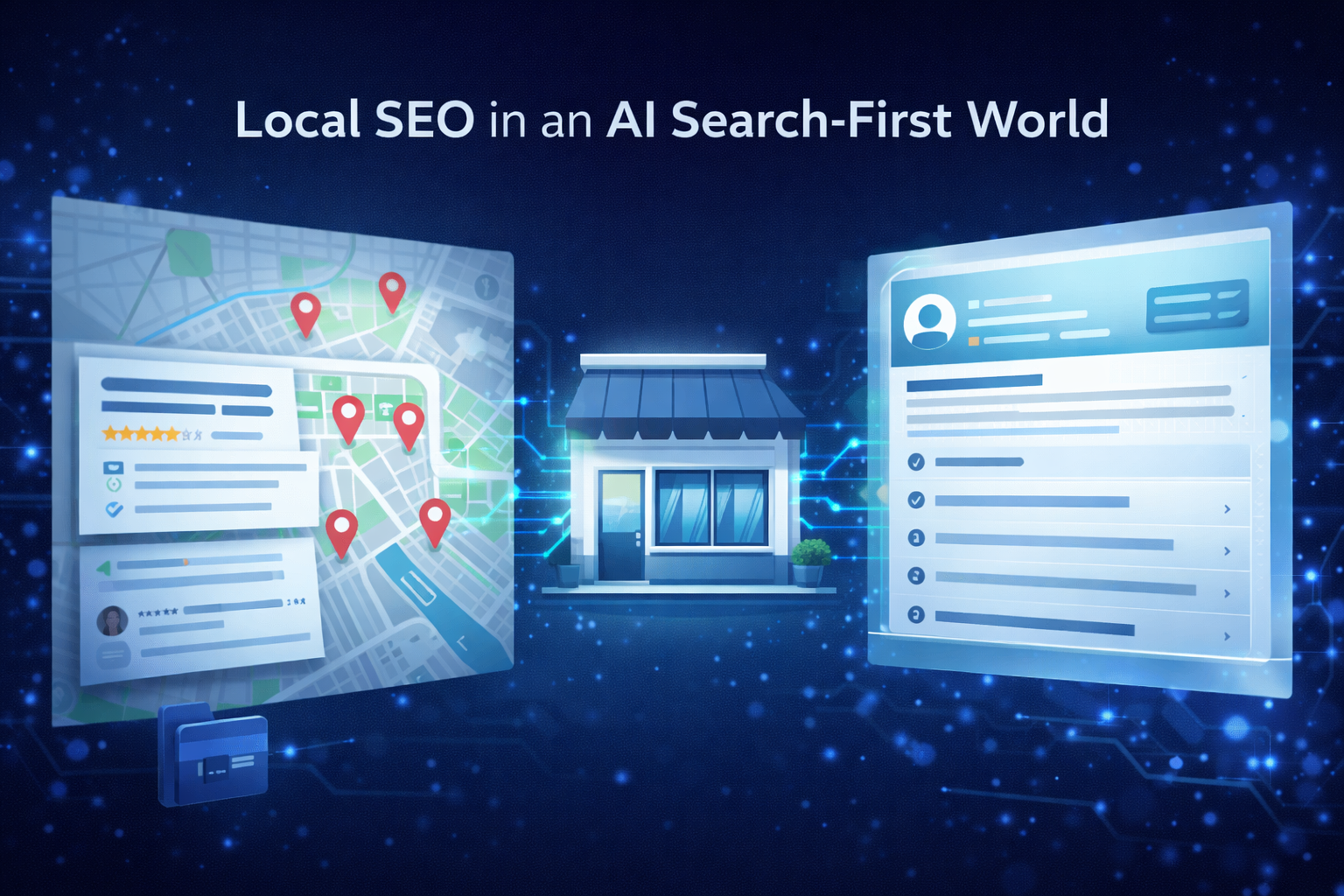
Local SEO in an AI Search-First World
How to Align Your Google Business Profile and Website for Maximum Visibility
Local SEO has changed.
Ranking in the Map Pack is no longer enough. Today, local search results include:
- The Map Pack
- AI-generated summaries
- Knowledge panels
- Review highlights
- Direct answers pulled from business websites
In an AI search-first world, visibility depends on alignment, not just optimization.
If your Google Business Profile (GBP) says one thing and your website says another — even subtly — Google’s confidence drops. And when confidence drops, so does visibility.
This guide explains how to align your GBP and website so you can:
- Increase Map Pack visibility
- Improve AI citation likelihood
- Strengthen trust signals
- Convert more local searches into enquiries
This is local SEO for 2026 and beyond.
The Shift: Map Pack + AI Visibility
Search results used to be simple: 10 blue links and a Map Pack.
Now?
AI systems summarise businesses, highlight reviews, extract FAQs, and sometimes answer the query before a user even clicks.
For example, when someone searches:
“Best estate agent in Durbanville”
Google may display:
- A Map Pack
- Review snippets
- A short AI-generated summary comparing providers
- A list of “popular services”
This means your visibility depends on more than just ranking.
It depends on Entity Alignment.
What is Entity Alignment?
Entity alignment means:
- Your Google Business Profile clearly defines what you are
- Your website reinforces the same service identity
- Your reviews confirm that identity
- Your content consistently supports that positioning
If your GBP category says “Marketing Agency” but your website H1 says “Digital Growth Experts” and your reviews mention “social media training,” Google receives mixed signals.
Mixed signals reduce confidence.
Reduced confidence reduces visibility.
Local SEO now rewards clarity over cleverness.
Category Precision: The Foundation of Local Visibility
Your primary Google Business Profile category is one of the strongest local ranking signals.
Not your description.
Not your posts.
Not your photos.
Your primary category.
Why Category Precision Matters
Google uses your primary category to determine:
- Which searches you are eligible for
- Which competitors you are grouped with
- What services are highlighted
- How AI classifies your business
If you choose a vague or broad category, you weaken your relevance.
For example:
❌ “Consultant”
✔ “SEO Consultant”
✔ “Accounting Firm”
✔ “Immigration Attorney”
Precision improves eligibility.
60-Minute Category Alignment Checklist
Step 1: Audit your primary GBP category
Step 2: Compare it to your homepage H1
Step 3: Ensure your primary service page matches that category
Step 4: Remove irrelevant secondary categories
Step 5: Confirm your GBP description reinforces your main service
If your primary category is “Plumber,” your homepage H1 should not be:
“Complete Home Solutions for Modern Living”
It should clearly reinforce:
“Licensed Plumbing Services in Somerset West”
Clarity beats creativity in local SEO.
Service Pages vs Location Pages (And When to Use Each)
Many local businesses misunderstand this distinction.
They create dozens of thin city pages trying to rank everywhere.
This weakens authority and often hurts performance.
Let’s clarify the difference.
| Type | Purpose | When to Use | Risk if Misused |
|---|---|---|---|
| Service Page | Explains what you do | Always required | None if structured properly |
| Location Page | Explains where you operate | Only if you have a real presence | Thin duplication penalties |
Service Pages
A service page explains:
- What the service is
- Who it is for
- How it works
- Pricing structure (if applicable)
- FAQs
Example:
“Local SEO Services in Cape Town”
This page should:
- Contain a clear H1
- Include structured subheadings
- Feature an FAQ section
- Link internally to related services
Location Pages
A location page is only appropriate when:
- You have a physical office
- You serve a major city consistently
- You can provide unique local content
Duplicate city pages like:
- SEO Services Cape Town
- SEO Services Durban
- SEO Services Johannesburg
With identical content except city swaps?
That is thin content.
AI systems detect this instantly.
Recommended Structure
If you serve multiple areas:
- Create one strong Service Page
- Add a “Service Areas” section listing cities
- Reinforce coverage naturally within FAQs
- Avoid cloning content
Review SOP: Turning Social Proof into Ranking Power
Reviews influence:
- Map Pack rankings
- Click-through rate
- AI trust extraction
- Local conversion rates
In AI-driven results, review summaries are often extracted and displayed prominently.
5-Step Review SOP
- Ask immediately after service completion
- Send a direct GBP review link
- Guide customers (without scripting) to mention service type
- Respond to every review
- Reinforce service keywords in responses naturally
Example Review Response Template
“Thank you for trusting us with your electrical installation in Somerset West. We’re glad our team could resolve the wiring issue quickly and safely.”
Notice:
- Service referenced
- Location referenced
- Reinforces entity clarity
Do not keyword stuff.
Do reinforce context.
Map Pack + AI Overview Interaction
This is where local SEO gets interesting.
AI Overviews may summarise top providers in a city.
If your website contains:
- Clear service definitions
- Short answer paragraphs
- FAQ sections
- Structured headings
You increase your chance of being cited.
Rank + Get Cited (Local Edition)
Traditional Local SEO goal:
Rank in the Map Pack.
Modern Local SEO goal:
Rank + Be Extractable.
That means:
- Clear short definitions under H2s
- FAQs answering local intent questions
- Schema markup for LocalBusiness and Service
- Internal linking reinforces the service authority
Common Local SEO Mistakes
- Choosing overly broad GBP categories
- Creating dozens of duplicate location pages
- Ignoring review management
- Hiding contact details
- No clear homepage H1
- Inconsistent NAP (Name, Address, Phone)
Local SEO rewards discipline.
Conversion Layer: Turning Visibility into Booked Calls
Visibility without conversion is wasted effort.
Your service page should include:
- Clear primary CTA above the fold
- Trust signals (years in business, certifications)
- Local contact information
- Testimonials
- FAQ section
Your GBP messaging must match your website messaging.
If your GBP says:
“Emergency Plumbing 24/7”
But your website says:
“Residential Renovation Specialists”
That disconnect reduces trust.
Consistency increases conversion.
FAQ Section
What is Local SEO in an AI Search-First World?
It is the alignment of your Google Business Profile and website so that both ranking algorithms and AI-generated summaries clearly understand your services, location, and authority.
Does Google Business Profile still matter?
Yes. Your primary category and reviews are major ranking signals for Map Pack visibility and local AI extraction.
Should I create separate pages for every suburb?
Only if you have unique, substantial content and real service coverage. Otherwise, focus on one strong service page.
How do reviews improve local SEO?
Reviews reinforce service keywords, improve click-through rates, and provide trust signals that AI systems evaluate when summarising businesses.
Can AI Overviews affect local visibility?
Yes. AI summaries may extract business information, services, and reviews. Structured content improves citation likelihood.
Final Thought
Local SEO is no longer about “gaming Google.”
It is about:
- Precision
- Clarity
- Consistency
- Authority
Align your Google Business Profile.
Align your website.
Align your reviews.
That is how you win visibility in an AI search-first world.