The Ambiguity Penalty: Why Your Social Media Contradicts Your Rankings

The Ambiguity Penalty: Why Your Social Media Contradicts Your Rankings

In the Coetzee Resonance Protocol (CRP), we’ve defined authority as a mathematical balance. However, most B2B firms suffer from a silent performance killer: The Ambiguity Penalty ($Am$). This is the structural mechanism by which search algorithms and AI agents de-prioritize your entity because your digital signals are in conflict. If your website claims you are…

The Netsurit Evidence Anchor: A 24-Month Case for Cultural SEO
|

The Netsurit Evidence Anchor: A 24-Month Case for Cultural SEO

The Coetzee Resonance Protocol (CRP) is grounded in a specific and documented strategic problem: the transition from a mass-market B2B service model to a boutique corporate model. To move beyond theory, we look to the Netsurit Evidence Anchor (2009–2013)—the empirical origin of the protocol. This case demonstrates how a 24-month commitment to cultural signal architecture…

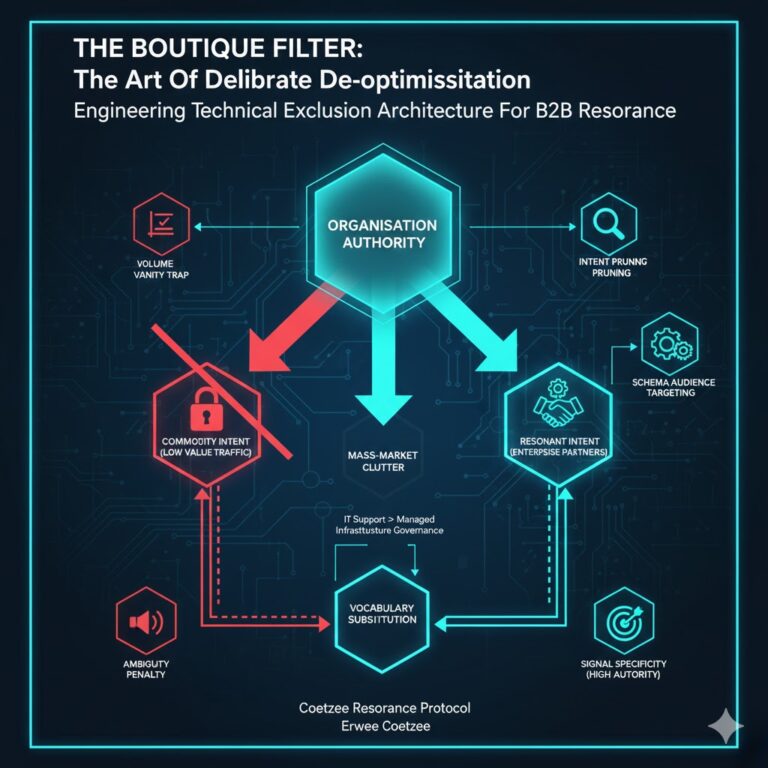
The Boutique Filter: The Art of Deliberate De-optimisation

The Boutique Filter: The Art of Deliberate De-optimisation

In the Coetzee Resonance Protocol (CRP), Pillar III introduces a concept that is structurally counterintuitive to traditional SEO: The Boutique Filter. While standard digital marketing focuses on volume maximisation, the CRP focuses on Intent Specificity. For a complex B2B entity, ranking for high-volume, low-value keywords is not a success; it is a source of Ambiguity…

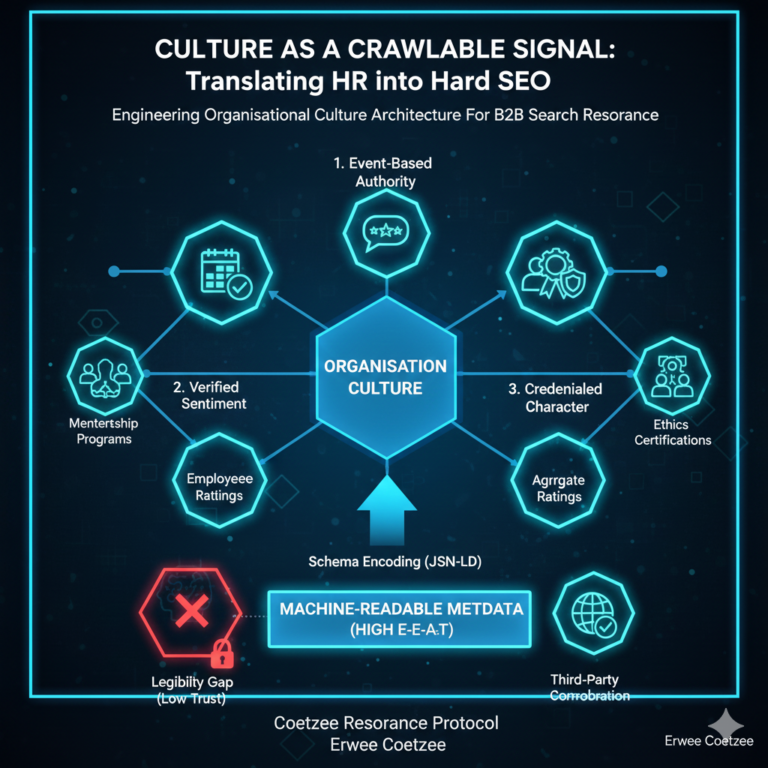
Culture as a Crawlable Signal: Translating HR into Hard SEO

Culture as a Crawlable Signal: Translating HR into Hard SEO

In the , we propose a radical shift in how we treat organisational culture. To most firms, culture is an internal HR asset—a set of values on a breakroom wall. To a CRP-compliant systems architect, culture is a data source. If your culture cannot be crawled, it cannot contribute to your authority. Pillar II of…

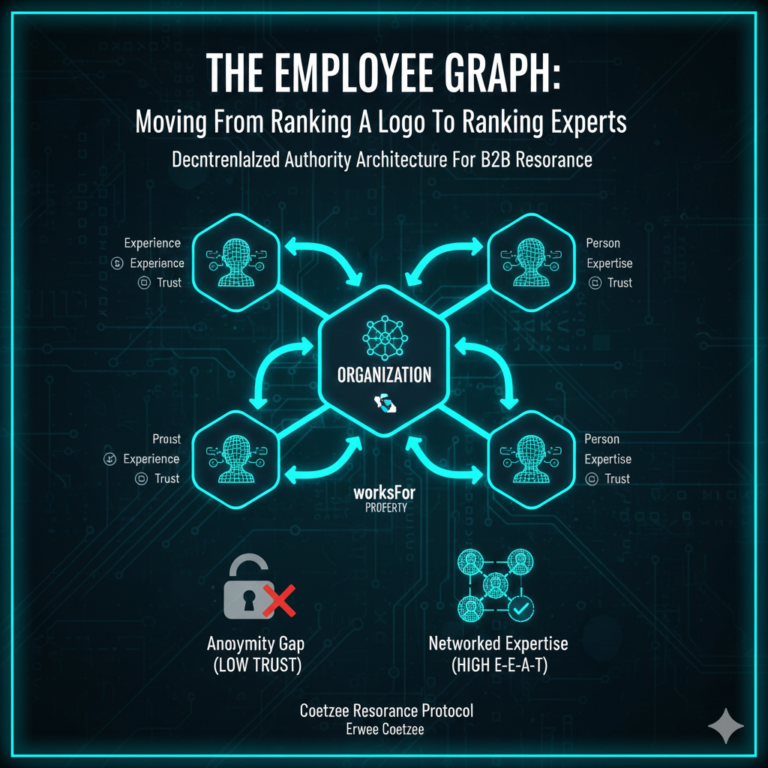
The Employee Graph: Moving from Ranking a Logo to Ranking Experts

The Employee Graph: Moving from Ranking a Logo to Ranking Experts

In the Coetzee Resonance Protocol (CRP), we establish a hard architectural truth: in complex B2B markets, logos do not have expertise—people do. Traditional SEO spends millions attempting to make a corporate “brand” appear authoritative. However, the CRP’s first pillar, the Employee Graph, reverses this. Instead of a monolithic brand trying to prove its worth, we…

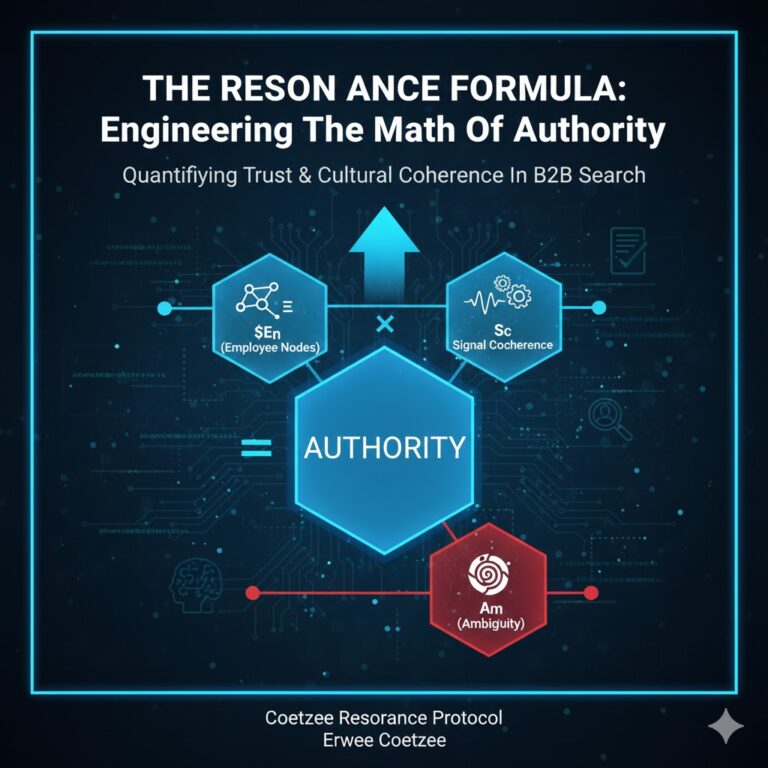
The Resonance Formula: Engineering the Math of Authority

The Resonance Formula: Engineering the Math of Authority

In the Coetzee Resonance Protocol (CRP), we move away from the “black box” of brand reputation and toward a formalised mathematical model. If you are a complex B2B entity, your authority in the search index is not a mystical property—it is a result of network physics. To manage your authority, you must first be able…

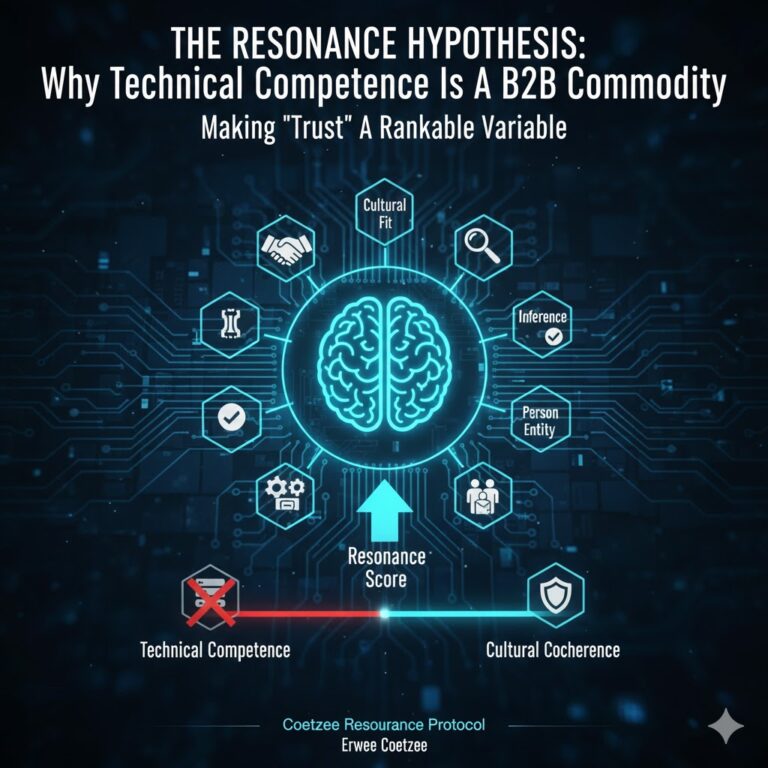
The Resonance Hypothesis: Why Technical Competence is a B2B Commodity

The Resonance Hypothesis: Why Technical Competence is a B2B Commodity

In the legacy era of B2B marketing, the objective was simple: prove you could do the job. If you ranked for “Managed IT Services” and your website listed a comprehensive suite of technical capabilities, you were in the game. However, under the Coetzee Resonance Protocol (CRP), we identify a fundamental shift in high-stakes procurement. In…

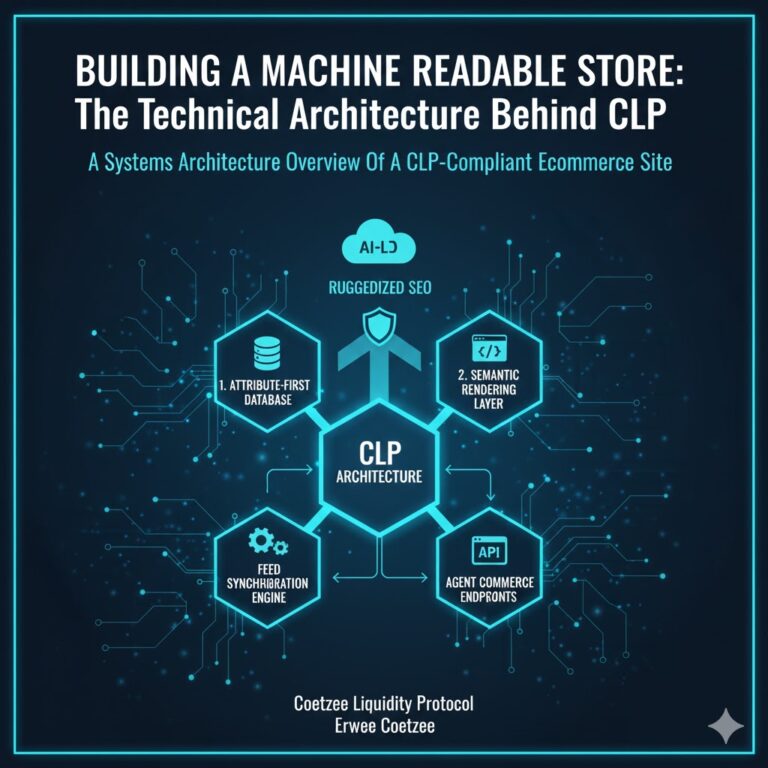
Building a Machine-Readable Store: The Technical Architecture Behind CLP

Building a Machine-Readable Store: The Technical Architecture Behind CLP

The Coetzee Liquidity Protocol is not a marketing theory; it is a systems architecture. To compete in an environment where AI agents (LLMs, Shopping Graphs, and Search Generative Experiences) are the primary consumers of your data, the “human-facing” website must be viewed as a secondary output. The primary output is a high-resolution, machine-readable data node….

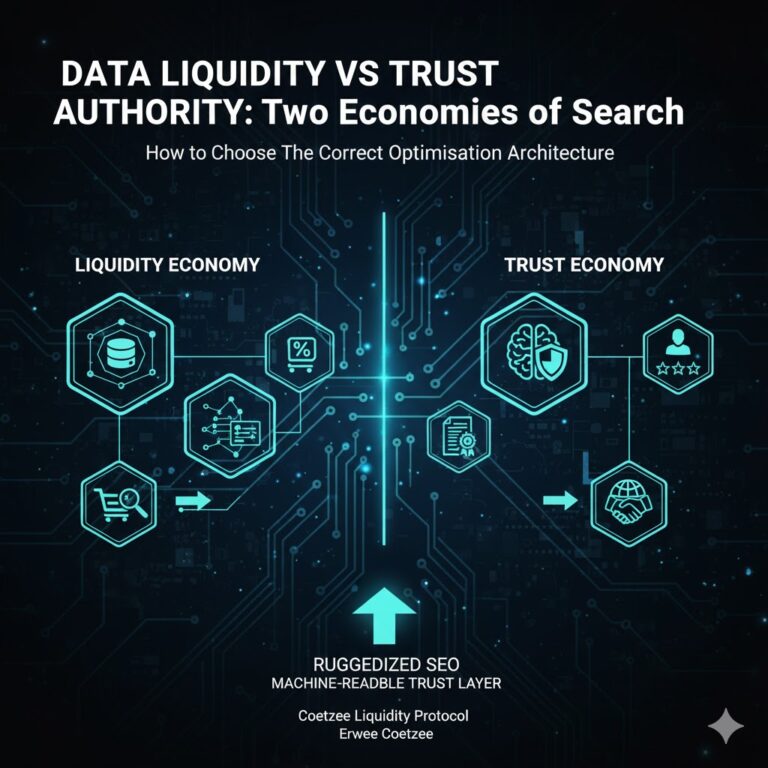
Data Liquidity vs Trust Authority: Two Economies of Search

Data Liquidity vs Trust Authority: Two Economies of Search

In the Coetzee Liquidity Protocol, we recognise that the modern search landscape is no longer a monolithic entity. It has bifurcated into two distinct operational environments: the Liquidity Economy and the Trust Economy. Understanding which economy your business inhabits is the difference between a high-yield digital strategy and a wasted marketing budget. While the machine-readable…

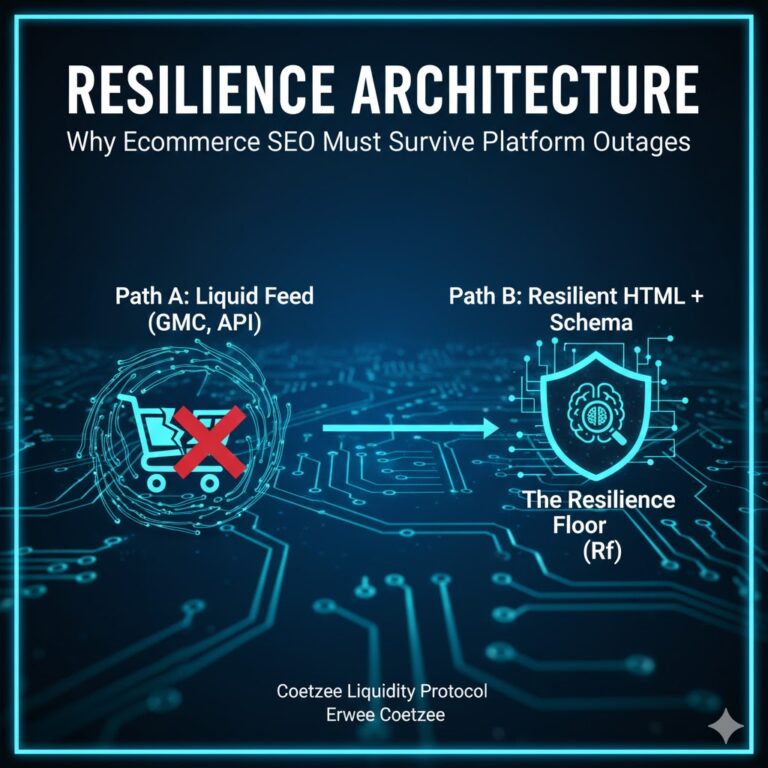
Resilience Architecture: Why Ecommerce SEO Must Survive Platform Outages

Resilience Architecture: Why Ecommerce SEO Must Survive Platform Outages

In the Coetzee Liquidity Protocol, we define the Resilience Floor ($R_f$) as the minimum level of organic visibility a store maintains when its primary data conduits fail. Most modern e-commerce sites are “fragile” architectures. They rely entirely on a single API, a single Merchant Center feed, or a single JavaScript-heavy framework to render products. If…